Richard Long built wooden circles from tree trunks, branches or from weathered wreckage wood. He collected the material for these temporary constructions in the immediate vicinity of where he exhibited. Sometimes even in nature itself.
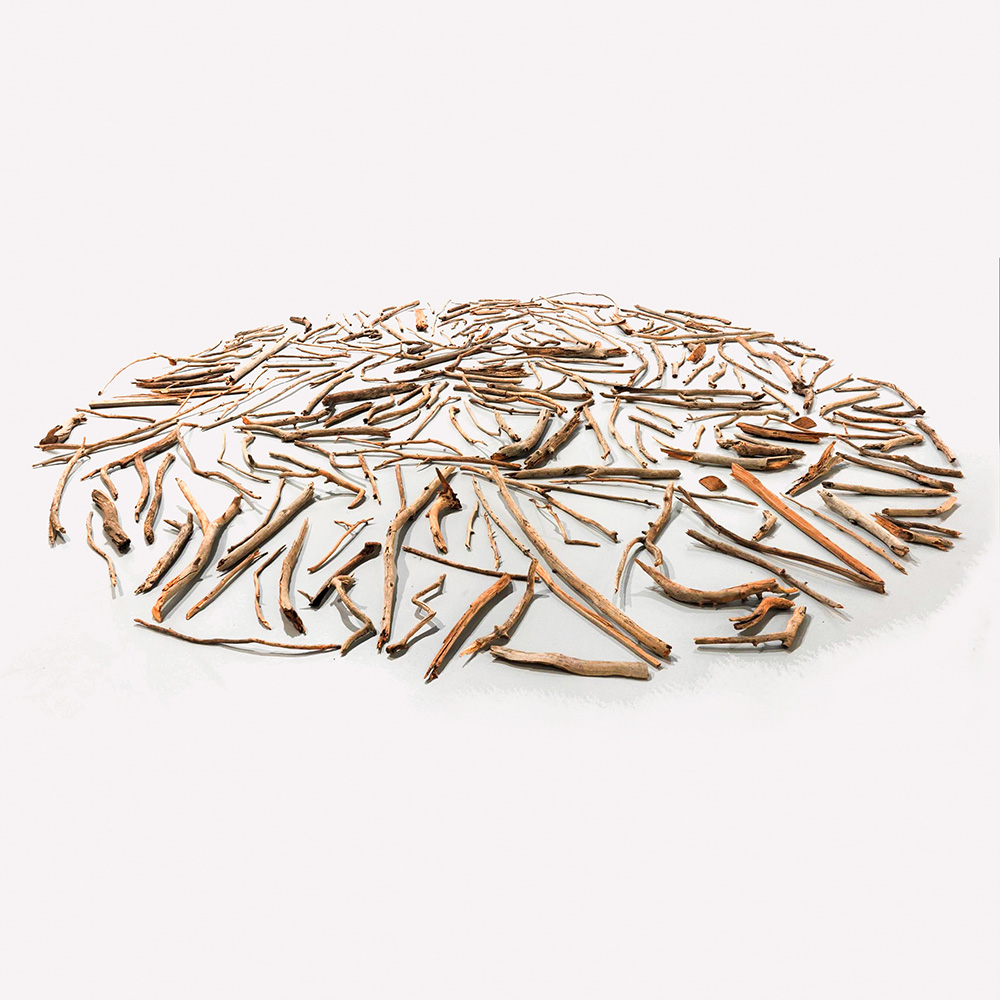
Richard Long built wooden circles from branches like this California Wood Circle, property of the Centre Pompidou.
Richard Long (1945) belongs to the most influential artists of British land art. Since the late sixties he has been exploring the relationship between man, landscape and time with minimal means. His work consists of walks, traces, lines and circles—temporary interventions in nature that often only live on in photographs, maps and sober text works.
Within this oeuvre his circles built from wood occupy a special place. It is precisely those works of natural material in which movement is concentrated into form, and the landscape itself becomes sculpture. But he also arranged pieces of slate, boulders or river stones into circles, also from the river Meuse. This was on display in 2023 in the garden of the Rijksmuseum, as the Maas River Stones.
A bodily circle
Long studied at the West of England College of Art in Bristol and later at St Martin’s School of Art in London. Early on he turned away from traditional sculpture. His breakthrough came in 1967 with A Line Made by Walking. That principle—footsteps as drawing instrument—remained leading, but alongside lines he developed the circle as an equally fundamental form. Precisely in wood that circle acquires a pronounced physicality and tactility.
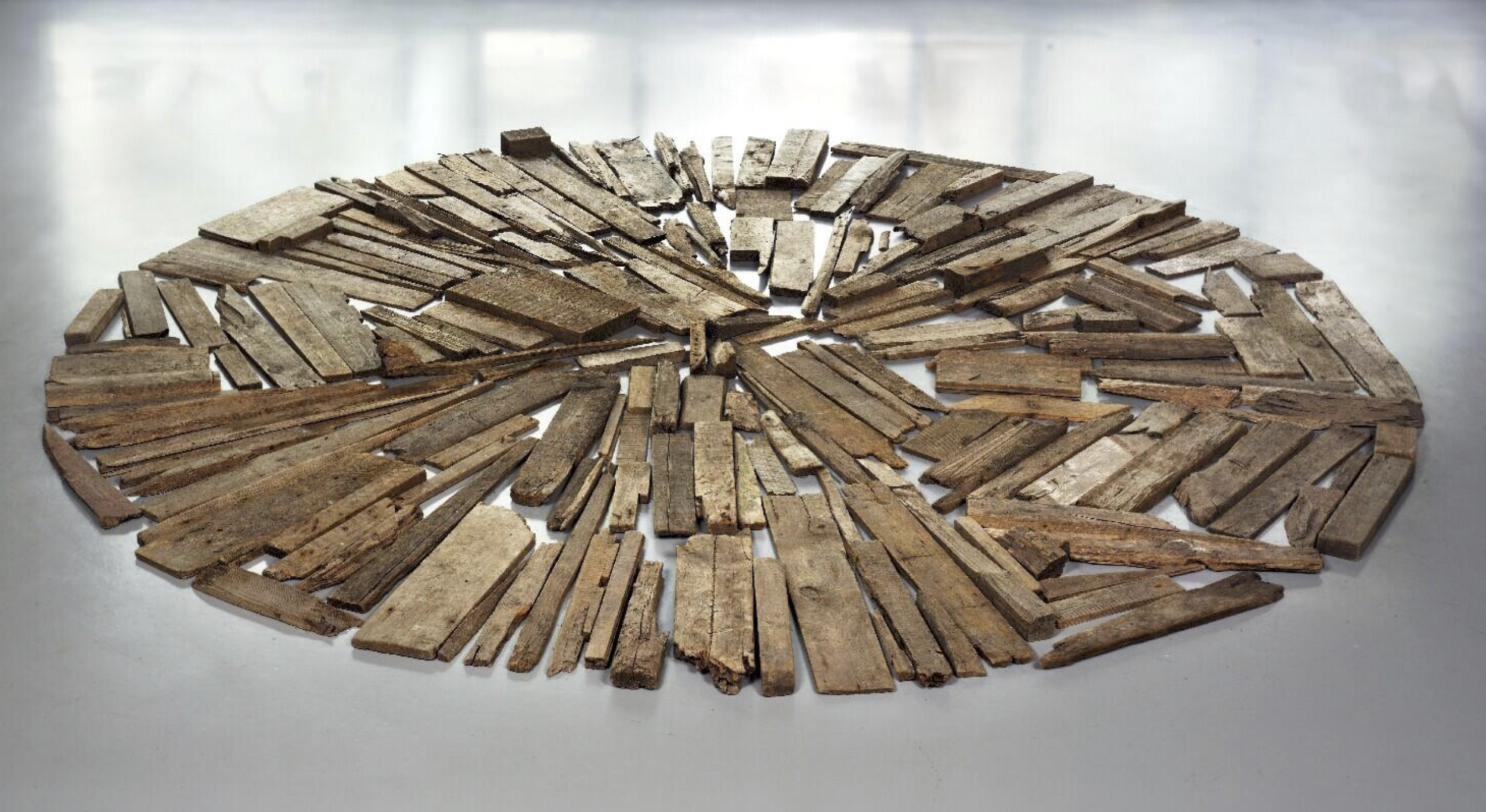
Driftwood Circle from 1978, on display among other places at museum Boijmans van Beuningen in Rotterdam.
An early and often cited example is Driftwood Circle (multiple versions), built from driftwood that Long collected along coasts and riverbanks. Such circles were on display in Rotterdam, at museum Boijmans van Beuningen. In this port city the rough wood, marked by sea and time, enters into a direct relationship with the museum floor and the light falling through the windows.
The material is not processed to become more beautiful; precisely the irregularity determines the rhythm of the circle. His circles lie directly on the ground, without pedestal, flat. That makes them unusual sculptures, which are almost always much taller.
Collected during walks
Another characteristic work is the California Wood Circle from 1976, since 1979 the property of Centre Pompidou in Paris. Here it becomes clear how Long deploys 237 branches within the white museum space without denying their origin. The wood continues to speak about growth, decay and time, while the circle suggests a human order—a simple, almost ritual act of 5.5 meters in diameter.
Some wooden circles also arose temporarily in the landscape itself, such as circles of found branches during walks in England, Ireland or Scandinavia. They disappeared again, but live on in photographs and descriptions. Nature reconquered the art form.
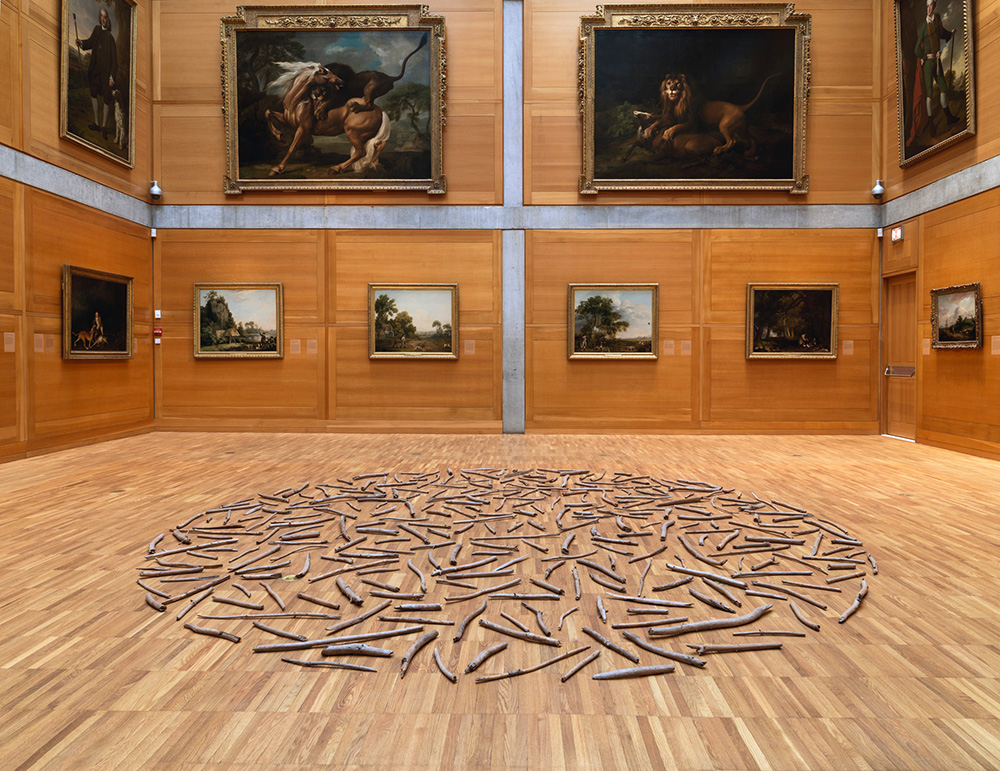
Richard Long built wooden circles in nature, but also in a classical museum hall like here (in 1981) the Quantock Wood Circle in the Yale Centre for British Art.
The circle is for Richard Long not a decorative motif, but an archaic and universal form. It refers to cycles of nature and life, to the sun, the seasons and eternal return. In his wooden circles the walking itself seems to have been frozen: a route without beginning or end. Where his lines often suggest direction and progression, the circles bring precisely rest and presence.
Not monuments, but moments
Richard Long’s work is ecological in attitude, but never moralistic. His wooden circles show how little is needed to create meaning: a walk, a choice, an ordering. They are not monuments, but moments. In a time of excess these circles remain silent signs of attention—made from wood that already had a life behind it, and that found a new, concentrated form in art.
With his circles of wood Richard Long has developed a sculptural language that is simultaneously ancient and contemporary. His artworks literally root in the landscape, but speak to a universal longing for coherence, rhythm and simplicity. Thus his work remains a continuous dialogue between man and nature.

Richard Long in 2023 at work in the gardens of the Rijksmuseum in Amsterdam.
I personally consider Long as one of the sources of inspiration for Dendroism, in which the story of the wood is the starting point for the final artistic expression. It is not without reason that Long was also in contact with the men of Arte Povera, where the youngest member Giuseppe Penone made a sensation with carving out ‘the inner tree’. Even though there was substantive kinship, Long never formally joined this post-industrial art movement. The difference: Arte Povera made the world readable, Richard Long let it be silent.
In summary: these are the well-documented wooden circles by Long:
California Wood Circle (1976) – Centre Pompidou, Paris
Wood Circle (1977) – Van Abbemuseum, Eindhoven
Quantock Wood Circle (1981) – Yale Center for British Art
Driftwood Circle (1978) – Museum Boijmans Van Beuningen
Petrified Wood Circle (2000) – temporary exhibitions
Jan Bom, January 7, 2026