Emile van der Kruk turns trees upside down. That way they look like people, he says. “Their roots are our brains.” He incorporated this idea into his most beautiful wooden sculptures. For example, he carved a large human ear from the trunk of a root stump. Because we need to start listening to nature.
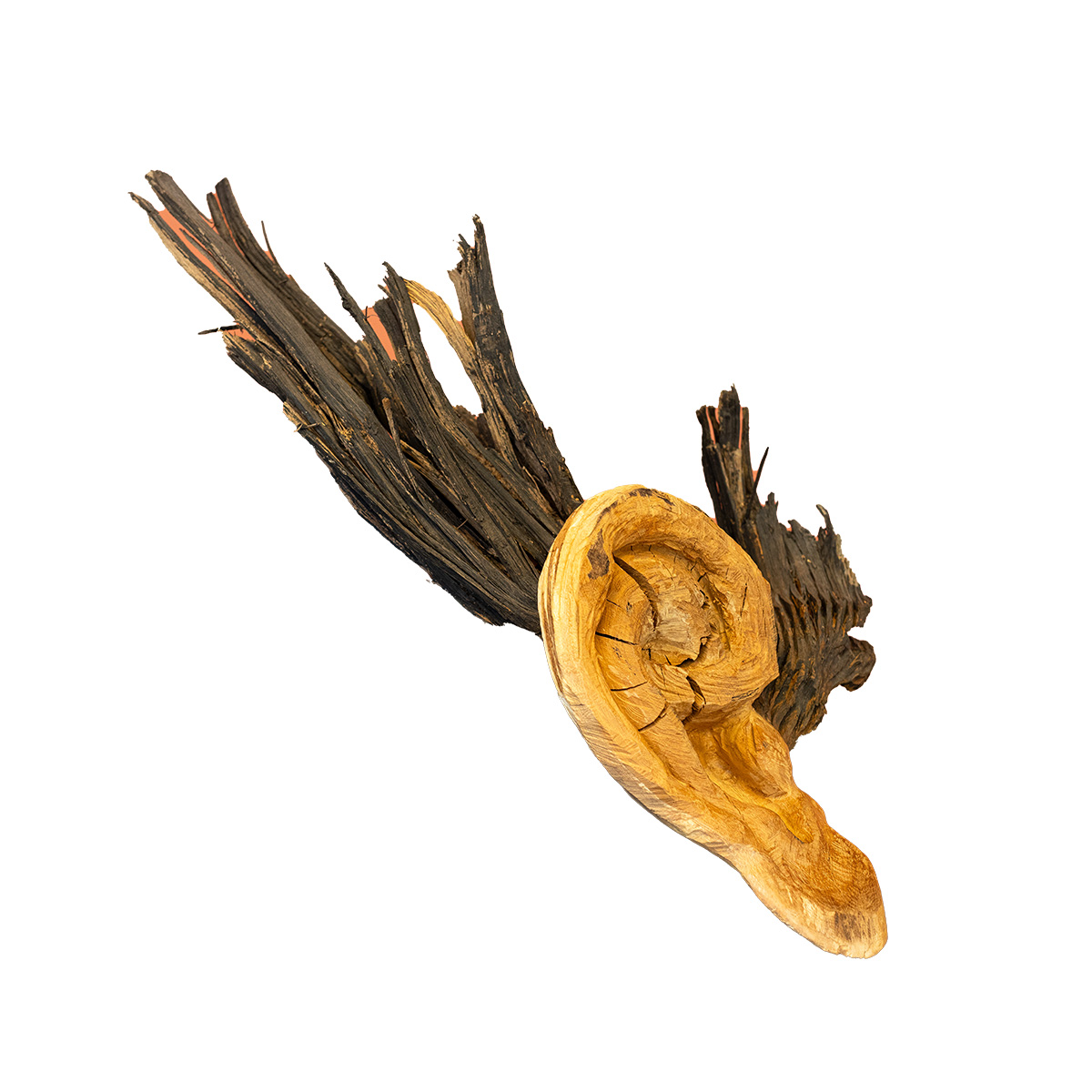
Emile van der Kruk turns trees upside down, in this case by carving an ear on a root stump.
His sculpture ‘Uprooted Ear’ was given a prominent place in Sculpture Gallery Het Depot in Wageningen. Visitors have to pass it to get into the large exhibition space. There in the hallway lies the giant ear, carved at the end of the rough root system of an oak tree. Cracked, as wet oak usually does when the wood has not been dried long and carefully. Van der Kruk couldn’t wait for that. The message had to go out into the world: “We have been torn away from nature. We must learn to listen again.”
It is certainly not his only sculpture in which tree roots form the basis. In the adjacent villa ‘De Peppel’ stands ‘Root Head’. On a root stump Van der Kruk (1956) depicted a head here. The eyes closed, the ears absent, the mouth contentedly curled. Thus the sculpture gives an impression of introspection. And that despite the rough treatment with the chainsaw. “You run it over the wood, so you get a pattern like Van Gogh applied with oil paint on his paintings. All those lines.”
Own villa ‘De Peppel’
Van der Kruk is the first chainsaw artist in the Netherlands to get a permanent museum presentation of his work. His benefactor: Loek Dijkman, the (1942 – 2024) entrepreneur who decided to put his fortune built up in the cardboard industry into good causes. A place for artists who work with wood and depict the human form with this material, for example. The patron bought Van der Kruk’s complete oeuvre and renamed the villa on the museum grounds after the poplar. Van der Kruk preferred to work with this. “It doesn’t crack, if you take out the heart.”
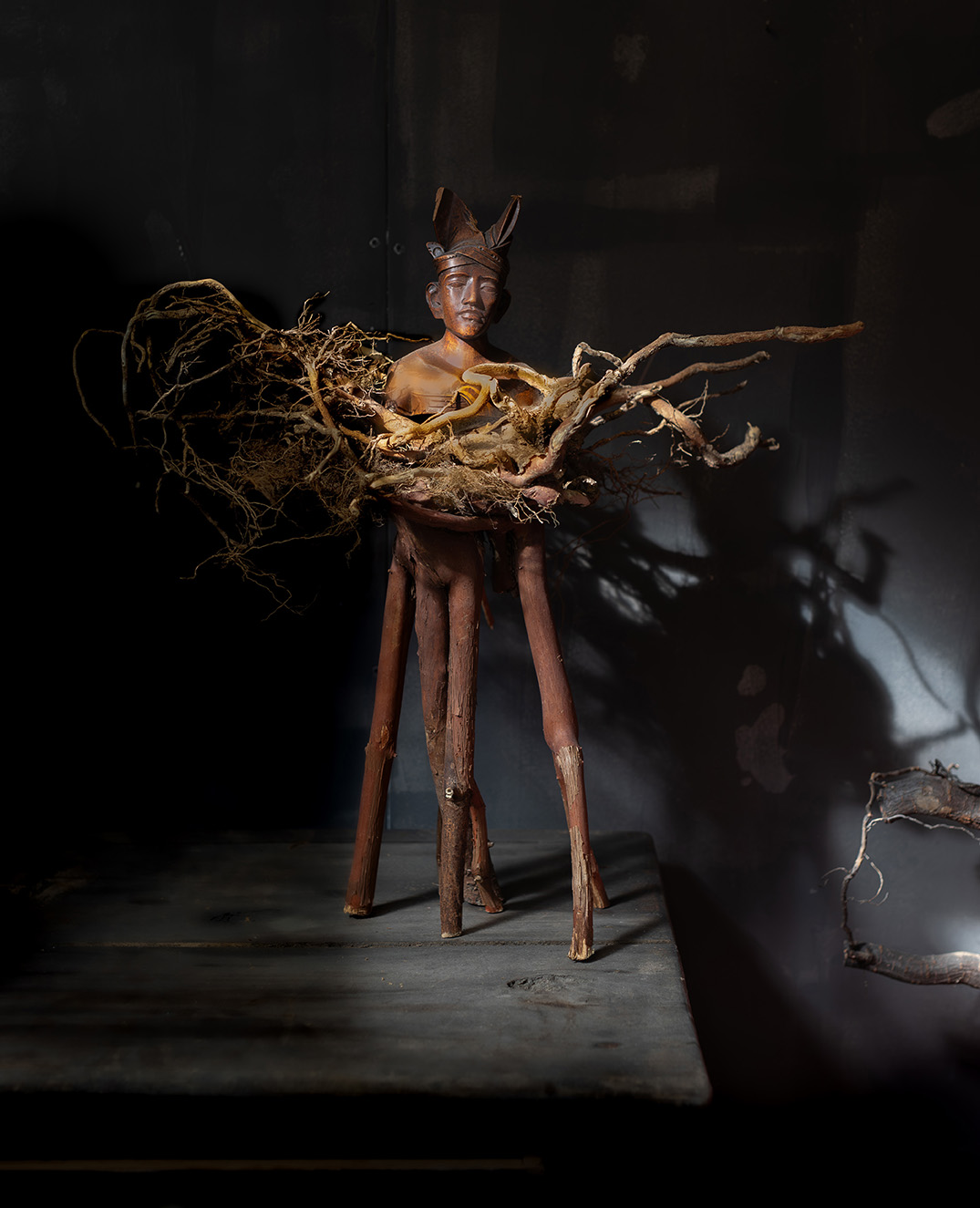
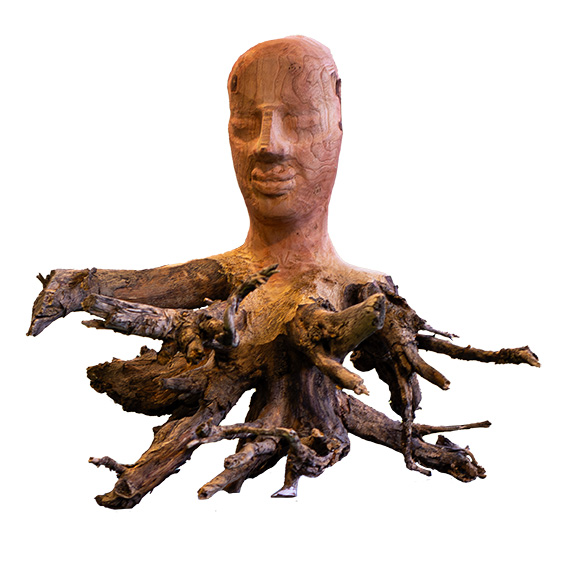
Dendro dancer, an assemblage of branches, tree roots and a carved Balinese head.
But still there are also works in his studio where the roots still stick out. In a very special sculpture he incorporated a Balinese head carved from wood and called it the ‘Dendro dancer’ (‘Dendro’ is ancient Greek for tree). Assembled on a scaffold of five sprouted branches, the roots in this sculpture form a widely fanning skirt.
Dendroism not 1 type of material
It is moreover a beautiful example of ‘Dendroism’, the art form that gives a name to the interplay between artist and naturally formed material. The starting point is what nature itself has already made. Also in this collage Van der Kruk is serving, discovering, adding: look here. The stories are already in the wood. The artist adds an extra element. In the case of the ‘Dendro dancer’ that is also humor. All those branches that become moving dancing legs. That combination with a slightly damaged Indonesian head.
How did Van der Kruk come up with making the wood itself the subject of such sculptures, where the story of the wood leads? “You saw that emerge ten years ago, when it became clear that the earth was warming due to human activity. More artists then started working with trees. As if man had become too artificially detached from nature. The message became: we must take good care of the earth.”
Does he find ‘Dendroism’ a suitable term for an art movement? Van der Kruk hesitates. Are there other art movements named after the material the artist worked with? “I don’t think an art movement can be named after a single material.”
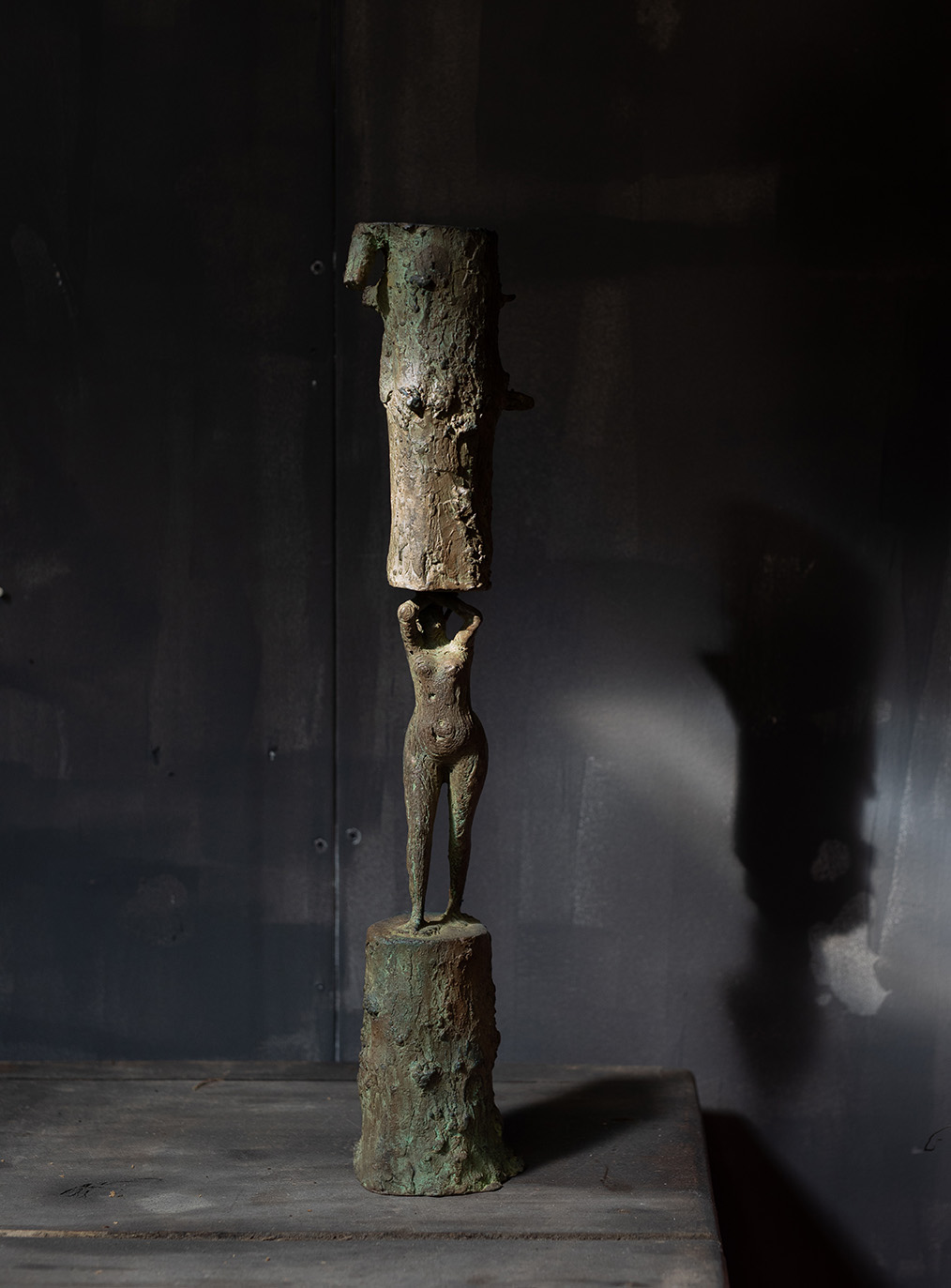
A bronze figurine by Emile van der Kruk, with clearly the bark of the tree.
Looking around in his own studio it is clear why Van der Kruk doesn’t want to limit himself. He also worked in bronze, in stone and even in plastic, found on the polluted beaches of southern Italy. He puts a bronze figurine on the sun-drenched presentation table. It is a tree trunk, where halfway a naked woman has been carved. She has thus become the bearer of the trunk above her. Giuseppe Penone also converted trees into bronze, thereby preventing these organic sculptures from decaying outdoors.
Accident with angle grinder
Van der Kruk made considerable sacrifices for his artistry. An accident with an angle grinder almost cost him a hand. “There was no protective cover on the grinder.” The saw hit his wrist, right through seven tendons. “The blood spurted out. You could look right inside.”
After a life-saving operation recovery took longer than a year. He also got an enormous skin rash after working in ebony, which is even carcinogenic. With the chainsaw he never had accidents. Yet Van der Kruk has never wanted to take on students. “Too dangerous. I can’t take the risk that someone has an accident with it. You have to get to know such a chainsaw well, especially mine, which is held together with strings. And I also work atypically with gouges. I only have two, which are quite jagged. I think they have a nicely drawn effect in the wood. I hit them with a steel hammer.”
“I have a Joseph complex”
And then there is the noise and the flying sawdust. After his academy years (art academies in Rotterdam and Amersfoort) he started with the chainsaw in his own living room. “Until one day a whole delegation of neighbors was on the doorstep. May we come in, they asked. We see that you are a great artist. But our laundry is full of sawdust. We have a solution for you. We have spoken to the mayor about a farm that is empty. You may work there… That was in the seventies. Today they would hang a firework bomb on your front door.”
In his studio, opposite his home in Amersfoort, he still keeps his very first wood-carved figurine. A rough, somewhat clumsy figure. “I was 12 years old then and had ADHD. I had to go with my parents, on vacation to the forests in North Brabant.” Now he is the calm itself. “That comes from the wood”, he says. Referring to the father of Jesus, who was a carpenter: “I now have a Joseph complex.”
Text Jan Bom, March 27, 2025