David Nash has been processing the four elements fire, earth, water and air in wooden sculptures all his life. His work with fresh wood continues to change through drying for a long time. The fact that the fresh oak wood will crack and split is intentional.
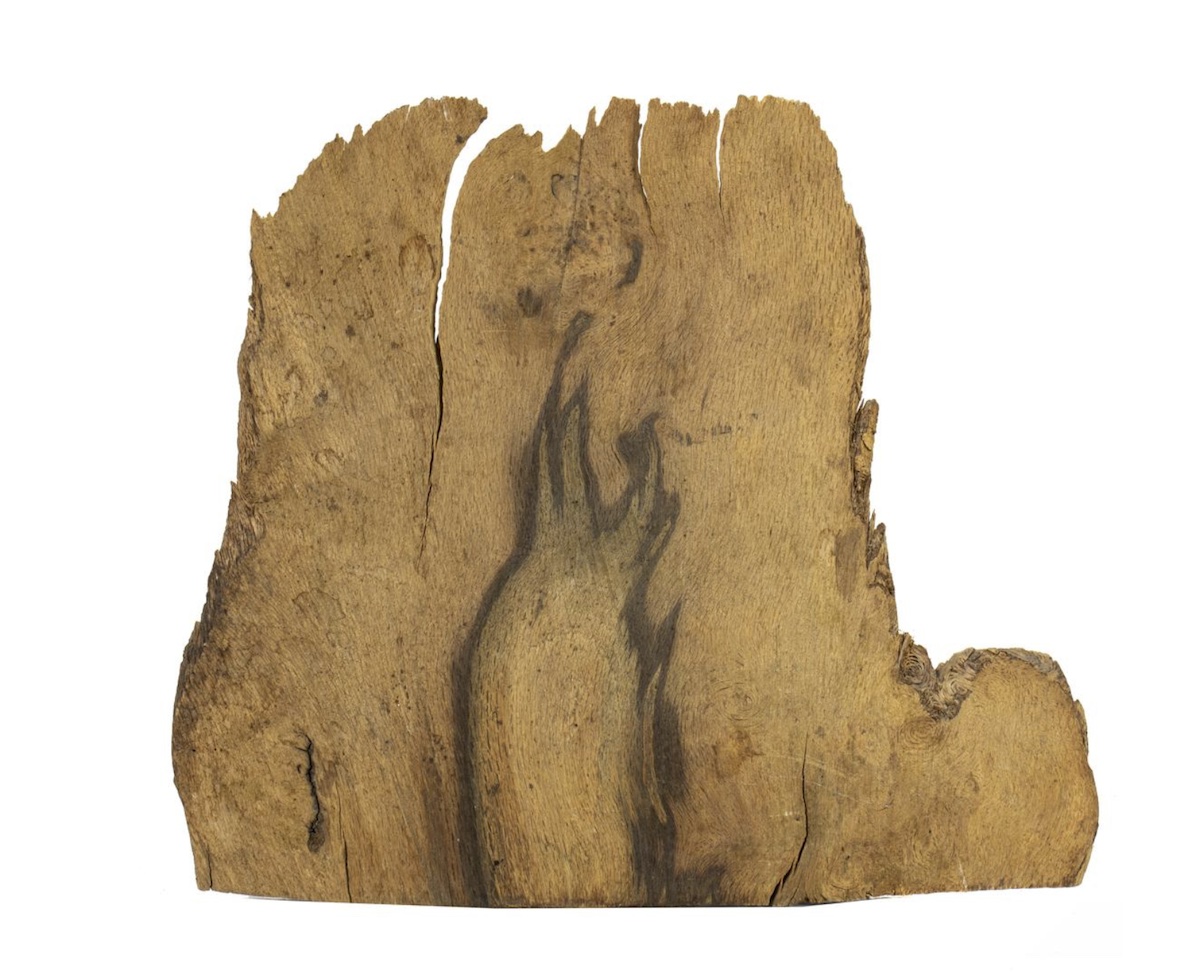
But also the grain in the wood is the starting point for his artworks. A good example is his work ‘Flame’ from 1999. He treated the irregular cross-section of a trunk with fire to emphasize the pattern of a flame. In other works he combined irregularly shaped branches in the roughly carved frame of a wooden list. Nash thus connected nature with culture as a statement.
Living in the forests
The Brit David Nash (1945) has thus become an artist who gives the medium of wood an almost spiritual dimension. He is known for his monumental sculptures, always made from fallen trees, and for his constant dialogue with the natural world. Nash’s work is characterized by a deep respect for the material he works with and a remarkable ability to bring out the intrinsic beauty of wood. Wood is his ‘prima materia’.
Nash grew up in the wooded Surrey Hills in Great Britain, a landscape that formed the source for his artistic mission. After his studies at Kingston College of Art and Chelsea School of Art in the 1960s, he settled in the abandoned chapel Rhiw in Blaenau Ffestiniog, North Wales. Here he found not only a lifelong home, but also an environment in which the trees stand that form the central theme in his work.
Nash works exclusively with wood that he finds, never with trees that he fells himself. This ethic is characteristic of his oeuvre: the materials dictate the process, not the other way around. With Nash, wood never becomes an object; it remains a living, breathing element.
The grain of the wood
What distinguishes Nash from other artists is his extraordinary attention to the grain of the wood. Every line, knot, crack and mark in the material tells a story about the tree it came from. Nash sees these traces as a form of memory, in which the lifespan of the tree and the conditions in which it grew are recorded. This means that his work not only has a sculptural power, but also a narrative depth.
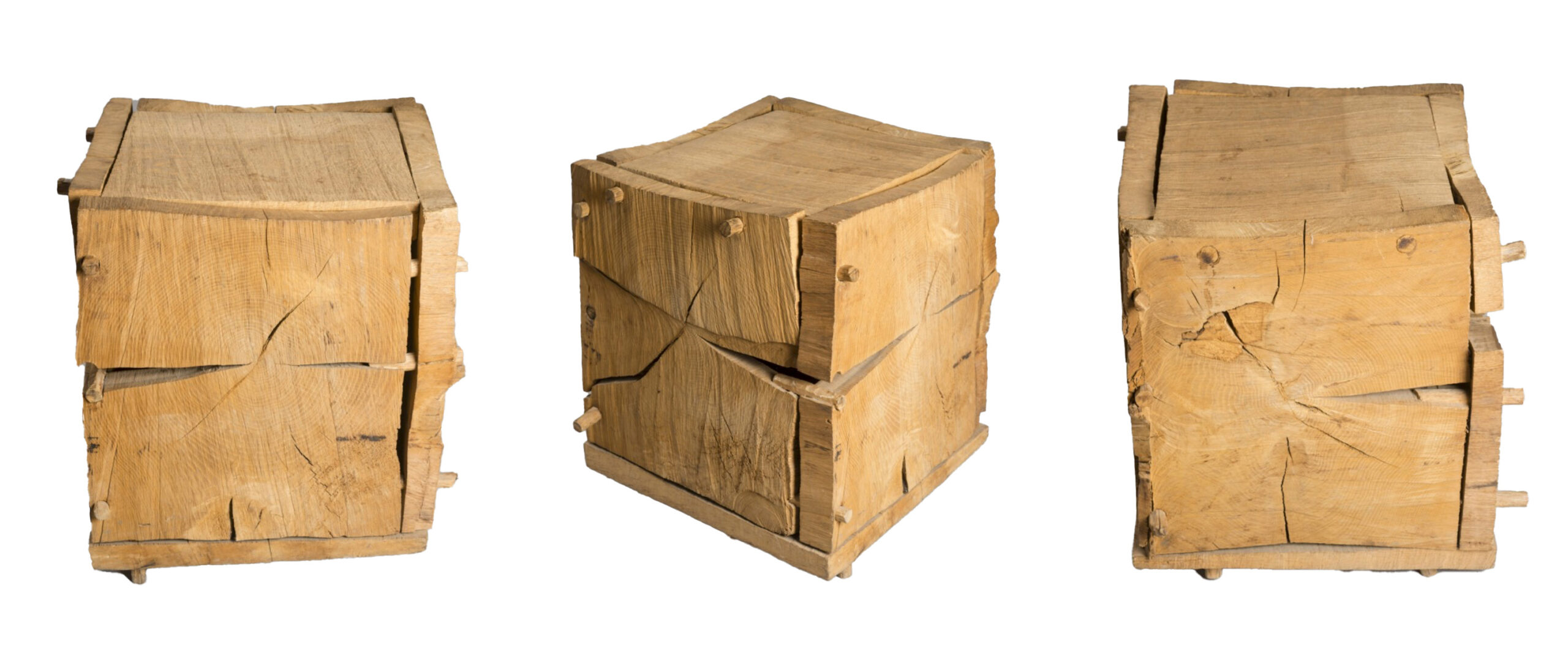
Take for example his work ‘Cracking Box’ from 1990. The sculpture looks at first glance like a wooden cube, hammered together with sturdy wooden pegs like those that hold together the framework of a wooden farmhouse barn. This ‘box’ of wet oak wood continued to work for a long time. The work seems minimalist, but due to natural change is essentially different in character from, for example, the six super-sleek steel cubes by Donald Judd (Untitled, 1969).
In other works, such as Ash Dome (1977), Nash even lets living trees become part of his art. He planted 22 ash trees in a circle, which over the years were supposed to grow towards each other and eventually should have formed a living dome. However, when the ash trees became diseased, Nash planted a second ring of other trees around them.
Process and transformation
Nash’s working process is as important as the end result. He uses traditional techniques such as sawing, burning and sanding. Burning wood, a technique he often applies, emphasizes the texture and grain of the wood by creating contrast. In his iconic works such as Charred Cross Egg and Black Steps (video on YouTube) the charred surface has an almost graphic intensity, in which the lines of the wood grain stand out like signs on an old manuscript. Burning also makes his wooden sculptures suitable for outdoor exhibition. The charred top layer protects against wood rot.
For Nash the working process is not a struggle against the material, but rather a collaboration. He often speaks of ‘listening’ to the wood, as if the material guides him rather than the other way around. This relationship between artist and material ensures that each work is not only an object, but a dialogue with nature.
Wood as metaphor
For Nash, wood is more than a medium; it is a metaphor for life itself. He once said: ‘Wood is the perfect expression of time. It grows, lives, dies, and decays’. This cycle forms a core motif in his work. The annual rings in a piece of wood can be seen as a visual representation of time, while the structures he creates are often a reflection on transience and rebirth.

A striking example of this is Wooden Boulder (1978), a large piece of wood that he let roll in a nearby river. The work was not a static object, but a nomadic sculpture that underwent the forces of water and time. For decades the boulder became part of the landscape, changing with the flow of the river and weather influences. The artwork was sometimes lost for years, but eventually reached the sea. Never to be seen again. Another motif of Nash are the sculptures that resemble primitive canoes: tree trunks hollowed out by fire. The canoe dates back to 8,000 years before Christ and is thus, along with the raft (40,000 years before Christ), one of the oldest means of transport of mankind, much older than the wooden wheel (4,500 to 3,300 years before Christ).
Poetry of nature itself
David Nash’s work is an invitation to see and appreciate the subtle beauty of the natural world. His sculptures, marked by the lines of the wood, are meditative objects that remind us how intertwined we are with nature. They call for respect for life and for a renewed awareness of time as a fluid, organic process.
With his dedication to sustainability and his ability to make the invisible visible in wood, Nash has a special position within contemporary art. His works are not static objects, but living witnesses of the dialogues he engages in with trees, forests and the elements. They remind us of the beauty of wood, not as material, but as life form. Nash lets us look at wood – not just as raw material, but as poetry, written by nature itself.
Several books have been published about David Nash’s work, also in Dutch. ‘A Survey’, a black-and-white catalog from 1996, was published by the Muhka Museum of Contemporary Art Antwerp and is still available from the museum.
Text Jan Bom, January 16, 2025