Levi van Veluw orders the chaos, by covering his head with square blocks of wood, as if it were a computer system board. He exorcises fears by rebuilding his boyhood room, as it began to haunt him at night in his nightmares. Hundreds of round wooden balls transformed into an exorcising vortex. Wood also provides order in all his large recent installations, in the form of cabinets and racks.
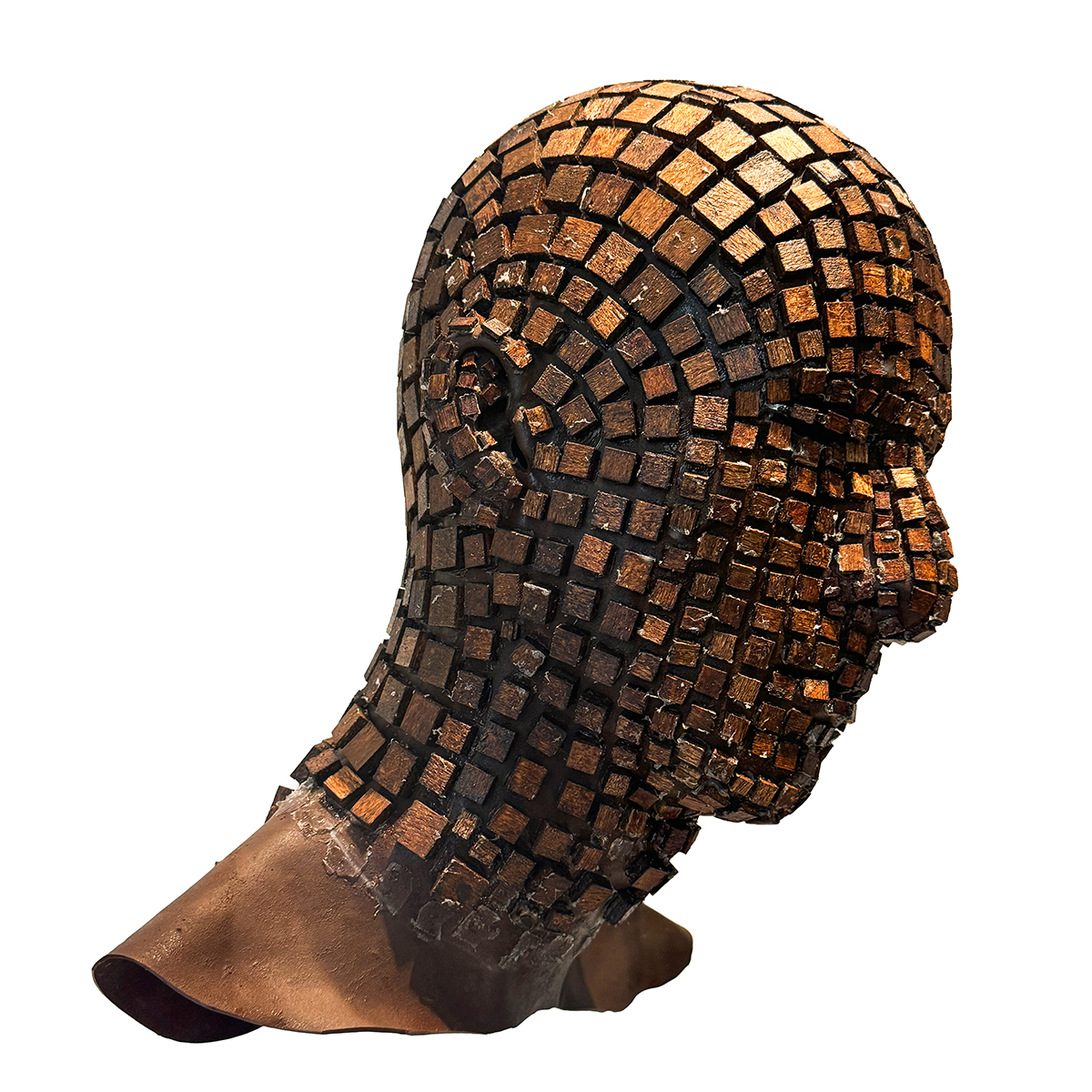
Levi van Veluw orders the chaos, by covering his head with square blocks of wood, as an ‘ordering grid’.
It is not only a cap covered with wooden blocks, in which his head fits. Gloves, for his hands. A kind of wooden chain mail, for his body. He also made these ‘costumes’ for both his parents, his brother and sister. A personal wooden costume for each.
In a video of this work ‘Family’ they sit together at the table. Van Veluw moves a hand first. Very slowly. As if he were a too slowly programmed robot. Then the other hands and heads at the table also begin to move, just as slow and strange as in a dream. The scene thus seems like an exorcism. Van Veluw retroactively applies the structure in the family that he longed for so much as a child.
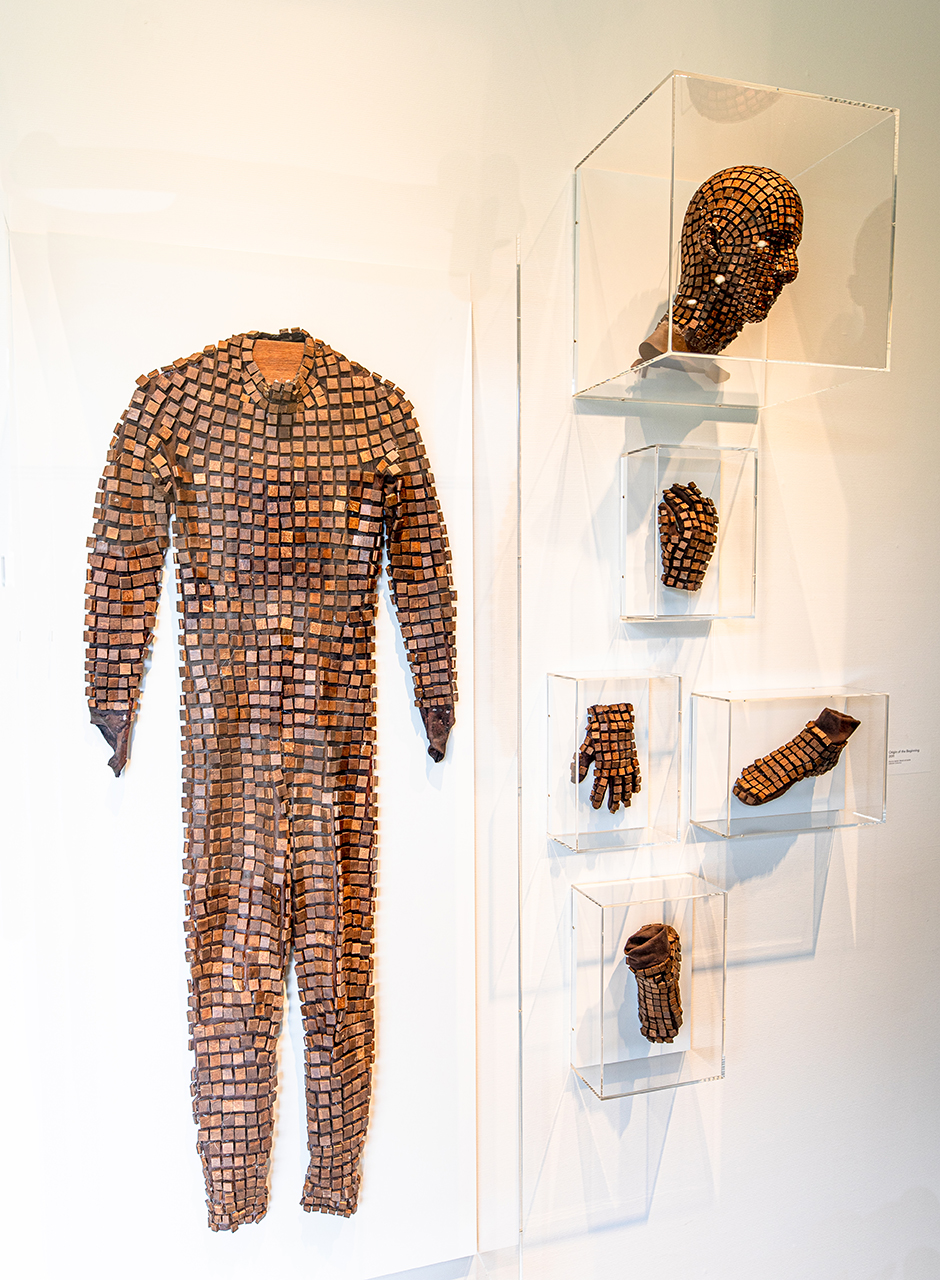
The complete ‘wooden’ costume of Van Veluw, including gloves and feet.
Because, the family in which he grew up was not that safe, Van Veluw (1985) told in the radio program Opium. His parents divorced. “As a child you try to keep everything together. You try to find control. Those blocks symbolize control for me. Blocks can be arranged. Balls cannot. Try putting ten balls on a table. They roll away.”
He doesn’t use computers to automatically mill the blocks. “Because then you don’t feel the struggle with the material. And in my opinion the work has no soul.” He limits his tools to a saw and sandpaper. Gouge and mallet are not involved.
“You try to find control”
In both his earliest works and his latest spectacular labyrinth for the Singer museum in Laren, wood is the ordering or rather confusion-causing base material. “Wood, you can make practically anything from it”, Levi said in another interview. “With many materials you immediately have an association, like plastic immediately makes you think of something artificial and modern. It’s hard to work around that. With wood you have much less trouble with that.”
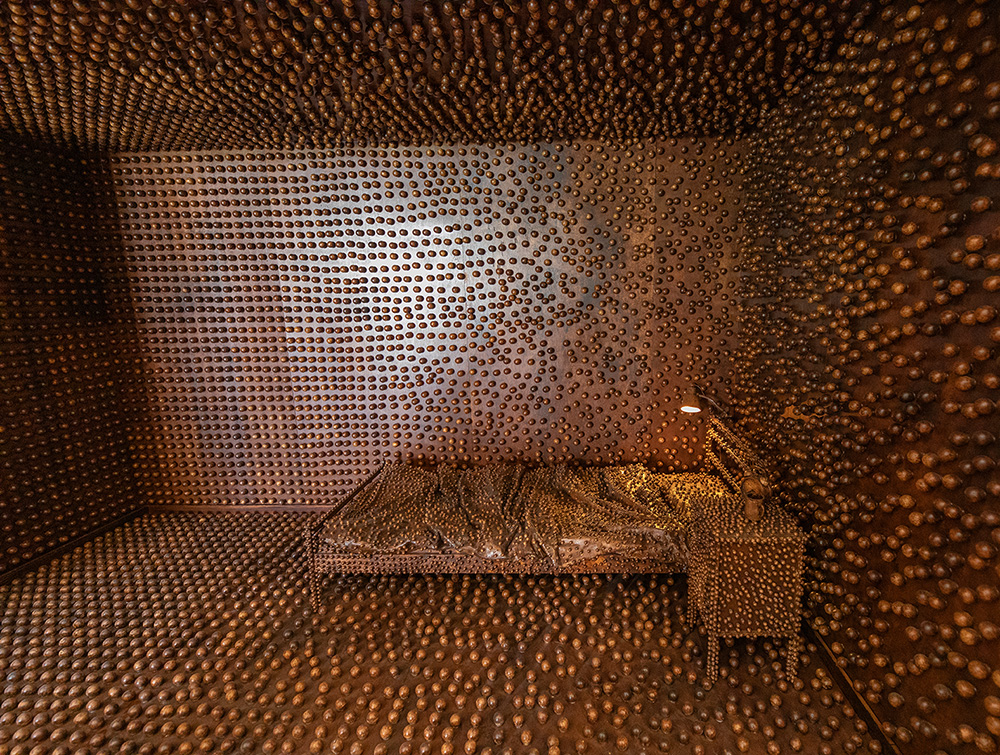
Levi van Veluw rebuilt with wood the nightmares in his boyhood room.
In another early work, ‘Origin of the Beginning’ (2011), he rebuilt his entire boyhood room in dark wood, floors, walls, ceiling, including bed, nightstand and alarm clock. It is the walls where the orderly balls on the wall above his bed turn into a frightening vortex. The pattern derails and turns into a nightmare. “Alienating. Obsessive.” These are words that Van Veluw himself uses to express the feelings he makes tangible in his work. He told Sophie Hilbrand about it, with a nice fragment from a childhood film (from minute 19). And a piece of video about the family table carved in wood.
His creative urge produced increasingly larger works in the years that followed. With wood he built his own cobalt blue (or is it even the patented and hypnotizing Yves Klein blue?) painted chapel, to investigate how religion served to make fears tangible and to curb them. His grandfather was a minister. But Van Veluw did not have questions of faith, but questions like why a church looks the way it looks. “How does someone actually know what a chapel should look like? Did God tell us that? It is imposed on you? That’s what religion is about. Religion has often been oppression as well. Exciting to investigate that.”
“Art about universal values”
Another work is reminiscent of the type cases of old typesetters. Van Veluw uses the small wooden compartments to arrange rough iron ore. As if he wants to safely store the last raw materials on this earth in a museum.
In another work it is blue semi-precious stones (quartz?), which enchant and frighten the visitor in a dark cell. How long can we continue like this, with the plundering of all our precious natural reserves? In the light the stones sparkle beautifully and lively. Van Veluw: “My art is personal, for myself, but what I make is also about universal values.”
His newest installation he made in 2024 especially for the Singer museum in Laren. He used a complete hall for building an immense universe. The viewer walks into a spiral space, as in a bottomless snail shell, through the use of mirrors on the floor and ceiling. The wooden racks again provide order. First for lumps of red-brown clay. These slowly change into heads, torsos, about 1,500 self-portraits of Van Veluw himself together. The artist developed into an obsessive worker, even though he had assistants who helped realize this impressive installation.
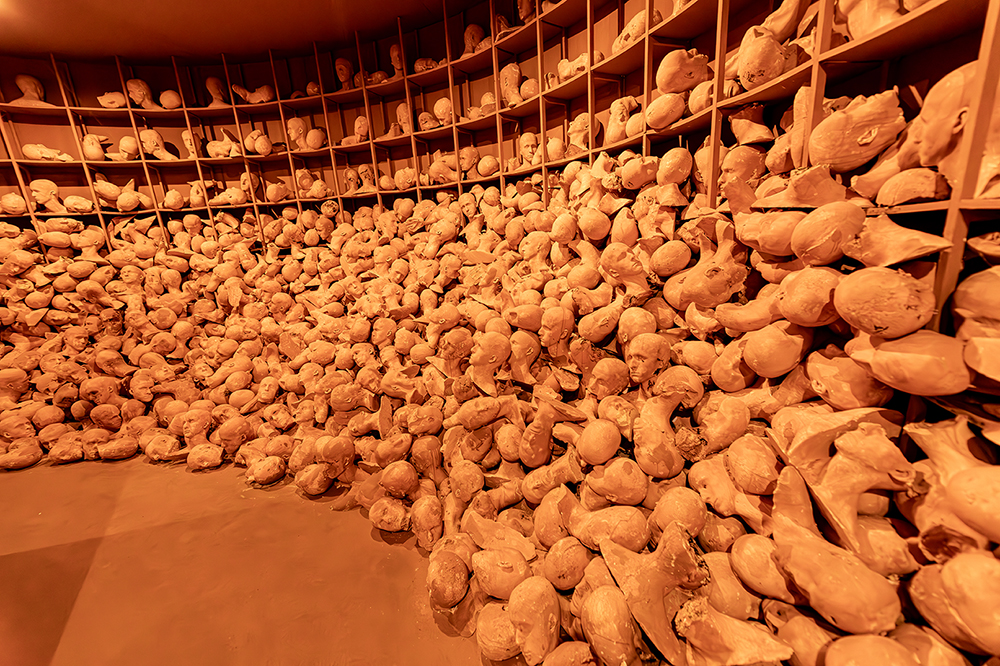
Levi van Veluw orders the chaos with a wooden rack, yet an ‘ossuary’ emerges.
In the corridor all failed heads have been thrown in a pile, which makes the artwork ‘In the Depths of Memory’ begin to resemble a macabre medieval ossuary, or more recently the ‘killing fields’ in Cambodia. Even the musty earthy smell of the dry clay contributes to that experience. But at the end the most skillfully executed heads of the artist await, the creator, the god of this universe. Or not? “When is it finished? When is it better? What is perfect? Is it perfect when it keeps getting better?”, Van Veluw asks himself.
“Great artisanal refinement”
The occasion for the exhibition ‘Labyrinth of Memories’ in 2024 was the awarding of the Singer Prize 2024 to Van Veluw. The Singer Prize is a biennial oeuvre prize for a contemporary Dutch artist and includes an exhibition and the purchase of an artwork. Van Veluw was declared the winner of the prize because he ‘shapes his memories in an authentic and unique way with great artisanal refinement’, according to the museum. The Singer Museum had to switch to time slots to somewhat regulate the enormous interest.
The last Friday afternoon in August 2024 that I visited this mind-boggling ‘one man’ exhibition there were still solid lines of visitors – who also partly came for the beautiful retrospective exhibition of Breitner.