
Master of Elsloo sounds like the name of a Dutch master wood carver. In reality, the sculptures came from multiple workshops in the Limburg region. There, four generations of wood carvers made their commissions, mainly for the Catholic Church. Completely anonymously.
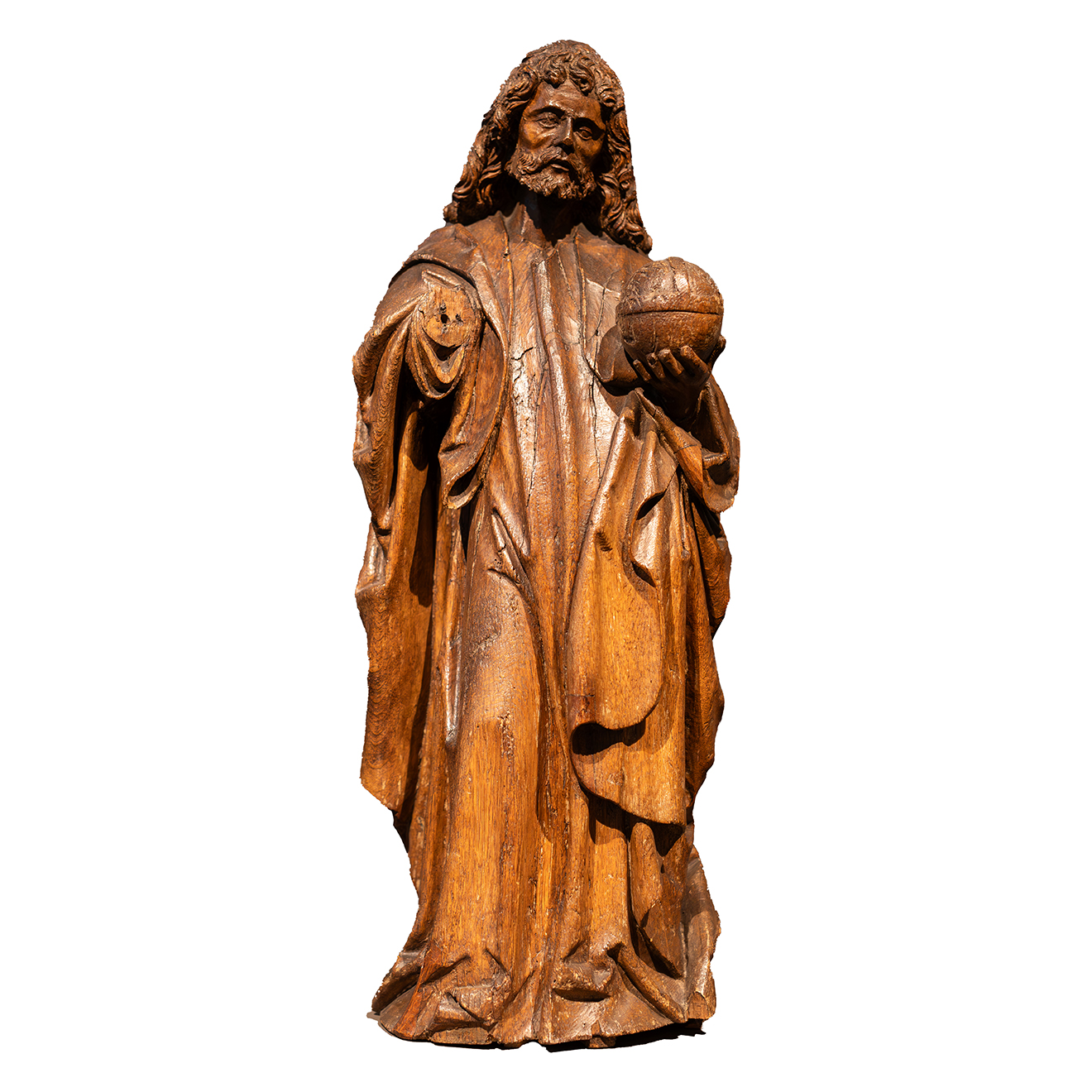
The Christ by the Master of Elsloo, found in the Catharijneconvent museum in Utrecht.
Their name was only given to them in 1940, when historian Prof. Dr. J.J.M. Timmers connected their works with a colored wooden sculpture of Saint Anne Trinity in the Saint Augustine church in Elsloo, just above Maastricht. Timmers saw corresponding style characteristics. The narrow faces. The high cheekbones. The beautifully carved draping of the mantles.
‘Niederlandisch’ is not Dutch
Only a single name surfaces as a representative of this group. Johan van Oel for example, who worked in a sculpture workshop near Roermond, from 1490 to 1530. Jan van Steffeswert from Maastricht certainly did not belong to it; he already signed some of his works, as one of the first wood carvers of his time. How many sculptors have ended up in museums as ‘Master of Elsloo’? Nobody knows for sure.
One of their works, the sculpture group ‘The Lamentation of Christ’, can now be found in the Suermondt-Ludwig Museum in Aachen, which claims to possess the largest collection of late Medieval wood carving from the Netherlands. This German city museum therefore published a well-produced and very thorough scholarly book, titled ‘Niederländische Sculpturen, von 1130 bis 1600‘.
However, don’t think that all described works come from the present-day Netherlands. The Germans go by former national borders, so that works by wood carvers from Antwerp, Brussels, Mechelen and Brabant are also included in the collection. ‘Niederlandisch’ should therefore be translated as ‘The Low Countries’. The Master of Elsloo was mainly active in what is now called the ‘Euregio’. This group also receives attention in the book, among many other anonymous sculptors.
Robes and the linenfold panel
The artisanal skill of the Medieval wood carvers is enviable. How the wide robes of all those holy men and women fall may be taken for granted by superficial museum visitors. We don’t even know many of those saints and their symbols anymore. But try to recreate it. Especially how artfully the folds fall at the bottom of the fabric. It is a technique that was also applied in Gothic times to so-called ‘linenfold panels’. These are depictions of parchment rolls, which were incorporated by guilds of furniture makers and wood carvers as decoration in chests, cabinets and doors. The association is also strong with an altar cloth draped over an altar.
Various Dutch museums possess works by the Master of Elsloo. The Bonnefanten Museum in Maastricht has several, but also the Rijksmuseum in Amsterdam and the Central Museum in Utrecht. Plus not to forget the Catharijneconvent museum, also located in the former Episcopal city of the Netherlands. Utrecht was at that time the central trading city of the Northern Netherlands, with many affluent clergy, nobles and wealthy citizens. In Utrecht itself dozens of sculptors were therefore established, such as ‘Master of the Utrecht Stone Female Head‘ and Adriaen van Wesel.
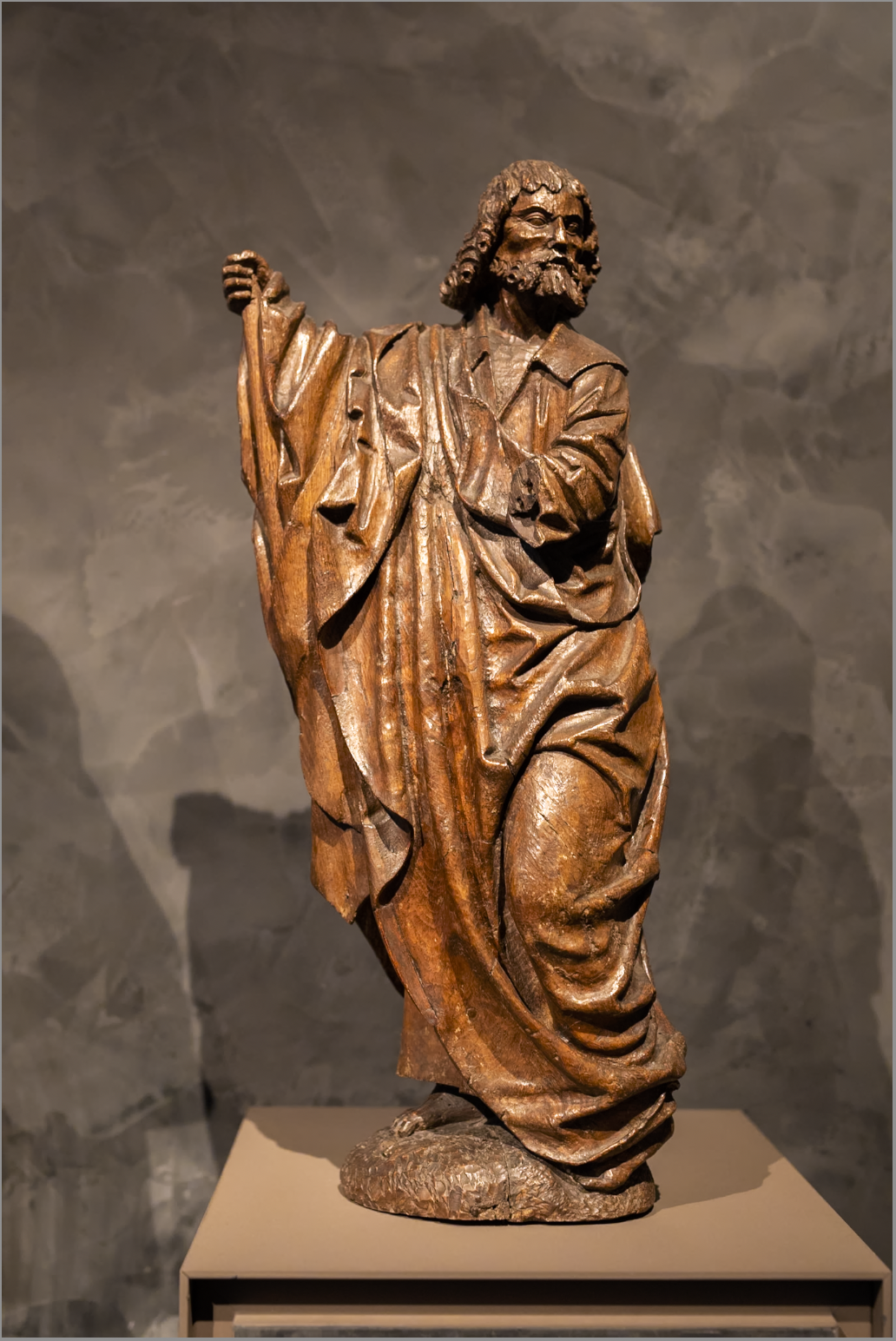
The disciple ‘James the Greater’ lost a hand and his staff through the centuries.
About two hundred works
In total about 200 works are now attributed to the Master of Elsloo, spread over ‘four periods’. It is the German scholars from the book who make this subdivision. I quote: ‘The stylistic development that can be established within the Elsloo group suggests that it concerns multiple successive generations of sculptors’.
The third generation would have been qualitatively the best at stylizing the wide-falling clothing of the Medieval people. And all in oak wood, not the easiest type of wood to work with. So hard that your shoulder feels painful after a day of chopping out rough shapes, but at the same time as brittle as a sugar cube when you want to carve a loose little finger.
Writers in the book attribute the loss of knowledge about these wood carvers to successive historical events. Due to the Iconoclasm of 1566, especially in the Northern Netherlands, sculptures were heavily damaged. Through the looting, the ‘context’ of the wooden sculptures was also lost: their place in the churches and their function in religious experience.
The cultural space
Paintings then displaced the refined wood carving from first place in art history. The French Revolution and the two World Wars also caused old archives to be lost. Worldwide sales of the historical sculptures by art dealers definitively caused the loss of the relationship between the sculptures and the sacred places where they first had a religious function.
What remains for us is to philosophize about ‘Kulturräume’, or ‘cultural spaces’. In this case it concerns a large area in the north of Western Europe, where wood carving had taken such a high flight at the end of the Middle Ages. That ‘space’ was filled by persons and groups who shared the same cultural values and used these as the basis for their artworks. And that area exceeded the current national borders in the case of the Northern wood carvers, but certainly did not reach as far as Italy, where the Renaissance already threw open the church and monastery doors to let the sunlight in. There artists reverted to the visual language of the ancient Greeks, with all their mythical gods.
Hands lost
I have the trip to the large ‘Niederländische’ collection in Aachen still on my wish list for now. I did already admire the works by the Master of Elsloo in Het Catharijneconvent in Utrecht.
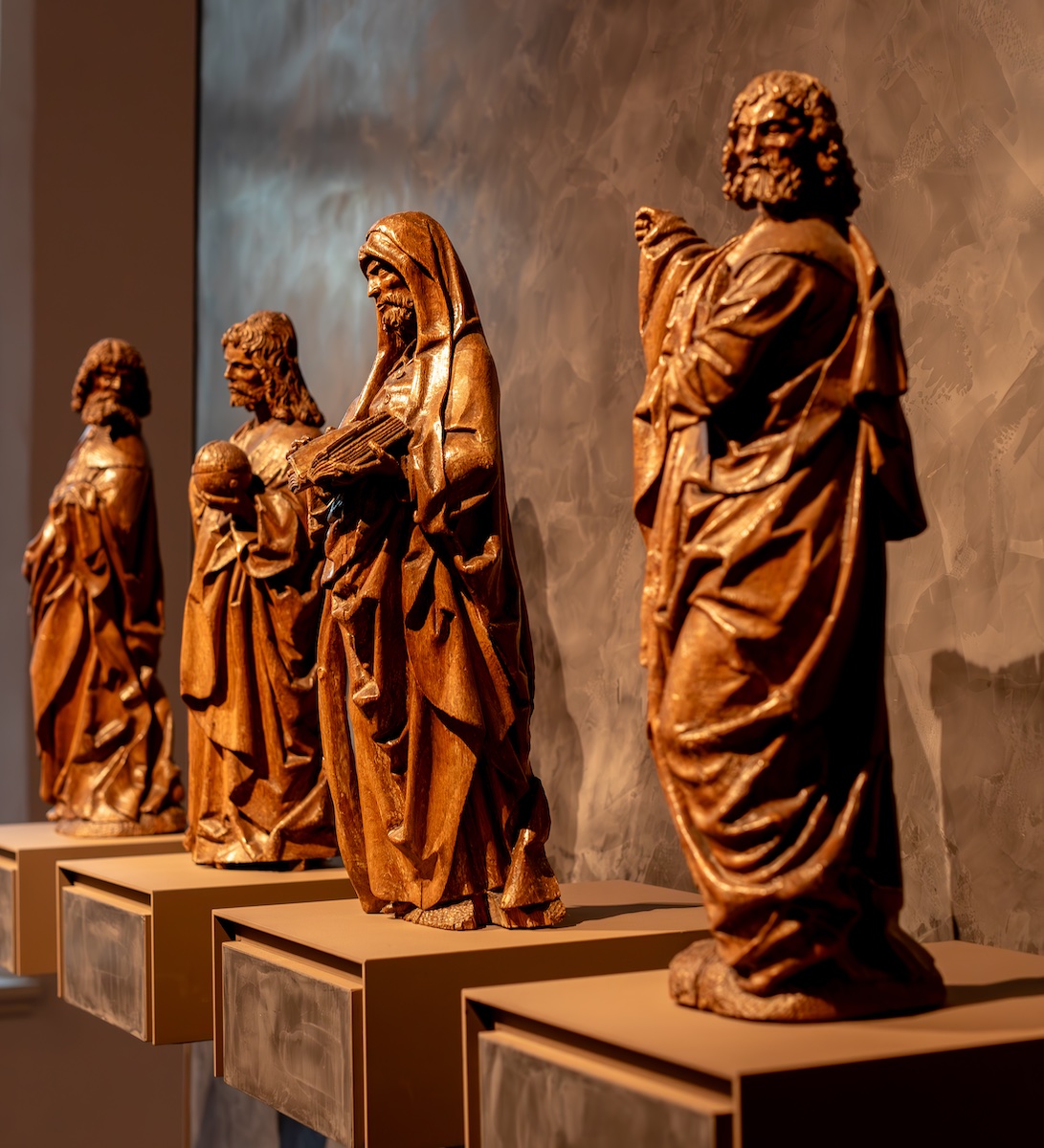
Of the 13 figures of the group, only Christ and three of his twelve disciples are still together.
In this beautiful historical museum there is among other things a collection of saints on pedestals, including one of James the Greater. Like so many old saint sculptures, he has lost various things over the centuries. A left hand for example: the hands were always carved separately from the sculpture and attached through a wooden peg in the sleeve opening. That has not proven to be a durable practice. I have perhaps seen as many wooden sculptures without hands as marble busts without noses.
In his right hand the apostle must also have held something up. It is not certain what that was, even though quite a few saints had their ‘own’ symbolic object. That could even be a house, which produced a somewhat surrealist image. I even once saw a painting in Tuscany, in the Palazzo Pubblico in Siena, where a dying man received a visit from a saint with a considerable amount of real estate clamped in his arms. The James by the Master of Elsloo still holds a piece of his stick or staff, but the top part has broken off. Perhaps it was decorated with some shells. But that is speculation.
The sculpture of James must have been carved around 1520, as part of a sculpture collection of Christ with his apostles. There must have been 13 sculptures including Christ. Now only four remain. At least, four of the 13 stand in a row in Utrecht.
Christ with a globe
I found the sculpture of Christ in this group the most beautiful, as he is depicted as ‘Salvator Mundi’, the Savior of the world. He holds a globe, symbolizing the round earth. And Christ makes a blessing gesture, according to the curators of the museum. Whether that is really true we just have to believe. That blessing hand has also disappeared, just like that of James. Only Judas still has both his hands, firmly clasping an open Bible.
It is all knowledge that has disappeared in the surf of time. Moreover, art historians have shown only very limited interest in the richest period in the history of wood carving in the Netherlands, according to the writers of this very desirable German book.
Jan Bom (with thanks to Tom Ligthart of Guts en Klopper)
‘Niederländische Sculpturen, von 1130 bis 1600′, available from the Suermondt-Ludwig Museum in Aachen. (Price: 29 euros, excluding shipping costs)