Fresh and therefore still wet wood forced Henry Moore (1898 – 1986), the most famous British sculptor of the last century, into a new abstract visual language.
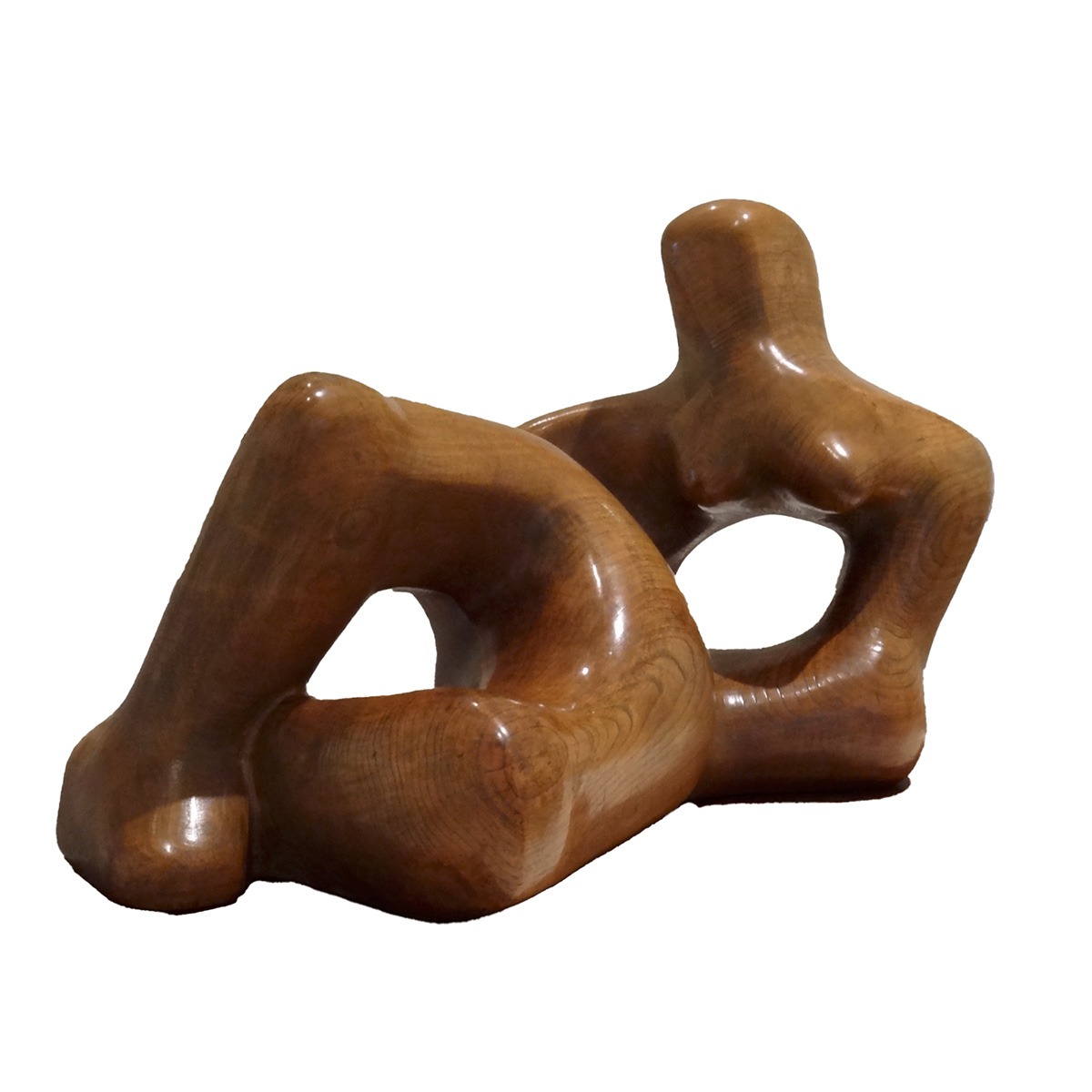
To ensure that the wood would dry evenly and without cracks, Moore made sure that his very first ‘Reclining Figure’ was nowhere thicker than 20 centimeters. The year was 1936. The result was so overwhelming that many other reclining figures followed, some enormously large, in stone. The ‘Reclining figure‘ of Moore accompanied him throughout his artistic life.
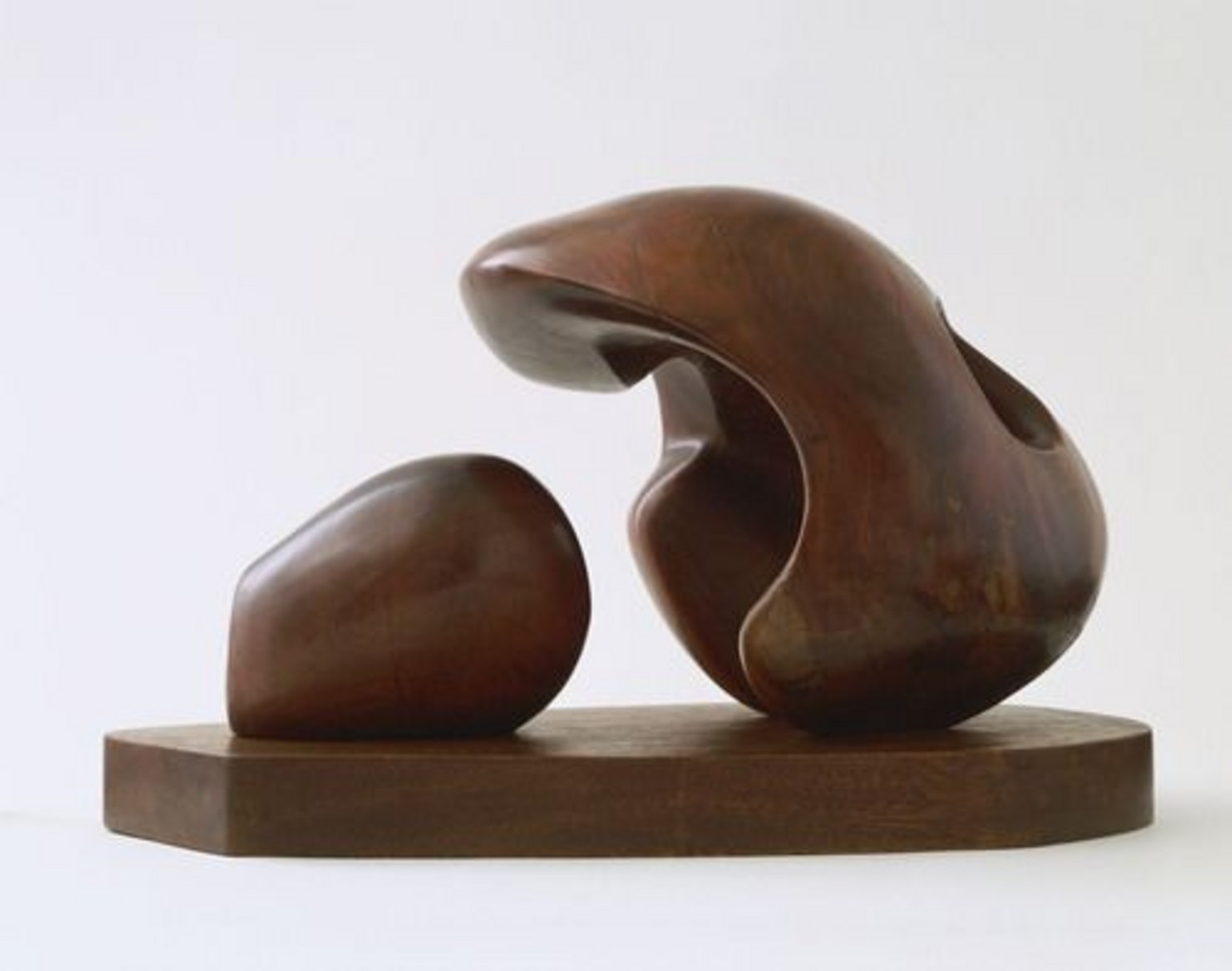
Two Forms, 1934, Museum of Modern Art, New York / The Henry Moore Foundation.
Elm wood is known for its beautiful wild grain pattern, but also for its strength. In old times, wainwrights made wheelbarrows and wagon wheels from it, because they could stand in water for a long time without rotting. The British even made water pipes from elm wood. For the same reason, undertakers also used elm planks to build coffins. It kept their buried dead drier and worm-free for longer.
Wood for coffins
Dry elm wood is rock hard. But it takes about a quarter century to dry the wood through and through. And the young sculptor Henry Moore did not have that much time and money. He had already made several sculptures from beautiful pieces of tropical wood, which Great Britain imported at the beginning of the last century from affiliated colonies. He had also already discovered ‘the hole’, round cutouts that could represent eyes.
But Moore underwent a turning point and began to orient himself more and more towards British nature.
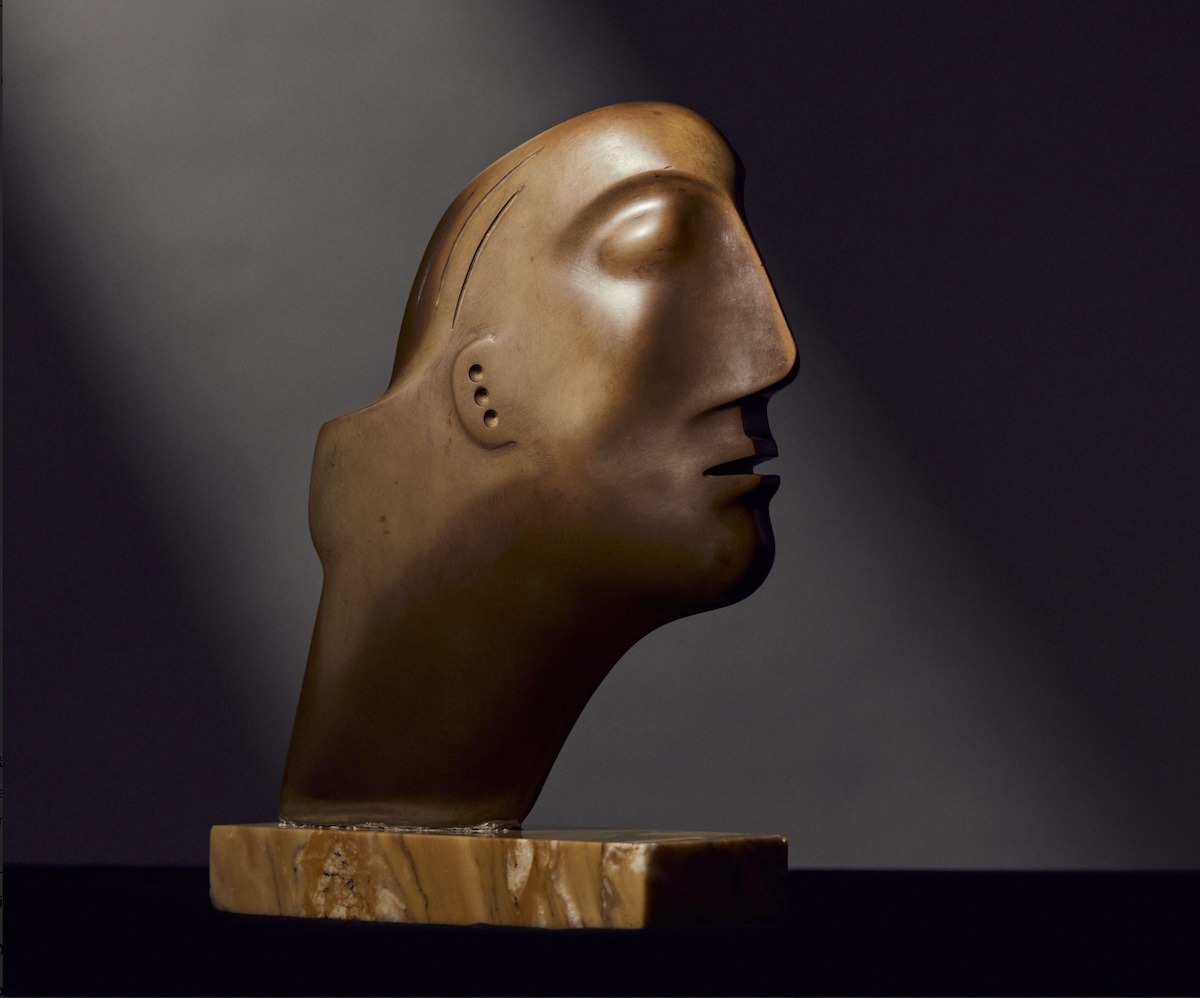
Head, Henry Moore, 1930
From a stone found on the beach (ironstone) he carved an abstract female head as early as 1930. He used the structure of the stone, polished smooth by ebb and flow and sand, as a basis. He added little more than a suggestion of eyes and ears. He did carve a clear mouth. The unique sculpture of 17 centimeters in height is now estimated to fetch at least 2.5 million euros at an auction by Bonhams. His lifelong friend / fellow sculptor Barbara Hepworth (1903-1975) also searched for stones with him on the same beach. She even had entire crates transported to her studio.
After his move from the city to the countryside, Moore’s interest in native tree species also grew, particularly in elm. This transition marked his career, due to the special characteristics of the wood. Unlike lime wood or oak, elm is rarely used for decorative wood carving. The grain of the wood is very wide and twisted. This makes it difficult to carve and unsuitable for anything requiring a fine or detailed finish. But it can be sanded beautifully smooth, like a ‘rolling stone’ on the beach.
The moisture still splashed from the wood
Moore studied the twisted grain of a piece of wet elm wood carefully, approximately 89 x 61 cm in size. He applied an idea to it that he had gotten from a sculpture he had seen from the Maya. A pre-Columbian reclining figure of a river goddess had a raised head that stood perpendicular to her torso. The twist of the elm wood lent itself perfectly to such bends and tilts.
But Moore opened up the figure because he had to let his wet block of wood dry without cracking. During the chopping and carving, moisture even still splashed out of it. But the toughness of the wood gave him the opportunity to carve deep grooves in the chest and knees. The spatial openings in his composition were born. A new abstract art movement thus took shape, inspired by organic forms from nature.
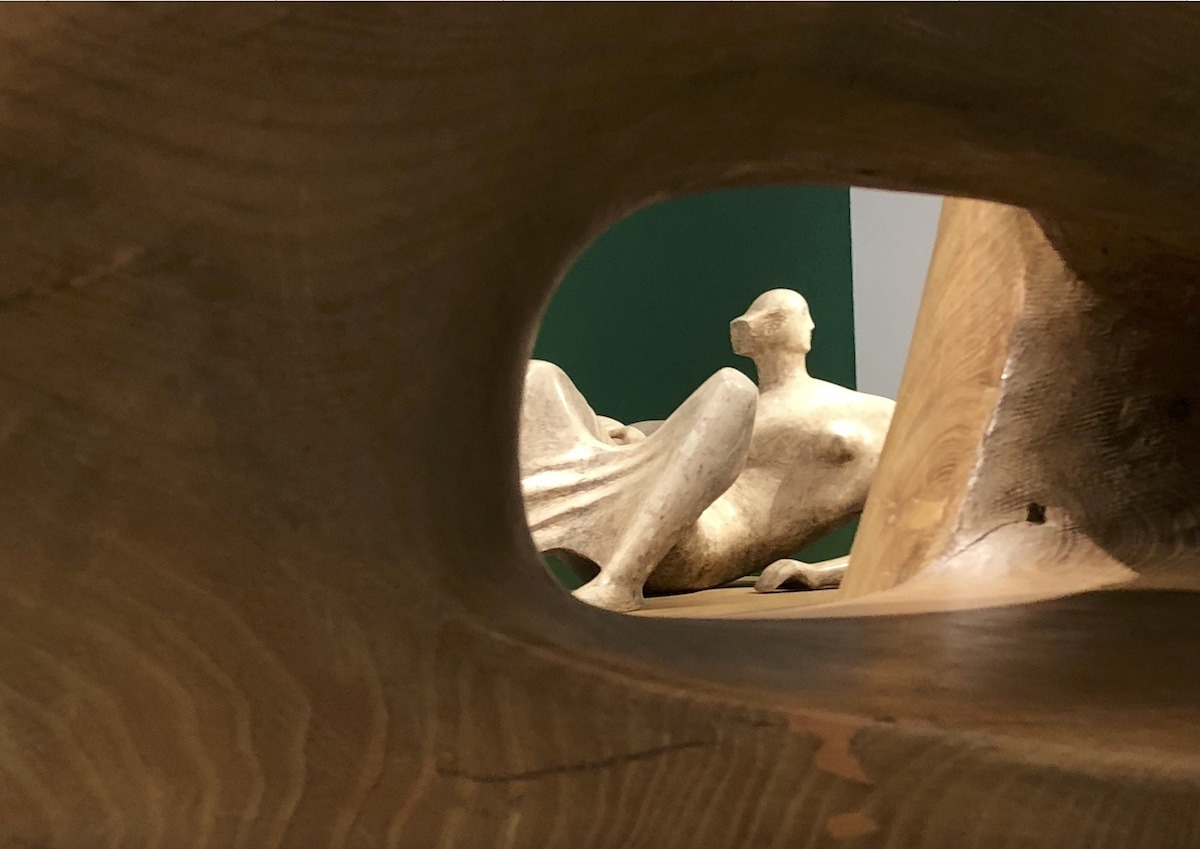
After the first reclining figure in wood, many many others followed, increasingly larger too.
The first reclining figure was so successful that Moore carved two more works in the following four years, each larger than the previous one. He gained increasing confidence in working with wet elm wood and the challenges of the processing. His ambition grew to make such sculptures on an ever larger scale, in other materials. He eventually became world famous and extremely wealthy from it.
Looking back on his early period, Moore described the transition to elm wood as a liberation. Carving some of his earlier wooden sculptures now seemed more like ‘a mouse nibbling at a hole’.
For this article the research of British art historian Ann Compton was used. She wrote an extensive analysis on the Tate website about Moore’s works in wood: An essentially different kind of rhythm: Rediscovering Henry Moore’s Sculpture in Wood. There is also a book by photographer Gemma Levine, who documented how Moore still made wooden sculptures in his later years. It is called ‘Henry Moore, Wood Sculpture‘ and is still available for purchase on the internet, used, for varying prices: from 13 euros to almost 80 euros (excluding shipping costs).