Zadkine carved 131 sculptures in wood, including a gilded and majestic deer: ‘Le Cerf’. Not everyone knows that for sure. Say Zadkine and most people think of the war monument ‘The Destroyed City’ in Rotterdam.

Ossip Zadkine (1888-1967) assembled Le Cerf in 1923 from different pieces of wood, which he sanded smooth, coated with chalk glue and painted with a red-coloring iron-containing pigment (red bole). He finally gilded this base layer with a paper-thin layer of 24-carat gold leaf. The result: a human-sized sculpture that radiates power and pride, especially through the high wide neck of the animal. On the head suddenly a playfully zigzagging sawn antler.
The sculpture inspired by both Art Deco and cubism is owned by the Stedelijk Museum Amsterdam. Zadkine was far from ‘style-committed’ and certainly in the beginning of his artistry mixed many style characteristics.
The American ‘art bible’ Janson’s doesn’t even devote a single word to him, being stone blind to any artist who dared to take a gouge and mallet in hand.
Man without a heart
The sculptor born in present-day Belarus as Yossel Aronovich Tsadkin spent his youth in the forests along the Dnieper River. In his work, memories of those trees always shimmer through. Even the sculpture ‘The Destroyed City’, or ‘The Man Without a Heart’, leans against a tree trunk, arms raised in despair. There is even a Polygoon Newsreel preserved of the unveiling.
An uncle taught him wood carving. Only after arriving in Paris did he learn to make sculptures from other materials, such as stone and marble (112), clay (132), plaster and other materials.
“Always been a carpenter”
Zadkine never denied his origins. Looking back on his life he confessed: “In my heart I have always been a carpenter, who, instead of making tables or a door, began carving sculptures in wood.” Those who knew Zadkine well knew that such statements were mainly intended to provoke loud protest from listeners.
A good example of his origin can be found in the hidden Zadkine museum in Paris and is called ‘The Harvest’, carved from elm wood, around 1918. In his memoirs Zadkine wrote that this work ‘reflects the old tradition of wood and stone workers, who, after leaving the forests, carved their dreams and fantasies about beautiful birds from large tree trunks.’ This certainly also applies to his oldest sculpture from 1913, Le Maternité, which he carved out just after arriving in Paris.
The Zadkine museum houses a total of 24 wooden sculptures, including another gilded work he made in the same years as ‘Le Cerf’: ‘Head of a Man’ from 1922.
The man has eyes like almonds, a reference to his Slavic background. He did mix the robust head with other sources of inspiration, such as non-Western art, renamed ‘primitivism’ in Paris.
Did he meet this deer?
I wonder if Zadkine as a child ever had an encounter in the forest with a deer, which must have made such a deep impression on him that he made ‘Le Cerf’ a king of the animal kingdom, more powerful and prouder than a lion. It must have been.
One more anecdote to conclude. The Dutch sculptress Christine Langerhorst knew Zadkine personally, through her husband, who was an architect. They visited him in Paris. Zadkine found her wooden lathe work very beautiful and at some point proposed to trade. He wanted a wooden bowl from Christine. The Utrecht artist: “He then showed me a spoon he had made. I didn’t think much of it. I didn’t accept the proposal, even though he was already very famous then.”
The refusal cannot be blamed on Langerhorst: from a memoir by a former student it appeared that Zadkine could be very rude and insulting. She herself once heard as comment on her work from him: “Look at this carpenter.” Was this a case of what Germans call ‘Selbsthass’?
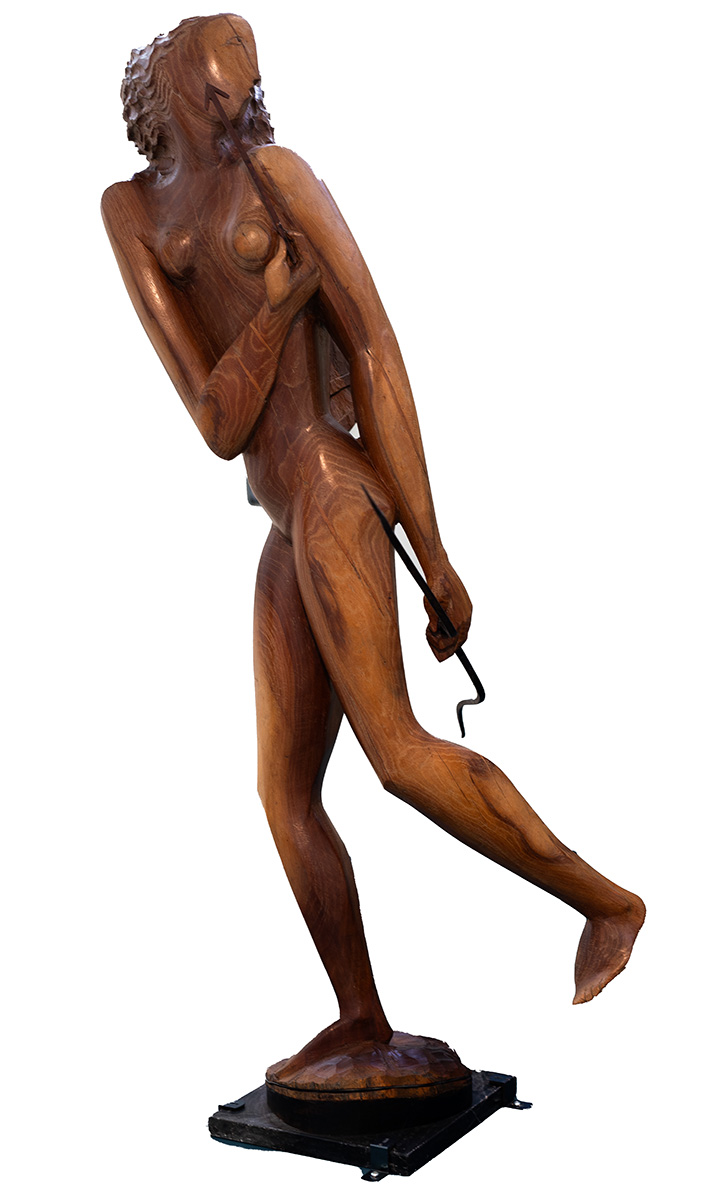
The sculpture Diana by Zadkine could be admired in the Netherlands in 2025 at Museum Jan in Amstelveen.
Zadkine’s wood carving rarely comes from Paris to the Netherlands for an exhibition. An exception was the exhibition in 2025 at Museum Jan in Amstelveen ‘Ossip Zadkine, Man, Myth and Metamorphosis’. Among numerous bronzes here stood a single wooden sculpture of the goddess Diana. It was a loan, as it is owned by the Palace of Fine Arts in Brussels, Belgium, purchased in 1948.
Diana is the Roman goddess of the hunt, the moon, the wilderness and birth. She is also known as the protector goddess of wild animals and virginity. In Greek mythology her equivalent is Artemis. Diana is often depicted with bow and arrow, accompanied by her nymphs, often in nature. She is an important goddess in Roman mythology and is associated with various aspects of life, including the protection of hunters, the fertility of nature, and the protection of women during childbirth.
Some other examples of wooden artworks by Zadkine.
Jan Bom, last update July 9, 2025