
Stefan Balkenhol (1957) makes art with humor. His businessmen always wear a white shirt and black trousers. But sometimes such a sculpture holds a teddy bear pressed against its chest. Or the businessman hangs high on the neck of a giraffe. Or he sits backwards on a donkey.
Humor in visual art is rare, but the roughly hewn sculptures of German Stephan Balkenhol bring a smile. This professor at the Art Academy in Karlsruhe says himself: “Yes, there is coarse and subtle humor.”
Balkenhol seems to always have an inner chuckle, this artist who is counted among the greatest of German art after the war. With a loosely rolled cigarette in the front of his mouth, he watches with amusement as the city officials of Leipzig unveil his statue of Richard Wagner. As if he considers the whole official display a big joke.
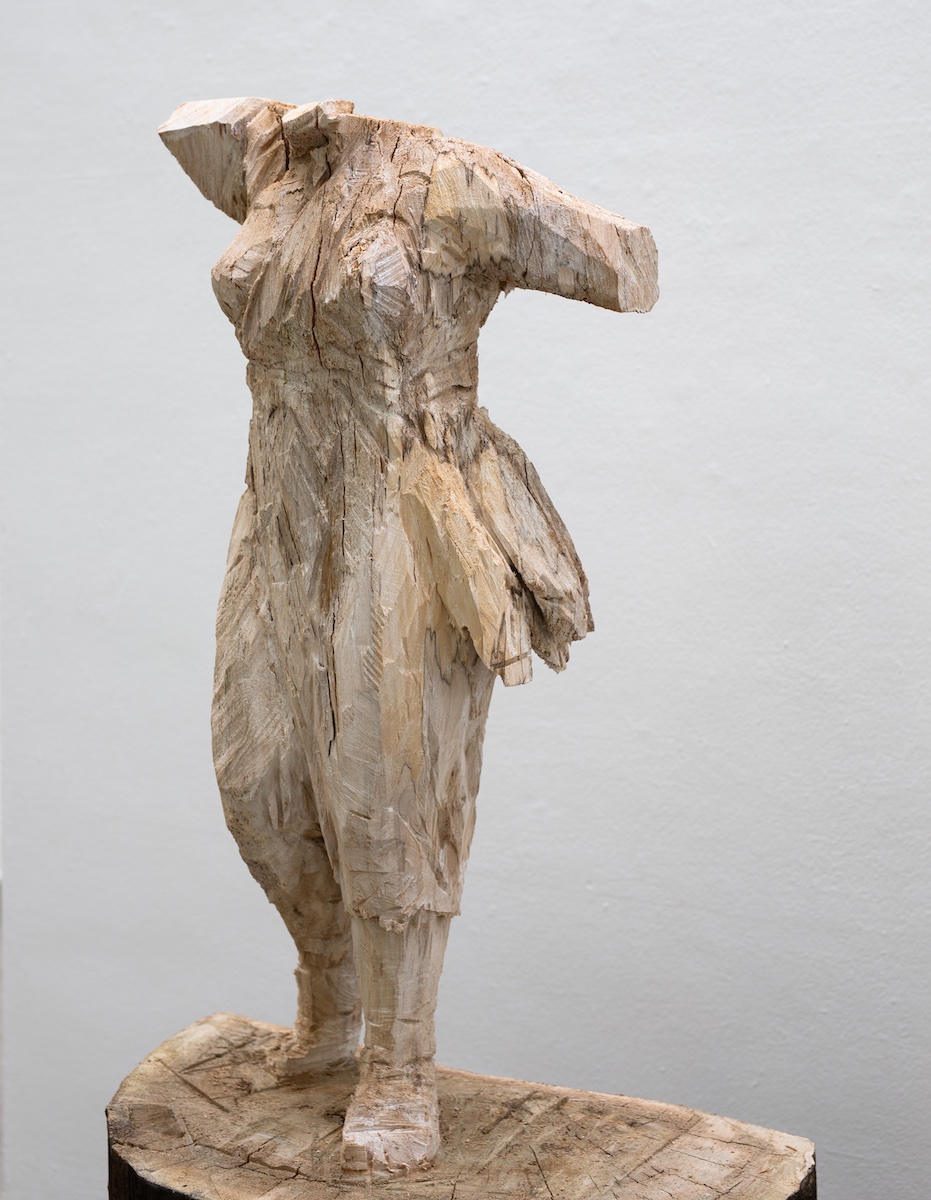
A sculpture by Balkenhol from 2024: Bozetto, referring to a dance.
That same look you see when he carves out the sculpture of a seated naked woman in two days, who on day three will sit centrally in an exhibition hall. In all corners and against all walls of the space, the businessmen are present everywhere, staring at this vamp. Visitors to this scene must feel as if they are walking through a peep show. Talk about audience participation.
“Trees, we have many of those in Germany”
It didn’t just come easily to this wood artist. He lived and worked for twenty years in a ramshackle home, without a shower. It was the price he paid for his contrary views. Trained at the Art Academy in Hamburg by Ulrich Rückhiem, a German giant in abstract art, Balkenhol chose the figurative, human figures.
He carved his first human figures in wood as well. Why wood? “Trees, we have many of those in Germany,” he once remarked laconically in an interview. About the difference with sculpting in stone: “Wood has the right resistance for me, also offers me the speed with which I want to work. It probably suits my temperament best.” But you certainly can’t accuse Balkenhol of wanting to revive the Black Forest wood carvers’ tradition that has become a tourist attraction. No Nativity scenes or cuckoo clocks from him.
“A punishment not to be allowed to work”
Today a buyer easily has to pay 50 thousand euros for a sculpture by Balkenhol, often much more. A roughly sawn and hewn dancer has a price tag of 105,000 euros. And yet there’s sufficient supply, with the incredible production pace Balkenhol maintains: “It’s a punishment for me not to be allowed to work.”
He is represented by a multitude of galleries. His work is for sale in the United States, Japan, Singapore, Scandinavian countries, of course in Germany itself and in the Netherlands at AKINCI in Amsterdam. His ruin has since been exchanged for a small castle on the border with France, where he partly lives with his young wife and family. Here he seeks the peace that his sculptures radiate, as sources of contemplation in a hectic cityscape full of commercial expressions: brightly lit advertisements, screaming shop windows and expensive cars whizzing by on the street.
The splinters and wood chips still stick out
In interviews Balkenhol doesn’t reveal much. More telling are the documentary images showing him at work. He uses large chisels that he sharpens himself. With heavy hoists he has Wawa wood trunks from Africa placed in his industrial workshop. After sawing out the rough shapes with a chainsaw, he writes a work schedule on the bare wood. An hour for the legs, an hour for the body, an hour for the head. The more than 10 thousand hours of experience in woodworking then pay off. It really goes incredibly fast. Balkenhol doesn’t sand the surface smooth but leaves it rough. The splinters and rough wood chips stick out on all sides. Yet every blow of his chisel is accurate. The depths under the eyebrows provide enough shadow to make the eye realistic. The cheekbone is perfect. The posture of the sculptures is stiff but still natural, inviting, recognizable from thousands.
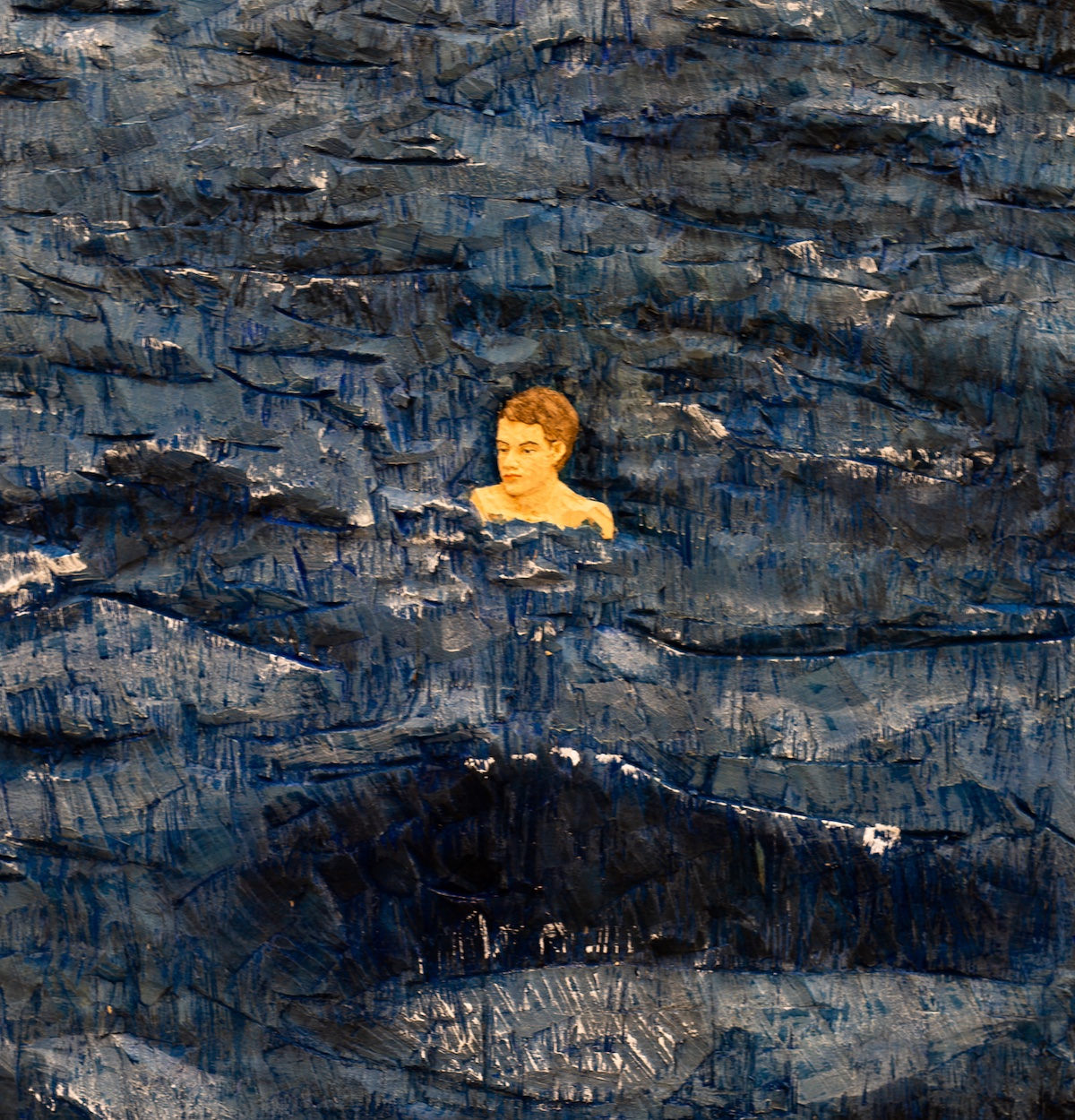
Fragment of ‘Schwimmer’ from 2024, an enormous wall relief.
The brains of the viewers complete the image and still smooth out the rough surface. Balkenhol helps the imagination a bit by painting his people. A fire-red dress, or rather an ink-black opera dress. To also add an ironic touch while brushing. So one of his men gets bright lipstick. Which gives Balkenhol the idea to also carve a sculpture of a male person who has breasts. Or to give the torso of a businessman a dog’s head, another the long neck of a giraffe, the third with the head of an elephant, including trunk and tusks. For an exhibition in Southeast Asia he gave his businessman four arms, as a reference to the Indian god Shiva.
His own statue with cigarette in the head
It’s funny that precisely the heavy German art culture has produced the greatest artists with humor in recent decades. In the Netherlands too, laughing is forbidden, even though we had plenty of humorists centuries ago, such as the painters Jan Steen and Frans Hals. We now only have Teun Hocks, Wim T. Schippers or Herr Seele and Kamagurka, but they are Belgians. What people get up to in the Dutch landscapes of art photographer Mischa Keijser should not be forgotten either.
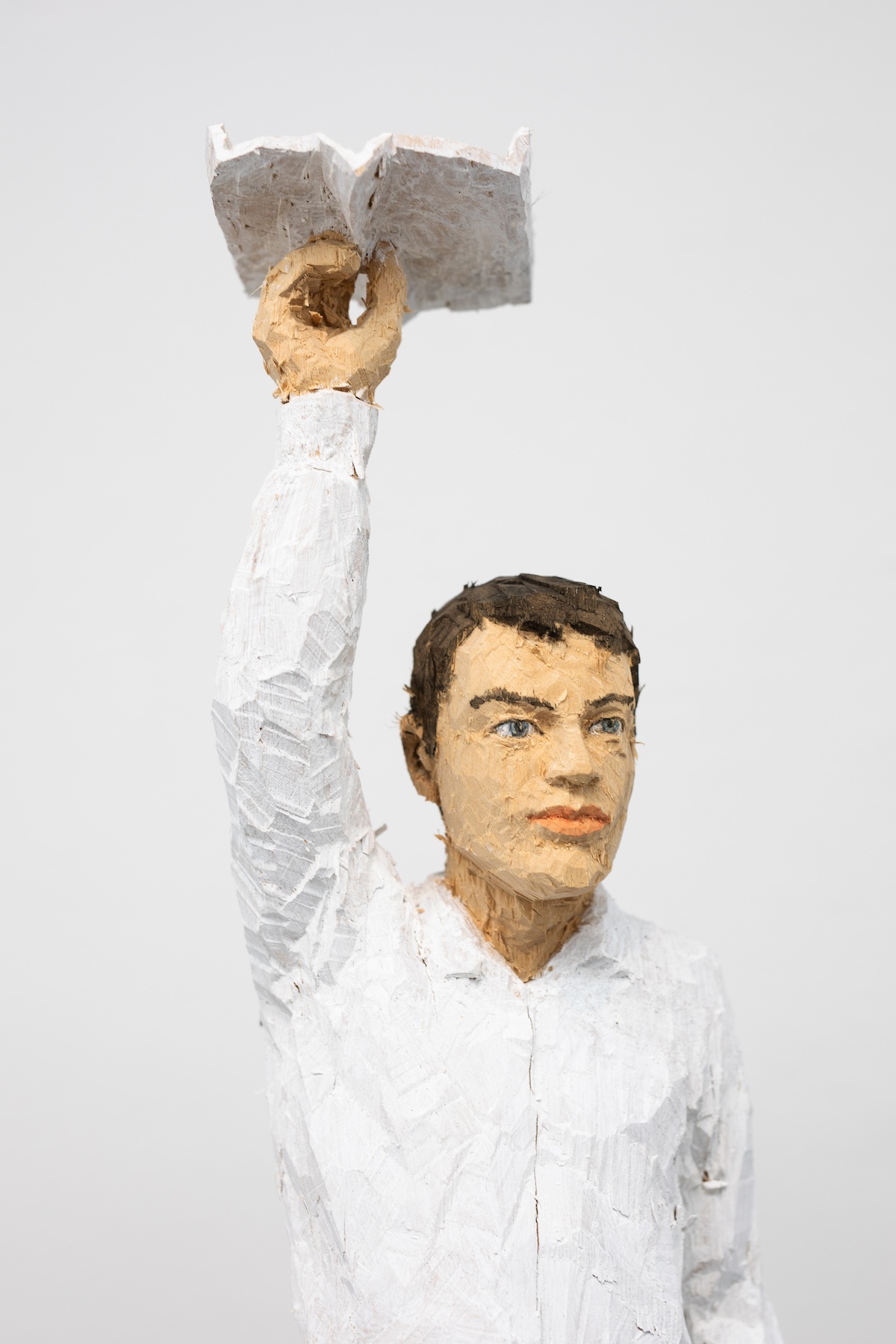
One of Balkenhol’s businessmen, now with a folded paper airplane.
But none of them achieved the world fame of Balkenhol, or that of the Austrian Franz West (1947 – 2012). The latter even got the city officials in Rotterdam to exhibit his brightly colored plastic ‘intestines’ in parks. In another city he even had a gigantic public toilet set up, with a free view of a pond. Making his audience laugh was the ideal of this Austrian. He once said about the famous urinal by Marcel Duchamp: “I would also like to make a urinal, but one you can actually piss in, in a museum.”
Balkenhol also seems intent on demolishing the ‘Great Prohibition on Humor’ in visual art. As if you can no longer take art seriously when a sculpture works on the funny bone. Perhaps it’s his indictment against the art establishment that ignored him for so long. Anyway, how he reintroduced woodworking into modern art history with his unfinished but still so accurate technique is worth a statue in itself. He should especially make that himself. A self-portrait of a man in a white shirt and black trousers. Loosely rolled cigarette sticking straight out of his mouth, like an extra chisel.