The eyes of Eveline van Duyl look at you from within a forest. Or is it Eveline herself who sees a roe deer or a wolf? Who is watching whom? When we are in nature, are we looking outward—or inward instead? In her series Forest, this artist allows tree trunks to become almost human.
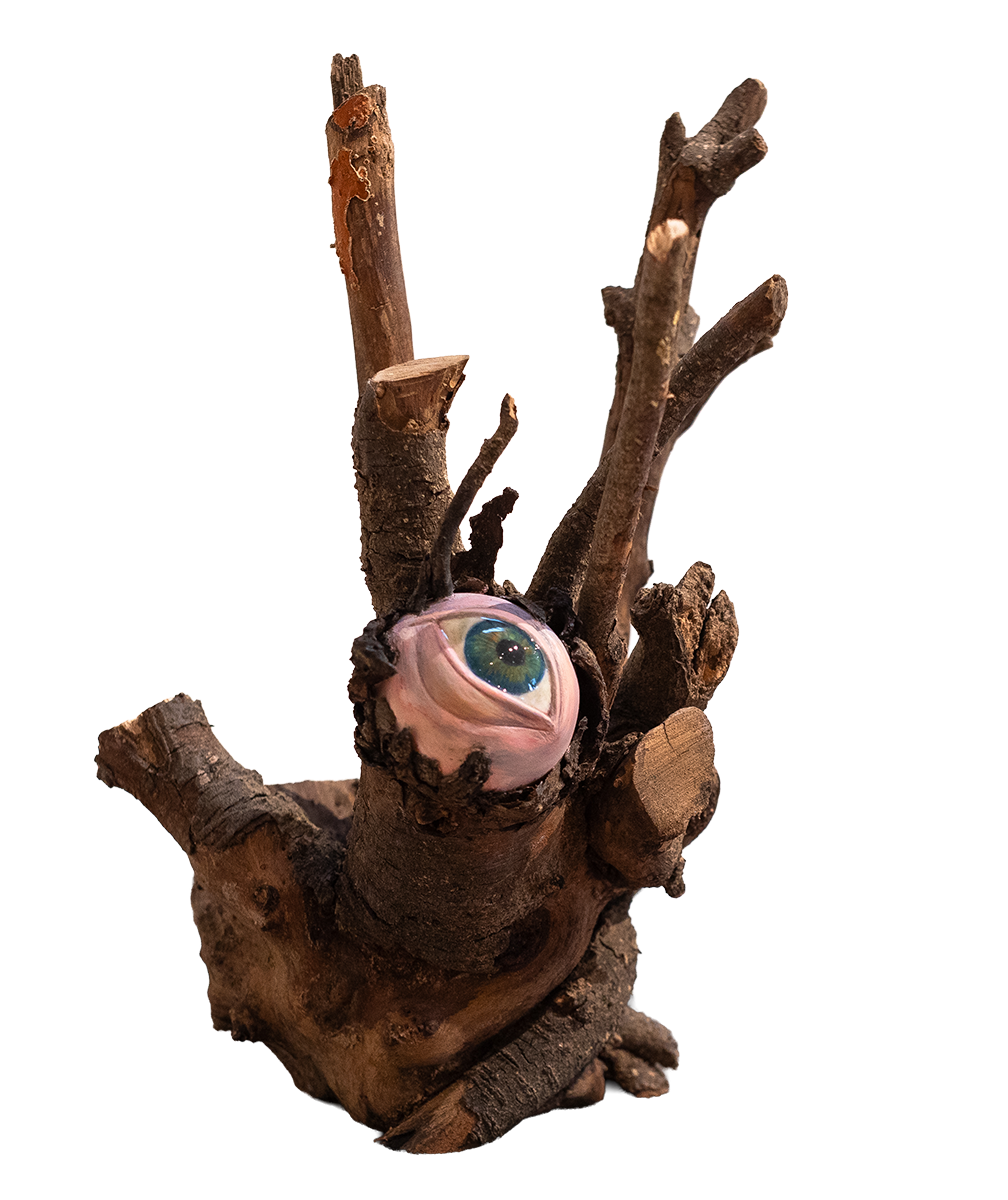
The Eyes of Eveline van Duyl: Eye Birth, 2023
When the coronavirus brought social life in the Netherlands to a standstill and people were no longer allowed to see one another, artist Eveline van Duyl (1957) retreated into the forest. High up in the province of Groningen, where she lives and works. Walking. Out there in nature, she did not feel alone at all. On the contrary—she felt observed, by animals.
That sensation became the source of a substantial series of sculptures she titled Forest. From the woods she brought back trunks and branches, worked on them, and carved eyes into them. The rough wood thus also acquired human-like forms—heads, torsos. And the eyes began to function as a subtle yet powerful means of confronting the viewer with their own gaze. They make the work resilient, alert, sometimes even unsettling. Eerily real. They break through the viewer’s safe position.
Eerily Real
The work of visual artist Van Duyl moves along the boundary between nature, imagination, and perception. In her sculptural practice, wood plays a central role—not as a neutral material, but as a bearer of history, growth, and vulnerability.
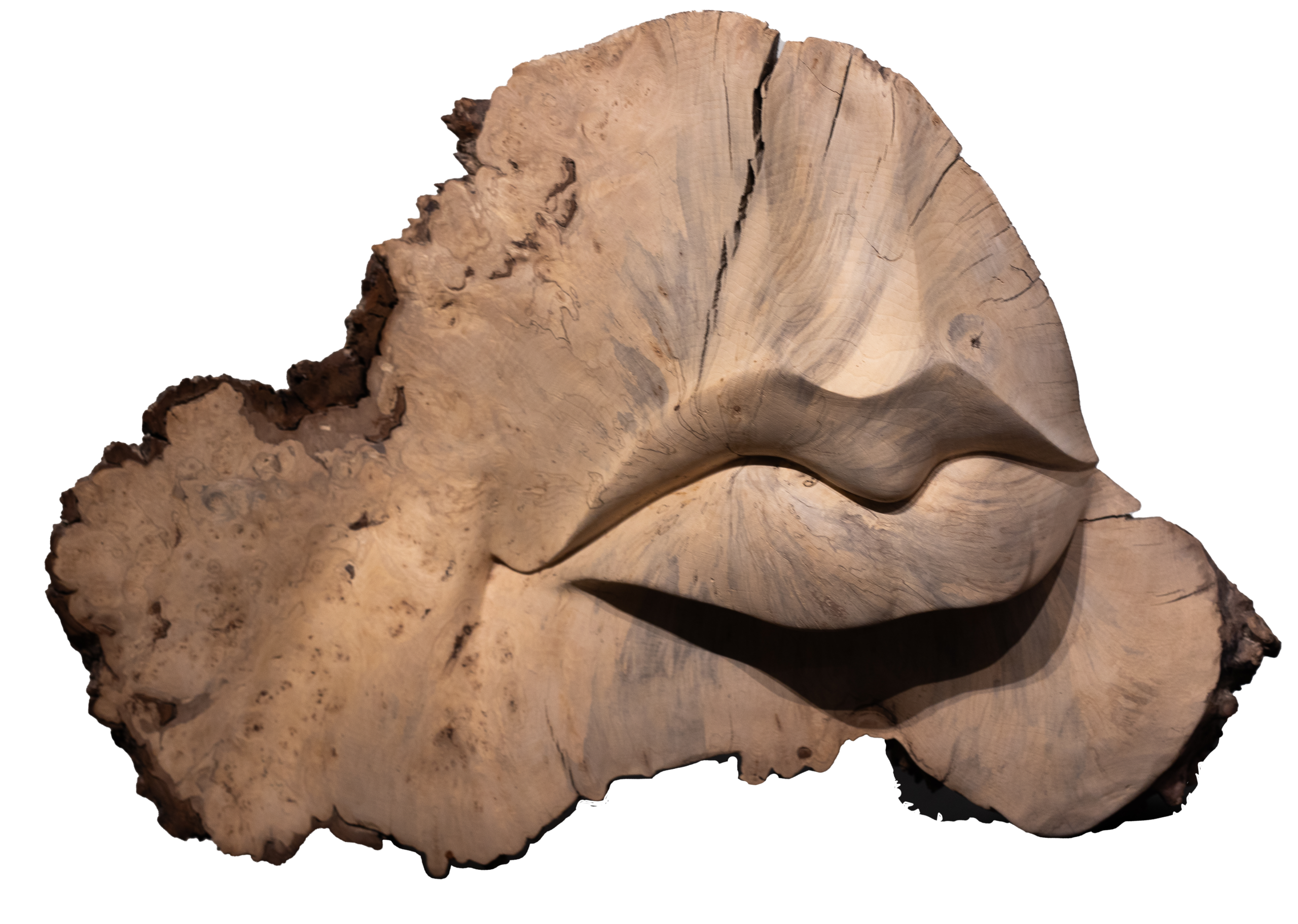
Agrippina, mother of Nero (and her son), a work carved from a cross-section of a willow trunk, 2021.
I place her approach within Dendroism, because in this series she proceeds from the story already hidden within the wood itself. In doing so, Van Duyl aligns with artists who listen to what the material itself suggests. The grain of the wood, its veins and knots, play an active role in the final form.
Rubbing, Rubbing, Rubbing
During the opening of her solo exhibition at Het Depot in Wageningen (from 1 February to 14 June 2026), I spoke with her about those eyes. How did she manage to make those enormous pupils so lifelike? Even the translucent structure of the wood contributes to an extraordinarily real iris.
It is a matter of painting very thin layers with great concentration, she told me. She uses impregnating oil mixed with soft pastel pigments. “Rubbing, rubbing, rubbing. Until I think: this is right. Then a glossy layer on top. I use, among other things, PU lacquer—a glossy lacquer finish.” The final result gives the eyes an emotional sheen.
A Layer of Animacy
As an additional effect, the eyes point toward a deeper layer of animacy. In many cultures—including our own, before the arrival of Christianity—trees were regarded as living beings with a consciousness of their own. The Sacred Oak in Germanic culture is one such example.
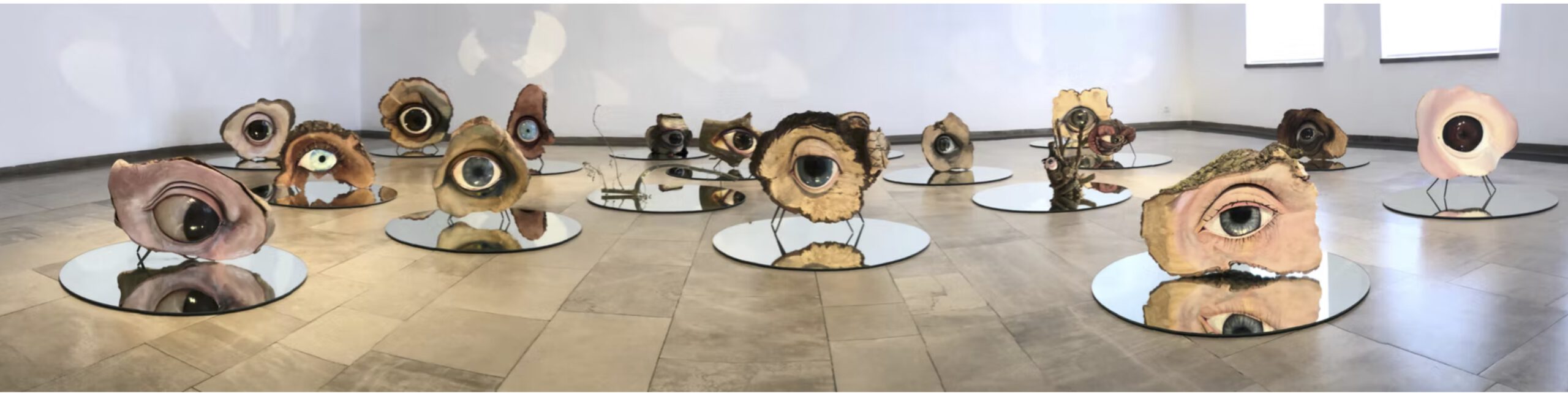
Forest, the complete wood with eyes that watch you.
Van Duyl does not explicitly align herself with this tradition, but her sculptures do breathe that idea: for her, wood is not a dead material, but a body that was once born, grew, felt, and responded. The eyes function as a reminder of that liveliness.
Pupils of Marble
I cannot help but draw a comparison with two Japanese artists who, using very different techniques, also incorporated lifelike eyes into their sculptures. The absolute master is Unkei, who was centuries ahead of European woodcarvers in his development. He lived from around 1150 to 1223 and used cut glass eyes to further enliven the profoundly human facial expressions of Buddhist monks. No fewer than eight centuries later, his compatriot Katsura Funakoshi took up this idea again—this time by painting pupils onto white marble in such a way that his figures seem to look straight through you.
Van Duyl admitted to me that she did not know these Japanese examples. Yet with her own technique she integrated the eyes into her sculptures with equal care. Even in the alienating work Eye Birth, the eye truly appears to be born from the bundle of branches, like a strange pink mushroom.
Like Windows…
In the exhibition guide of Het Depot, a line from the poem Autistic by Rutger Kopland is quoted. It seems to describe a newborn baby, capable of looking in this way without yet being able to see sharply: “(–) I look and it looks like eyes of glass, like windows, simultaneously outward and inward, toward everything that is.” A beautifully chosen line, and highly appropriate to Van Duyl’s work.
With Forest, Eveline van Duyl invites us to slow down and reflect. Her sculptures do not ask for quick interpretation, but for an encounter—an encounter in which looking and being looked at coincide, and in which the boundary between human and nature briefly dissolves.
Jan Bom, 7 February 2026