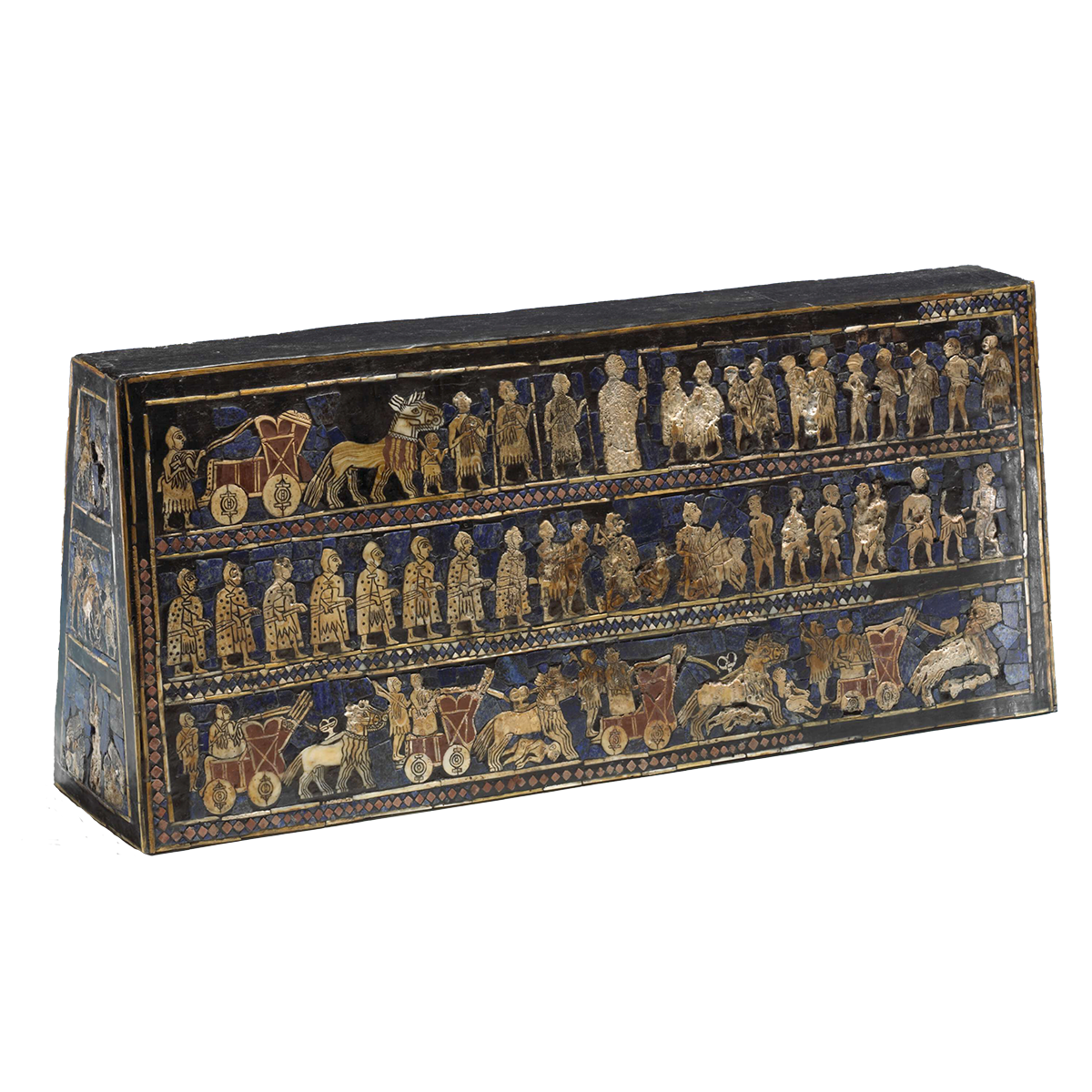
The Royal Standard of Ur is one of the most evocative objects to survive from the dawn of urban civilization. Created around 2600–2400 BCE, during the Early Dynastic period of Sumer, it offers a rare, intimate view of how one of the world’s first complex societies imagined power, war, peace, and order.
The Royal Standard of Ur: Power, Storytelling, and Early Woodcraft
Though often discussed as an object of luxury, its true importance lies in the way it combines storytelling, craftsmanship, and the intelligent use of wood as a structural core.
The object was discovered in the 1920s by archaeologist Leonard Woolley during excavations of the Royal Cemetery of Ur, in present-day southern Iraq. It was found in a grave, likely associated with elite or royal burial practices.
Decayed local timber
Despite its modern name, the function of the Standard remains uncertain. Woolley believed it may have been carried on a pole like a banner; others suggest it was a soundbox for a musical instrument or a ceremonial container. What is clear is that it was designed to be seen — and read — from multiple sides.
At its heart, the Royal Standard of Ur is a wooden box, probably made from a now-decayed local timber. This wooden core was essential: it provided a lightweight yet sturdy structure onto which decorative panels could be mounted.
Two contrasting stories
Over this core, Sumerian craftsmen applied a complex mosaic technique, using small pieces of lapis lazuli, red limestone, and shell, all carefully cut and set into bitumen, a natural asphalt that acted as both adhesive and waterproofing agent.
The panels are arranged in horizontal registers, telling two contrasting stories. One side, often called the War panel, shows soldiers, chariots, prisoners, and a commanding ruler towering above others — an early visual language of hierarchy and organized violence.

The Standard of Ur shows musicians on the Peace panel.
The opposite side, the Peace panel, depicts a banquet: musicians play, servants carry food, animals are presented, and again a central figure presides. Together, these scenes suggest a worldview in which military power and social harmony are inseparable, both sanctioned by authority.
Old trade routes
Technically, the object is remarkable not only for its materials — lapis lazuli was imported from Afghanistan, indicating long-distance trade — but for its precision. The mosaics required careful planning, standardized proportions, and a deep understanding of how materials behave over time. The wooden base, though now lost, was crucial: without it, this layered composition could never have existed.
Today, the Royal Standard of Ur is divided between institutions, but the most complete reconstruction can be seen in the British Museum in London, where it remains one of the highlights of the Mesopotamian collection.As a work rooted in wood yet transcending it, the Royal Standard of Ur reminds us that from the very beginning of civilization, wood was not merely functional. It was a carrier of images, power, and memory — a silent but essential partner in humanity’s first great stories. The Standard is also mentioned in the Janson’s, an American ‘Art Bible’.
Jan Bom, Februar 8, 2026.