The wooden death dolls of Sulawesi are guardians between life and the afterlife. The figures stand in rows before excavated caves. As a living culture of the Toraja people they have become a tourist attraction.
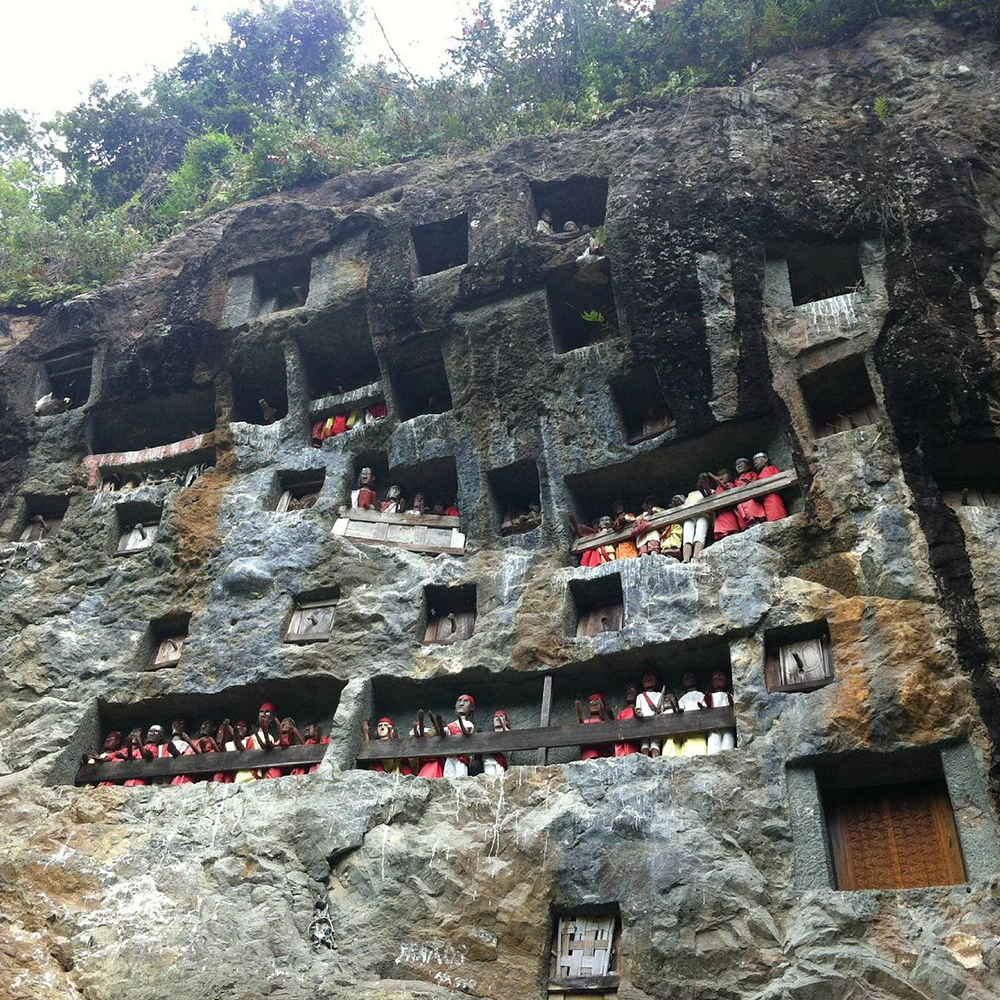
The wooden death dolls of Sulawesi stand as guardians in front of the carved burial sites.
When travelers cross the green high plateaus of South Sulawesi, they encounter a sight that lingers longer in memory than the views themselves. Life-size wooden figures that seem almost alive yet stand silently above graves and rocks.
These figures — tau-tau — are the death dolls of the Toraja. In their presence one can sense something that completely transcends our Western relationship with death and funerary art.
Tau-tau literally means “person-person” in the language of the Toraja, the ethnic group living in the southern part of the Indonesian island of Sulawesi. These wooden figures are not simple grave ornamentation. They are embodied representations of deceased persons, made to serve as guardians between the worlds of the living and the afterlife. They look out from balconies high in rocky burial sites.
Respect for Ancestors
In many ways the tau-tau resemble the Bisj poles of Papua New Guinea in their profound reverence for ancestors. Just as the Bisj poles symbolize the essence of a deceased and keep their spirit within the living community, so too is each tau-tau a continuation of a person — protected and revered
But whereas the Bisj poles are often expressively abstract and mythical, the tau-tau move visually closer to the human form: they are proportioned like real people. The dolls of the deceased wear traditional clothing, and woodcarvers do their best to make the heads resemble “grandma and grandpa.”
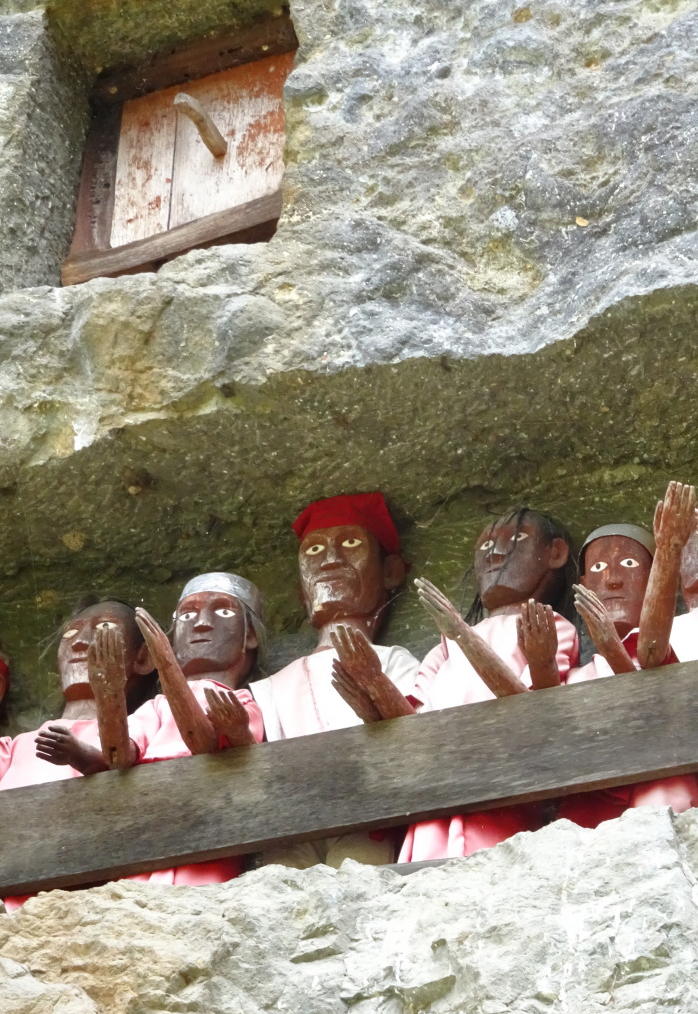
The wooden death dolls from Sulawesi extend their arms out toward the living.
The creation of a tau-tau does not begin in an atelier, but in the heart of the community. The Toraja use simple bamboo for villagers of lower status and precious jackfruit or sandalwood for the wealthy. The choice of material is not aesthetic, but a social language: wealth, position, and honor are immortalised in the grain of the wood.
In Toraja tradition, babies who died young were given a special burial place known as the communal burial tree, a practice that is no longer carried out. When a child died before getting teeth, they were placed inside a hollow of a “baby tree” rather than in a rock grave. In villages like Kambira, small niches were cut into the trunk of a breadfruit tree, and the opening was covered with a weave of palm fibres.
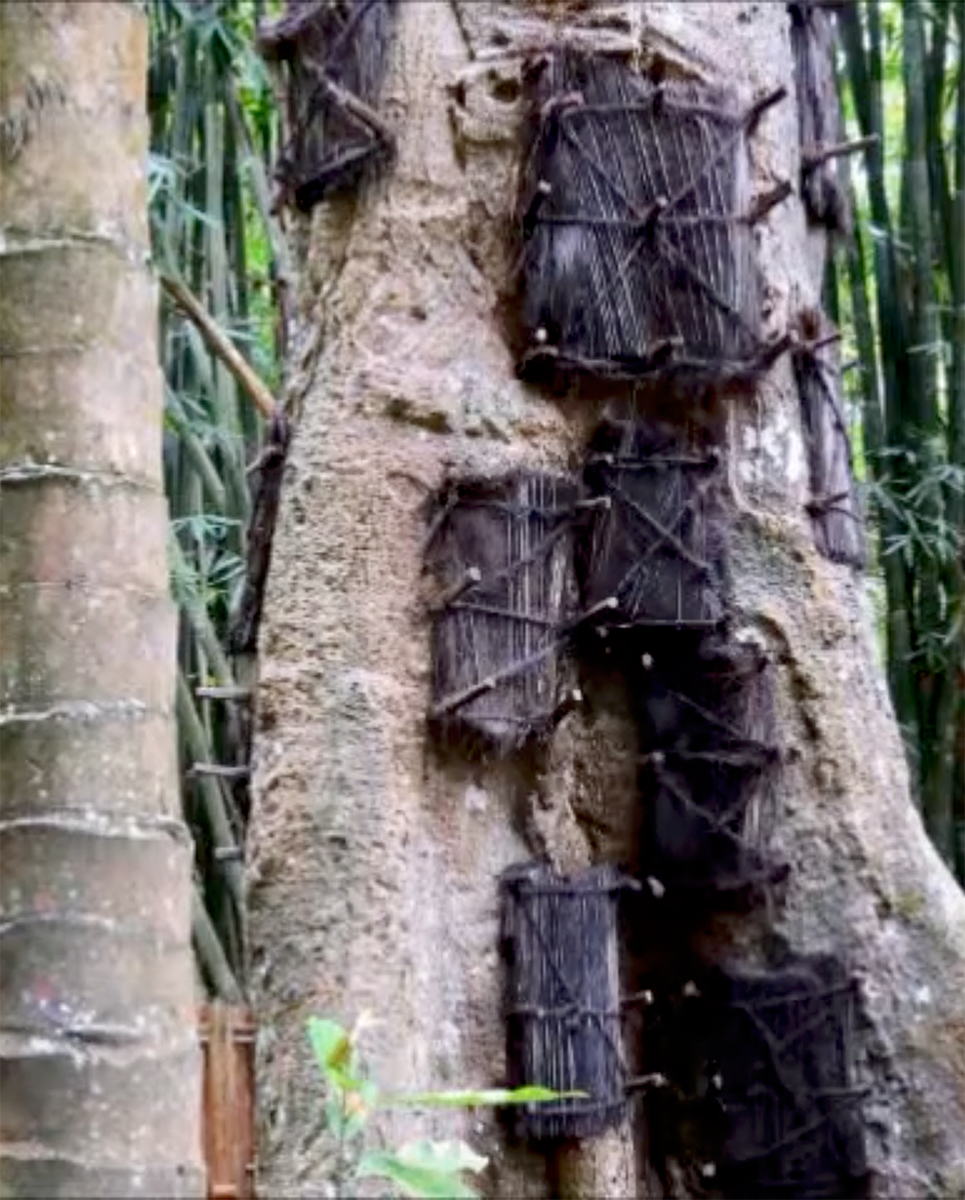
Young children were given a place in the Baby Tree, which slowly absorbs their remains.
As the tree grew, it slowly enveloped the child. For the Toraja this was not a macabre sight, but a comforting thought: the tree took the young life back into the natural cycle. The trunk thus became a living grave pillar — an organic monument where death and growth converged.
Transition Between Life and Death
In traditional Toraja cosmology, death is not the end of existence, but a transitional phase in which the deceased still participates in the daily life of the community. Until the funeral, the body remains at home in long shaped Tongkonan-houses as if it were ill; people continue to care for it, even placing food beside it. Only when the family has gathered enough resources for a proper funeral is the final journey to the grave undertaken. This can take years.
The ritual makes the rocky cliffs around villages such as Lemo and Londa into living burial grounds. There, wedged between limestone and cliffs, a row of wooden figures towers above the valley. They seem to watch day and night, as silent witnesses of a culture that blurs the boundary between life and death.
Creepy and Touristic
For tourists from the West this sight can seem eerie, yet the internet is flooded with vacation snapshots of people eager to share their experiences. The downside of this interest: some figures have been taken. They end up mostly in collections outside Indonesia. The Toraja also now carve figures as souvenirs. ir.
In comparison to objects like the Bisj poles, which focus on the mythical and animistic, the tau-tau invite an intimate confrontation with the human figure itself. The wooden dolls are not static monuments, but active portals. The wood gives expression not only to remembrance, but also to the belief that the dead continue to be an active part of the community just like the living.
Jan Bom, 15 Februar 2026