George Minne and the empty tomb of Jesus. It results in a sculpture of three deeply grieving women, wrapped in heavy cloaks. They are on their way to the final resting place, not yet aware that He has risen from the dead.
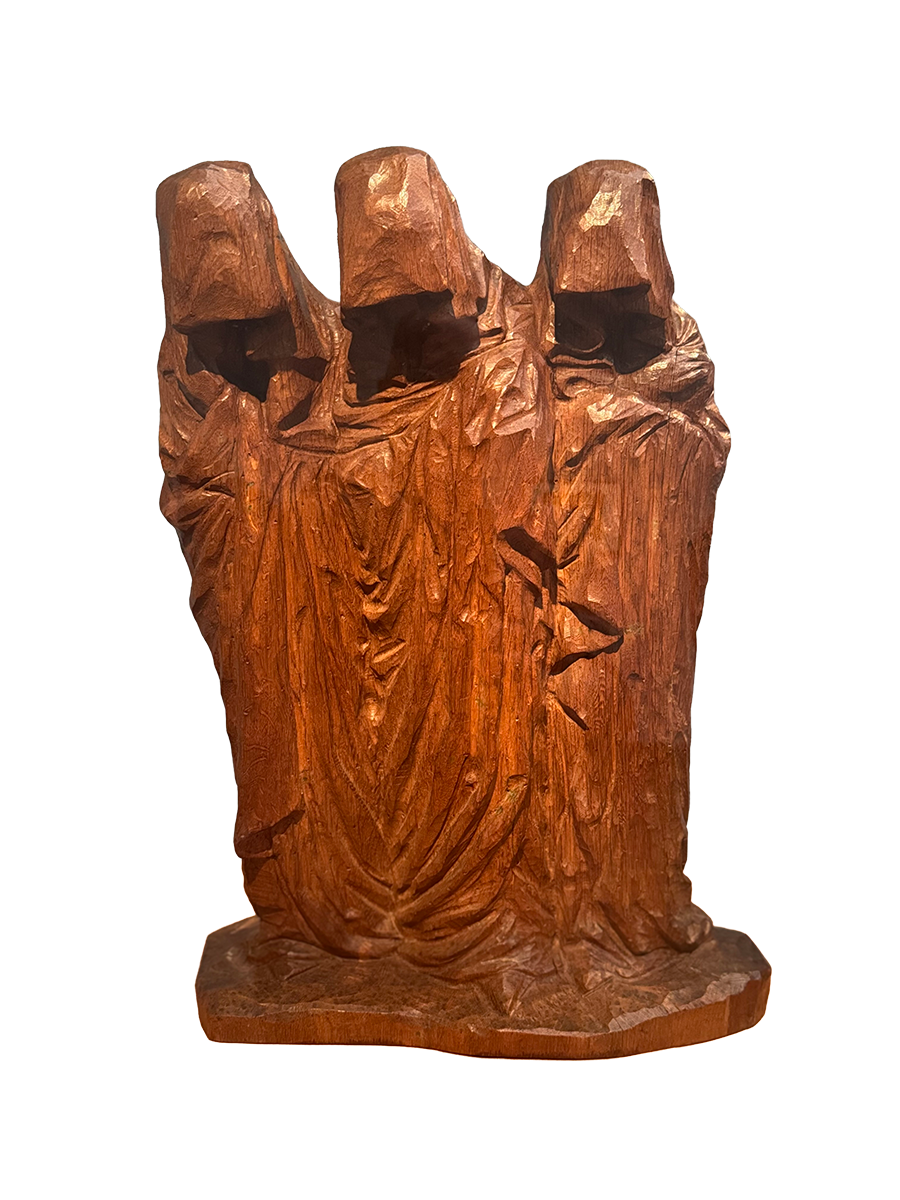
George Minne and the Empty Tomb: “Three Holy Women at the Tomb.”
The Belgian sculptor Minne did not often work in wood, yet this piece clearly demonstrates his mastery: it is filled with devotion, pain, and stillness.
Three Holy Women at the Tomb shows how Minne transforms religious themes into existential images. In this narrative scene from the Gospel, he depicts three crouching women, bent forward and wrapped in heavy cloaks pulled over their heads. Their faces remain hidden and unseen.
Traditionally, the three women are identified as Mary Magdalene, Mary (the mother of James), and Salome. But Minne reduces the story to pure emotion: a concentrated expression of mourning.
A sculpture of human sorrow
It is precisely this reduction that characterizes his art. The women resemble medieval “pleurants,” the small mourning figures found on tomb monuments. Their bent bodies express an intense grief. By supporting one another, they transform from three individuals into a collective. The narrative from the New Testament disappears. The three women become a universal image of human sorrow.
This approach places Minne firmly within Symbolism, a movement that emerged around 1880 as a reaction against rationalism and materialism. While Impressionists explored visible reality, Symbolists sought the invisible: emotions, dreams, and inner truths.
The Belgian sculptor George Minne usually cast his sculptures in bronze. They often depict young men, heads slightly bowed, turned inward. With their austere forms and spiritual intensity, they rank among the most radical expressions of his artistic quest. Minne’s work is even regarded as one of the forerunners of Expressionism.
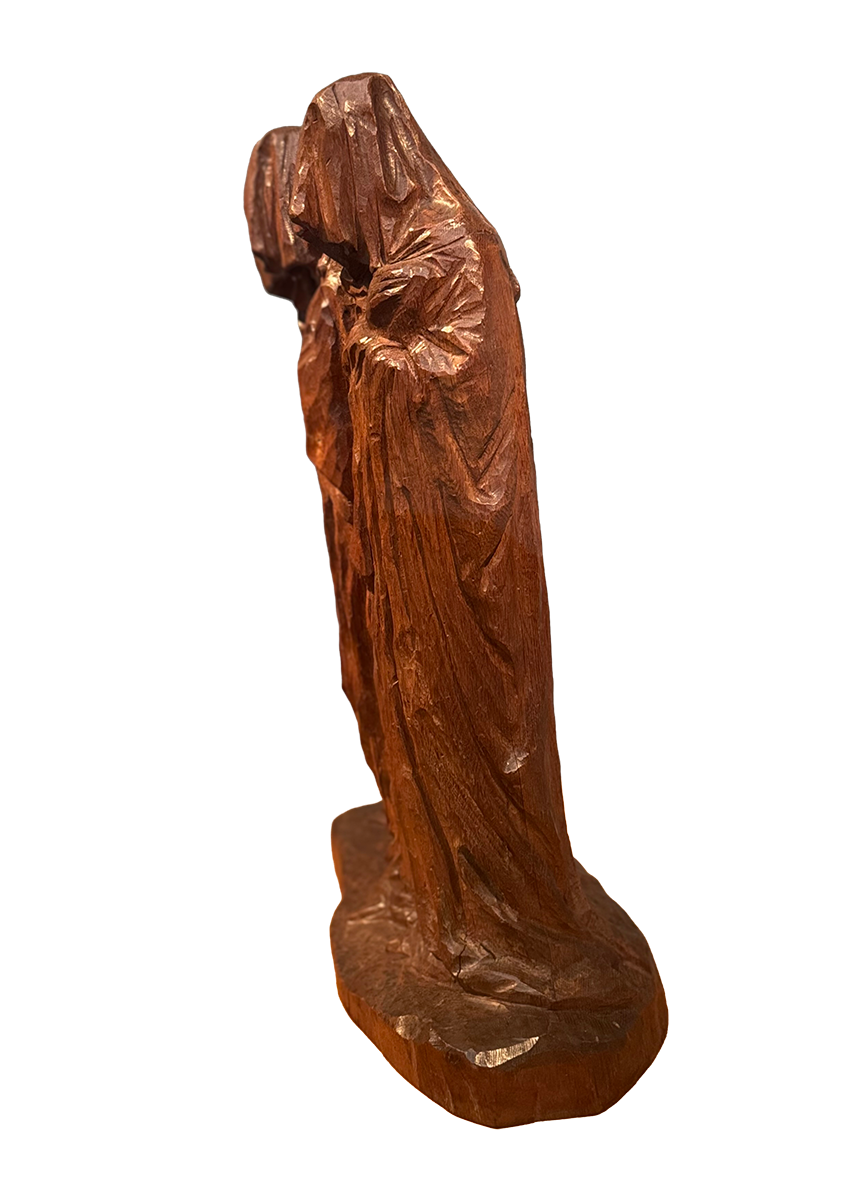
Seen from the side, the three women lean so far forward that they almost seem to lose their balance.
Minne thus belongs among the most compelling artists of the fin de siècle. Born in Ghent in 1866, he developed a visual language that opposed the naturalism of his time, which he considered too superficial.
Instead of external beauty, Minne sought a form for inner experience: pain, devotion, stillness. His oak sculpture Three Holy Women at the Tomb (1896) is a key work in his oeuvre, not least because very few of his sculptures carved in wood are known. He also carved a carpenter, so stylized that only the title reveals that this is a craftsman at work.
Contemporary of Jan Toorop
Minne was a contemporary of Jan Toorop (1858–1928), the Dutch painter who also depicted the inner world in his work, rich in symbolism and spirituality. Minne’s wooden sculpture was therefore included in the well-attended exhibition on Toorop at the Singer Museum in Laren in 2026, where I encountered it, to my surprise.
The sculpture could hardly form a sharper contrast with the pointillist paintings composed of colorful dots that hung in the same room. Although created in the same period, Minne’s work seemed almost that of a medieval artist lost in time.
I would have found his three women less striking in the very first gallery of the Rijksmuseum in Amsterdam. The sculpture aligns closely with the masterpieces of Southern Netherlandish masters such as the Master of Hakenover or the Master of Joachim and Anne.
Three Holy Women at the Tomb is part of the collection of Museum Boijmans Van Beuningen in Rotterdam.
Jan Bom, April 25, 2026