Boris Paval Conen and the lessons of the master carvers of Val Gardena. The Dutch woodcarver was given the unique opportunity to attend the Summer Academy in this Valhalla of woodcarving in South Tyrol, Italy. No more than 20 people are admitted each year, following a rigorous selection process. What did Conen take home from these ten intense days, apart from a beautiful sculpture of a girl in a hooded cape?
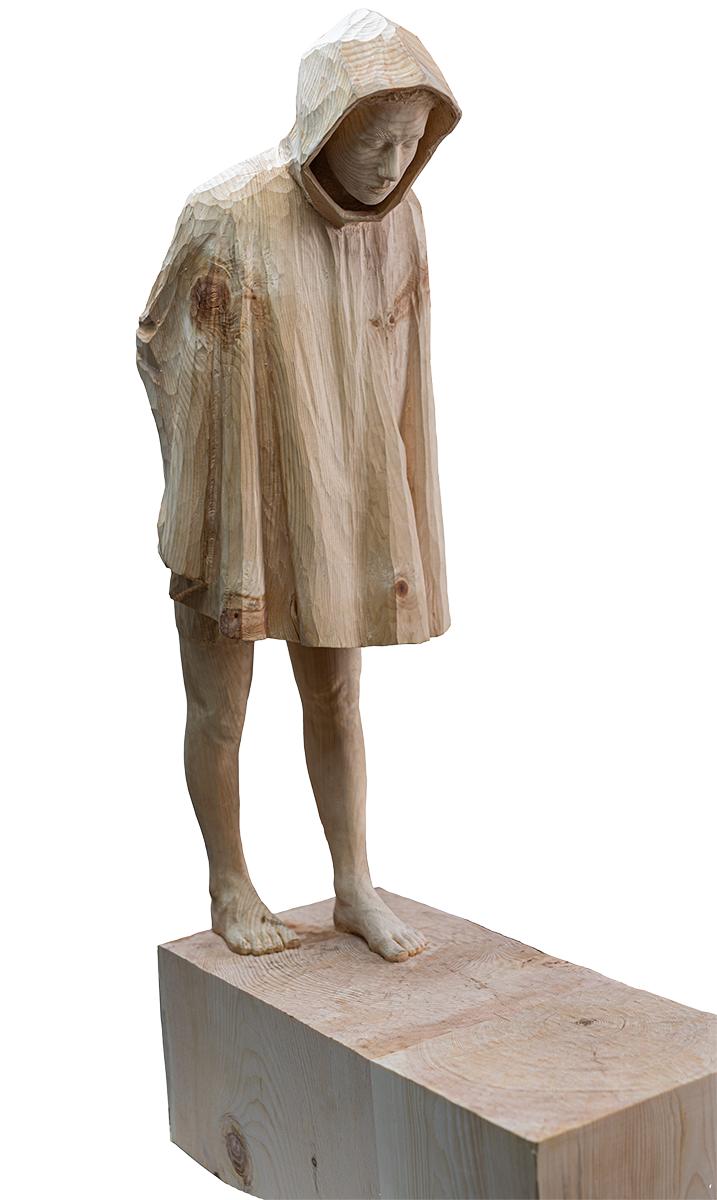
Boris Paval Conen and the lessons of the master carvers of Val Gardena: he carved the girl in the cape in ten days.
I give Conen’s sculpture (1968) five out of five stars. It stands there in his studio in the heart of Amsterdam, still smelling wonderfully fresh. The scent ofZirbelkiefer (Swiss stone pine) still lingers around it, the tree species that grows high in the Alps. This wood became the source of an ancient and still thriving woodcarving tradition.
Look at the delicate little face, hidden deep inside the hood, gazing down at the ground. Those tiny fingers and toes. So lifelike. A heel subtly protruding over the long plinth. The way the folds of her cape fall is fascinating. There is something magical about this sculpture. What is it?
All born in the same village
It could easily have been a work by one of the four master carvers themselves: Gehard, Aron and Peter Demetz, and Hermann Josef Runggaldier. Artists who broke through into the international art world with their figurative sculptures. And even more remarkably: all four come from the same village, St. Ulrich, or Ortisei, in the Val Gardena valley.
You could have been born in Val Gardena yourself.
“I wouldn’t have minded that. Definitely not.”
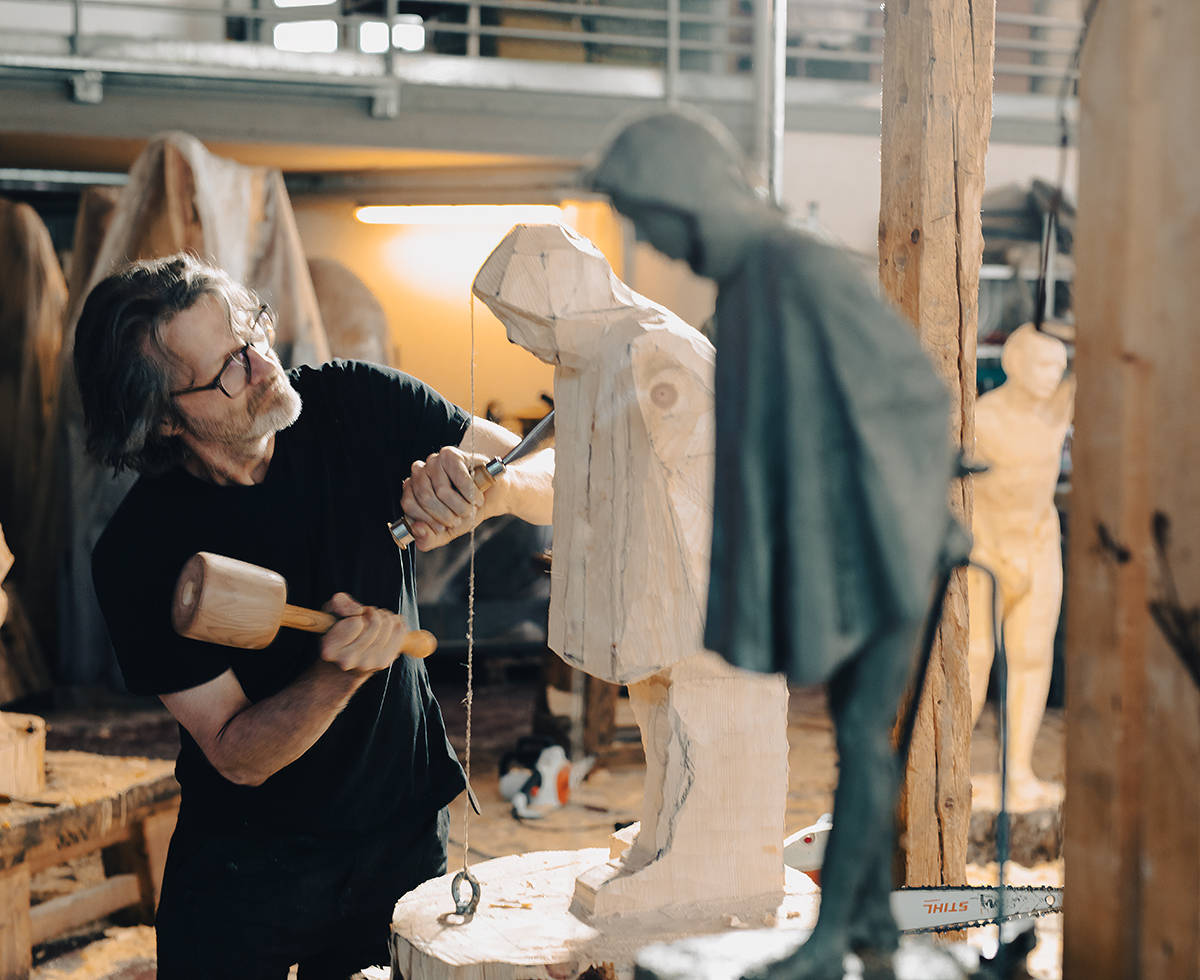
Boris Paval Conen at work during the first week of the Summer Academy in Val Gardena.
Conen did not go there unprepared. Many years ago, he took two sculpture seminars at the Academy of Art. “But that was during the period when figurative art was a dirty word. Everything had to be abstract. And I already had a strong preference for figurative art. So I immediately realised: this isn’t going to work.”
“Later, after I had also graduated from the Film Academy, I started working with stone at home. I took marble courses in Italy, in Carrara and Pietrasanta. It was a hobby alongside my work as a film director. Every year and a half or two years, I made a sculpture. I did that for twenty years. Something just for yourself. As a director, you’re a walking head that communicates and delegates. And then you miss working with your hands.”
From marble to wood
Moving to Amsterdam forced him to make a choice. No studio in the city would accept all the dust and noise involved in working with marble, using pneumatic hammers and angle grinders. Boris switched to wood.
You can make quite a lot of noise working with wood, too.
“There are eleven artists in this building. At first, they were a little nervous about having a sculptor move in. So I built a double floating floor with very good sound insulation. And I put acoustic panels on the walls. Now everyone is very happy with it.”
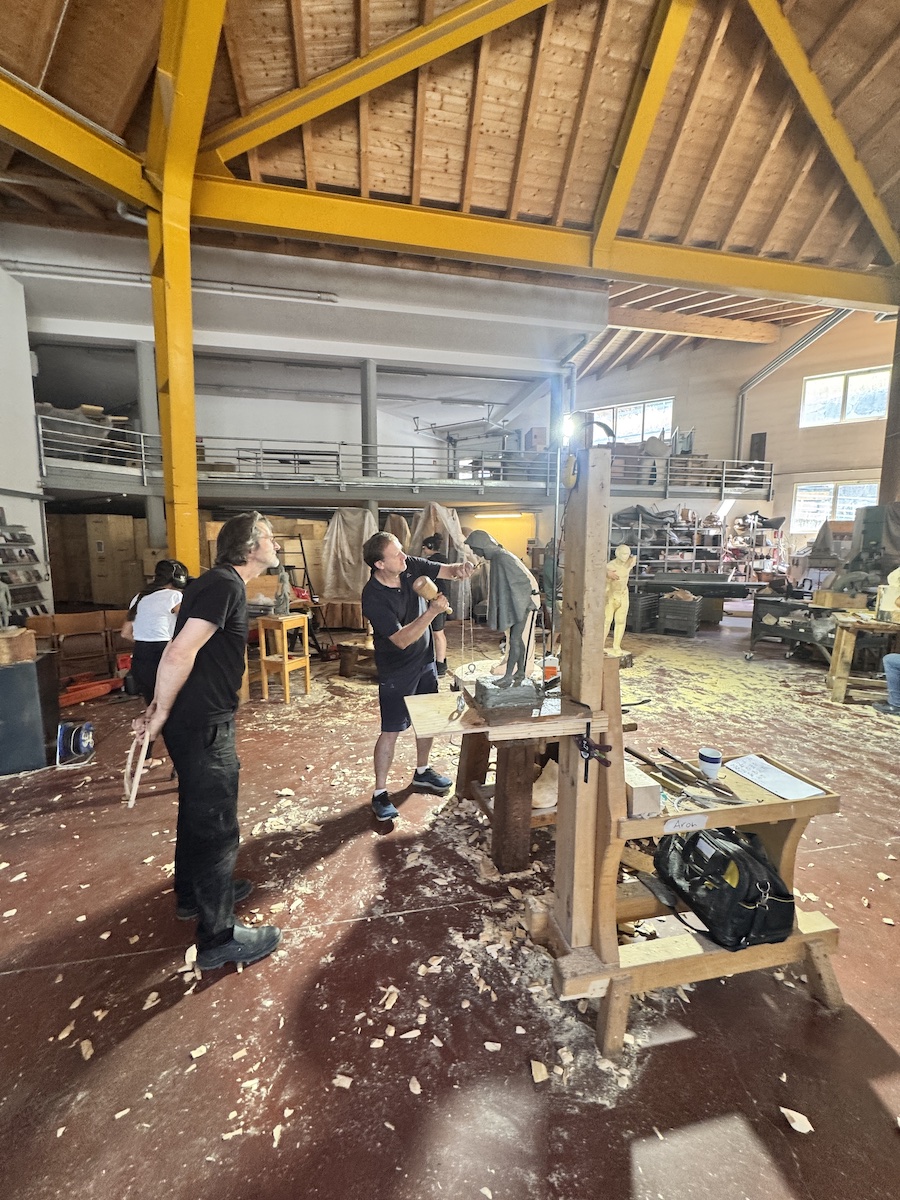
In the studio of Aron Demetz, under the guidance of master carvers who sometimes joined in.
Since then, he has made sculptures in wood, at a much faster pace than is possible with marble. He took his first woodcarving course with Bruno Walpoth, who was also born in Val Gardena. He incorporated something of this artist’s introspective quality into his own visual language. His figures are withdrawn into themselves, deep in thought.
“Walpoth teaches you, as it were, to look through his eyes. You dive into someone’s head. He is also extremely honest about his own insecurities, which I find remarkable. But with Walpoth I also realised: wow, there is still so much to learn.”
Strict selection
Recognition followed. An art gallery represents him. In 2023 and 2025, his sculptures were nominated for the Dutch Portrait Award. Exhibitions every year. And then his wife saw a call for applications for the Summer Academy.
“It came at exactly the right time. A film production with choreographer Jiří Kylián fell through. Suddenly I had a gap of a few months in my film work.”
The selection for the Summer Academy is rigorous.
“Very rigorous. It’s designed for young people. Not for oldies like me. So I was the oldest one there. That’s quite confronting, too. Sitting there among all those young, ambitious kids.”
You certainly don’t look old.
“No, but I am 58. And when the youngest participant is only 18 years old…”
They must have recognised the quality of your work.
“Yes. And apparently they also saw the potential that I might still have something to learn.”
What did you still wanted to learn from these master carvers?
“I sometimes thought: I would like to work more freely. Out of fantasy, without a model. To let it be more about what is in your head than what you see. At the same time, what I think is the danger is that when you go for what is in your head, a sculpture can quickly become very ‘deliberate’. You attach an opinion to it. I would like to learn to make sculptures out of a fascination with a posture, a look or a pose. You can’t quite put your finger on what it is yet. You may only see it once the sculpture is finished. Only then do you know what it means to you.”
You first had to make a figure in clay.
“There was supposed to be a model, but there wasn’t one. We had to spontaneously come up with our own figure and draw it first. That was stressful for me. I always work from models, which I photograph from four different angles. So I was making large sketches.
“And Aron said: Boris, instead of immediately committing yourself to a large sketch, try making little doodle figures first. Draw without taking the pencil off the paper. And he demonstrated a few. That way you can very quickly see: this pose is more what I’m looking for.”
“Gehard pointed out the importance of the plinth when I was working out the figure in clay. He was so frustrated with the way his sculptures were presented in galleries that he makes sure his sculptures already have a plinth. In my sculpture, that even became a theme, because the girl is looking at where the plinth ends.”
“And Peter said: everyone here is going to race to make a model as quickly as possible, so they can start carving as quickly as possible. But just take your time. But then you’ve already lost two days and you think, Jesus, I’ve only got ten. But that advice was incredibly valuable.”
So you learned by doing.
“There are two things I learned a lot from. One is the way they think in planes. They say, for example, you have a cloak around a figure. You should see it as a circle. That means that when you have a fold, it is never round. It is always made up of planes. If you have a rounded form, then nothing has been decided. That is the way they think. Whereas working in marble is very much about curves. They call those ‘sausages’ and ‘church bells’. In wood, you should avoid those.”
“Those planes create angles. You feel that there is a direction. It suddenly stops and goes in another direction. That is what makes a sculpture start to work. Tension emerges. It is a little bit of abstraction.”
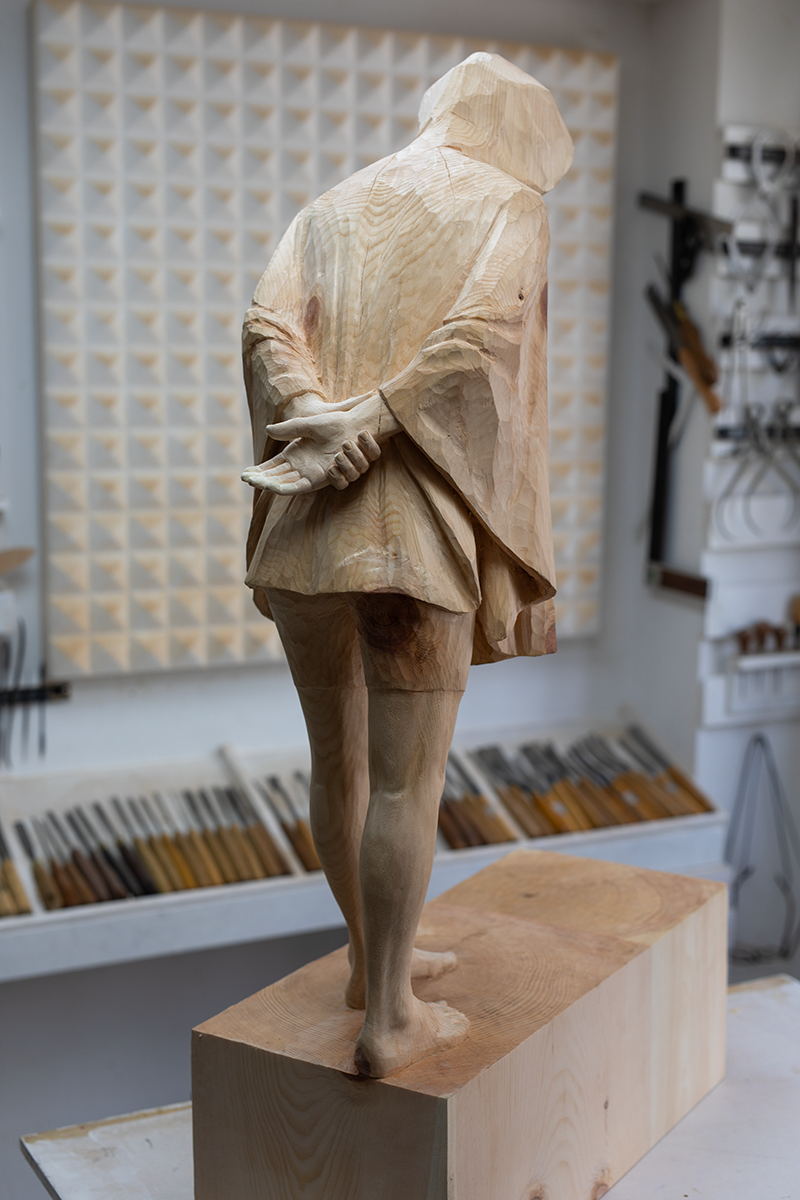
The sculpture seen from the back, with the hands behind the back.
I met Conen twice while he was working at the Summer Academy. The second time, after the weekend, I barely dared interrupt him, he was working so intensely. With a measuring stick, he walked back and forth between his sculpture and a notebook.
The reason for all this measuring?
“Proportions. Proportions. Dividing things into proportions. I learned that from them too. Normally, you divide the whole body into eighths. A figure is as long as eight heads. They don’t. They divide it into tenths. Ten heads. That is a different way of thinking. Why is that? From the hairline to the chin is one tenth. And the whole body is divided up in this way. From elbow to hand. That entire method is laid down in an old German book from 1915: Die Verhältnislehre (und plastische Anatomie des menschlichen Körpers für die Kunstjünger) by C. de W. Antonio. The width of a hand: also one tenth.”
The broadest, flattest gouge
An unexpected lesson also came from the choice of tools for carving.
“I used to mainly use very round gouges. With a round gouge, the wood doesn’t split as easily. Nice and easy. Now I learned: it’s better to use a much larger gouge that is almost flat (a number 2, jb), but rounded at the edges. The men themselves all work with an even flatter and larger gouge (a number 1, jb), so flat that it is almost a chisel. But they only put part of it into the wood. In a way, you peel the wood away like that. I ordered one, and I still have to put a handle on it. It cost almost a hundred euros. Incredibly expensive.”
Did you make any mistakes while making the sculpture?
“That was very confronting. At the end of the first week, Peter told me: leave the legs alone for now. Concentrate mainly on the poncho. But of course, you want to know what your sculpture is going to look like. So I did some more work on the legs anyway. The next day Peter said: you’ve taken away too much. And he was right. I had wanted to position one foot slightly inward. That was no longer possible, because the hip would then have to be much more twisted. I no longer had enough wood to make that work. I had to shift the whole sculpture within the space to compensate for that loss. The entire sculpture had to move a few centimetres backwards. Which created another problem at the back. I had to carve the fingertips into the sapwood. I literally had not a millimetre left.”
Trusting your eyes
And what was the lesson you learned?
“On the fourth day, Peter said to me: today you can still calculate, but tomorrow you have to start trusting your eyes. That was difficult for me; I always work very precisely.”
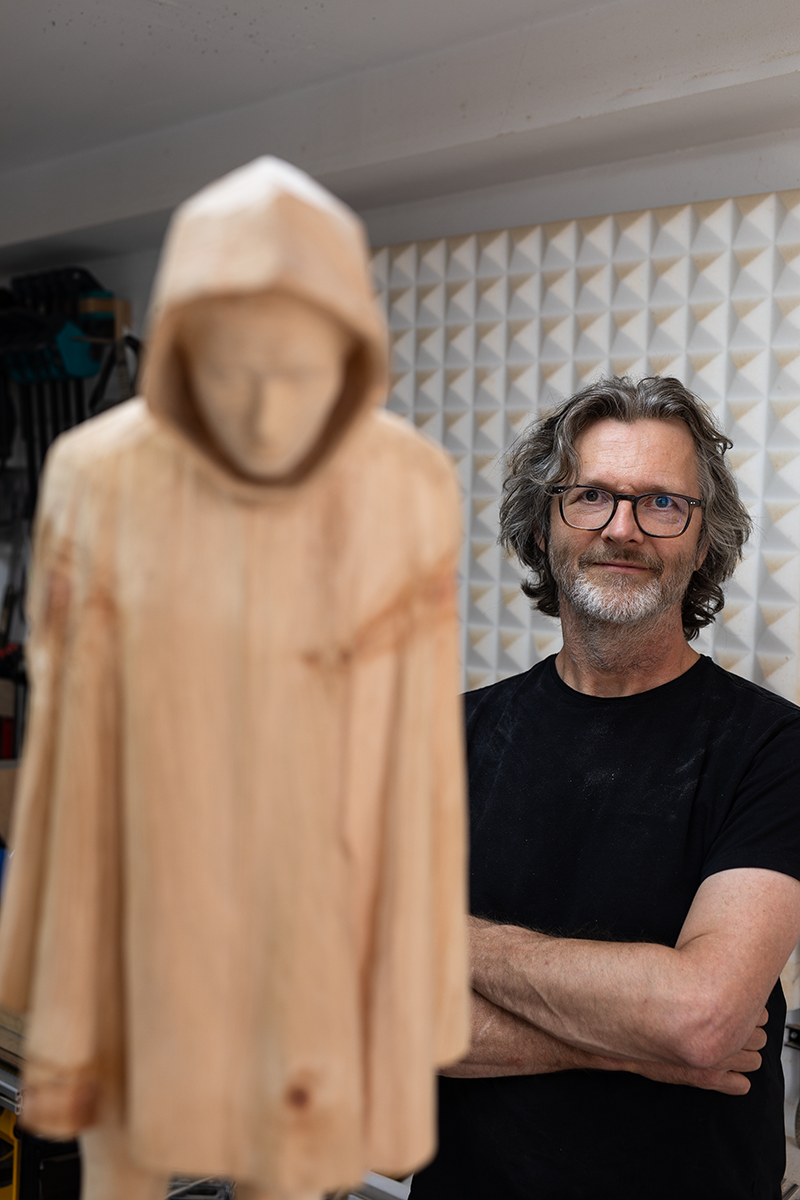
Conen in his studio in Amsterdam, with his study piece.
Your sculpture wasn’t completely finished after those ten days. Did you call Val Gardena afterwards with questions about finishing it?
“No, I know how that works. I feel sure enough not to contact them about this last fase. The Summer Academy is mainly about construction, the concept and the rough execution. But all that fine sanding and so on, I don’t find that particularly interesting either.”
You didn’t finish the sculpture with oil.
“I never do. If I put oil on it, that means the face, body and plinth will all take on the same tone. I find the differences in colour created by the carving more interesting.”
Didn’t you bring home more blocks of this particular wood?
“No, Zirbe isn’t the kind of wood that made me think: okay, I want to make many more sculptures from this. Those knots. I have worked a lot with ginkgo, which resembles limewood. It just takes colour much less. But limewood remains my favourite.”
Jan Bom, 26 August 2026.