The Idol of Samos is one of the few surviving wooden sculptures from classical antiquity. The figurine was carved around 650 BC in Greece. The painting or even the dressing of this ‘idol’ has perished over the centuries.
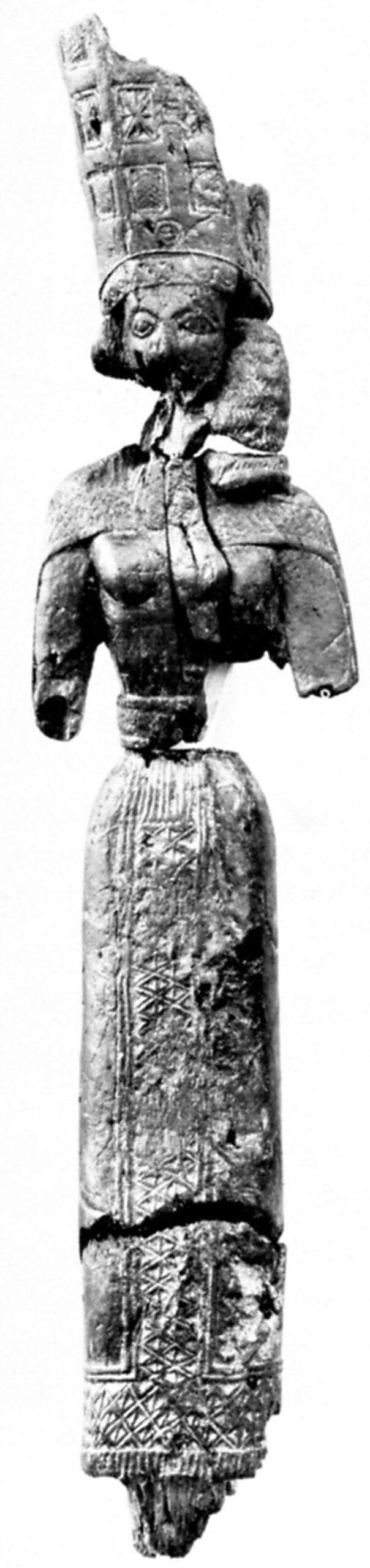
The Idol of Samos: was it the Greek goddess Hera?
Was the figurine of no more than 20 centimeters in height a depiction of the Greek goddess Hera, sister and wife of supreme god Zeus? No one dares to say. Was it even a woman? The figurine appears to have breasts, yet no historian dares to assign a sex to this idol.
From the available archaeological sources it appears that most of the earliest Greek idols were made of wood. The term that ancient authors already used in the 5th century BC for a sacred wooden image of a deity is xoanon (plural: xoana). The word is derived from a Greek verb meaning ‘to smooth or polish by scraping’.
Carved idol figurines
Certainly larger wooden sculptures were also made. Excavations at the Minoan sanctuary of Archanes on Crete have, based on the discovery of a pair of life-size terracotta feet, led to the theory that a large idol in this temple must have had a wooden body. Literary evidence also shows that the two earliest known xoana, the statue of Hera on Samos and the statue of Athena Polias in Athens, date from the beginning of the 8th century BC. These statues, however, are not carved from wood.
Ancient writers also state that xoana were simple, downright crude idols. Actually more chunks of carved wood. The quality of the surviving wooden figurine from Samos, however, does testify to the ability of the ancient Greeks to produce refined wood carving.
Idol of Samos preserved in swamp
Literary sources also tell that xoana were made from various types of wood, including olive wood, ebony, cypress, cedar, oak, yew, lotus wood and juniper. These include hard wood types that do not decay quickly.
Now Samos, which lies off the coast of Turkey, is certainly not a dry island in summer, but definitely not in winter either. That this idol has not rotted is because it was preserved sheltered in the temple complex for Hera, which was built between 538 and 522 BC. It is on the UNESCO World Heritage List. The temple and the figurine are therefore almost the same age. Archaeological sources mention many wood finds in this complex, preserved by water/marshy deposits in parts of the sanctuary.
Idols dressed as dolls
It may also be that the figurine had a protective layer of paint. The ancient Greeks did that painting to suggest clothing, shoes or jewelry, but only when fabric garments and real accessories were not available. Preferably xoana were dressed as if they were dolls.
A photo of the Idol of Samos can be found on the website of the Penn Museum in Philadelphia (United States). This museum names the temple complex Heraion as the find location, but this is not certain. Penn Museum has a connection with Samos through the modest Archaeological Museum of the island. Here many other artifacts can be found, including the 5 meter high ‘Kouros of Samos’. The Mediterranean department of the Penn Museum itself also houses a collection of finds from the region.
Not as old as the Shigir Idol
It would be nice if the Americans (or Greeks) would take a somewhat better photo of this unique wooden find. The only available black and white photo comes from an article from 1982! The importance of this find is underlined by mention -again with the same grainy photo- in the magnificent book Sculpture (From Antiquity to the Present Day) published by Taschen. It is still readily available at reasonable prices at second-hand bookshops like De Slegte.
To put things in perspective: this ‘idol’ of Samos seems very old at over 2,500 years. But the oldest surviving wooden sculpture of mankind is no less than 11,600 years old: the ‘Shigir Idol’.
Jan Bom, December 1, 2025