Gehard Demetz doubles faces. Especially those of children, who at a young age are forced to adopt existing role models as identity. A girl is presented with the attributes of the Virgin Mary, which function almost as a mask.
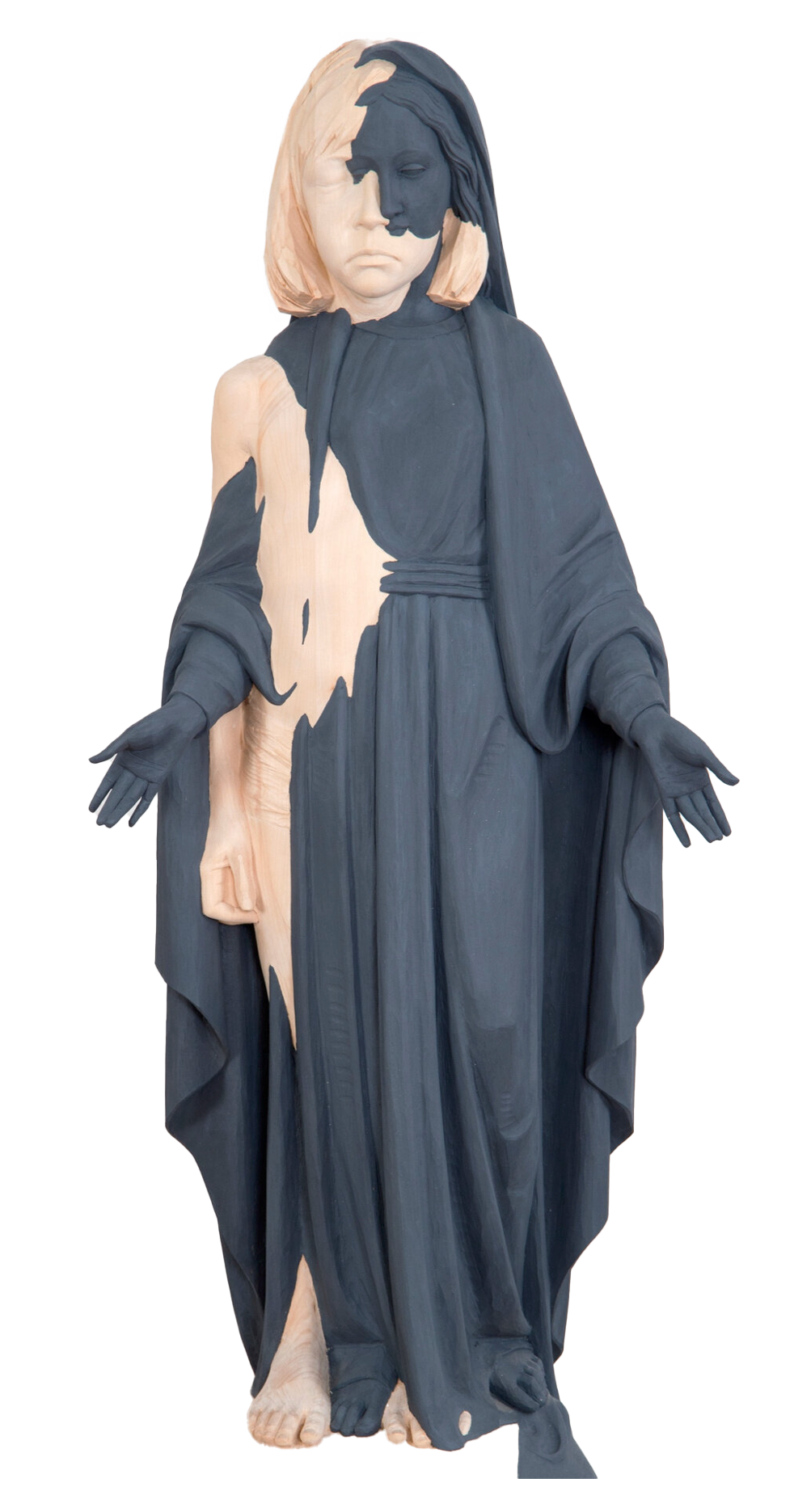
Gehard Demetz doubles faces, like this tearful girl who is presented with the Virgin Mary in the sculpture Miraculous Breath.
Gehard Demetz (1972) presented in 2017 in New York and Rome a striking series of wooden sculptures under the title Introjection. I find these works a fascinating exploration of psychology and identity. In what way do external influences become part of our inner self? Who are we really? What masks do we wear, unconsciously?
The term ‘introjection’ comes from psychoanalysis. It refers to the process whereby a person absorbs and internalizes behaviors, beliefs or attributes of others. Without realizing it, by the way. In this series Demetz visualizes how the ‘external’ — such as social norms, religious iconographies, cultural traditions or even individual experiences — become part of the psychological structure of the individual.
Faces overwritten
Demetz projects onto his characteristic wooden child figures objects and iconographies from both the profane and the sacred world. Some sculptures show children whose faces or heads merge with other elements.
This ‘doubling’ of faces can be seen as a metaphor for the way identity is always a composite reality. What we absorb from outside — belief systems, narratives, expectations — becomes part of how we see and show ourselves. The masks or merged faces show both coherence and tension between inner individuality and social influences.
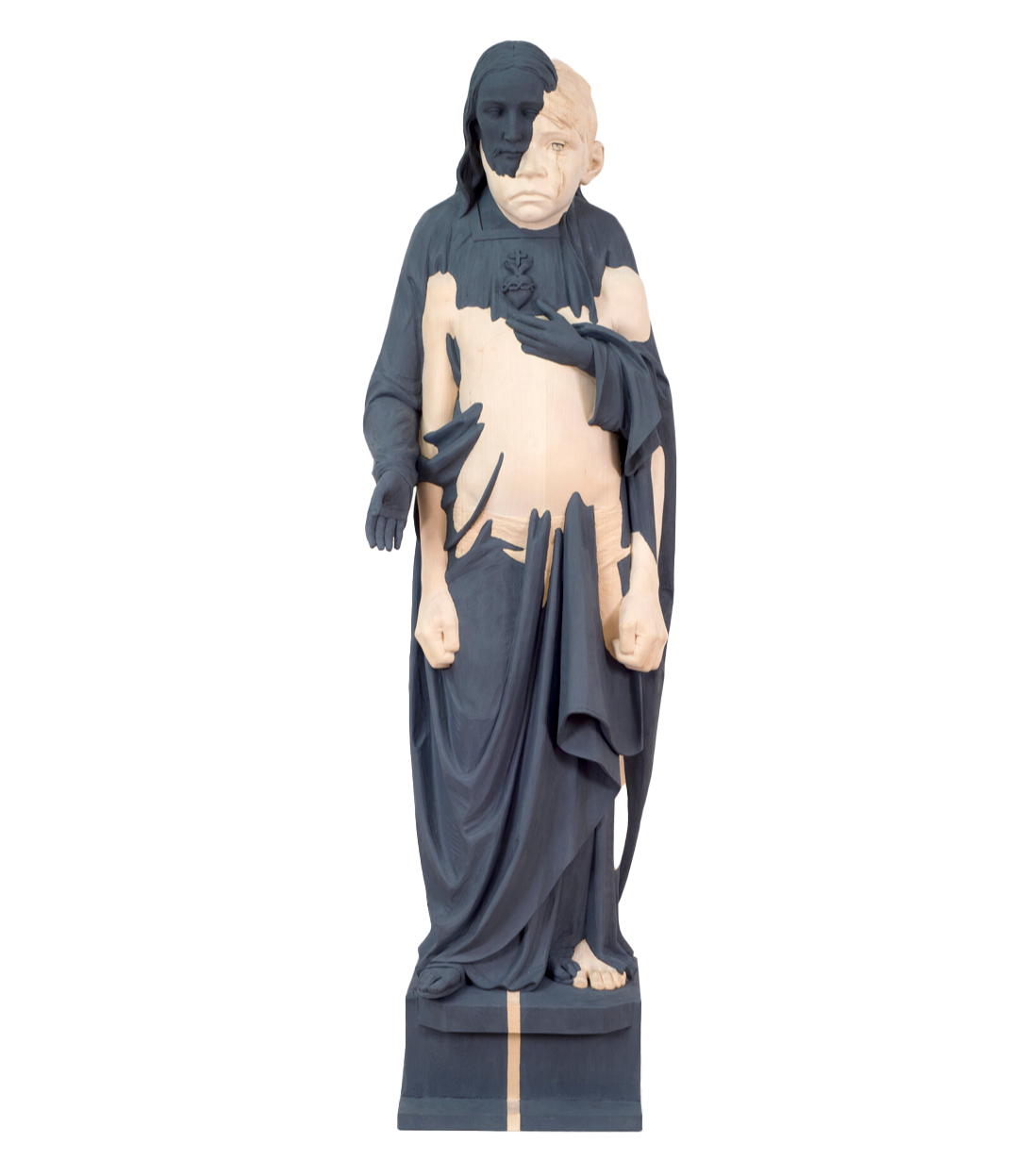
Gehard Demetz doubles faces of Jesus and a sad little boy, under the ironic title Life without Christmas.
By using the images of children — often life-sized, placed on pedestals so they stand eye to eye with adults — Demetz emphasizes that these processes start from an early age. The children seem to stand on the border between unfulfilled potential and early-learned beliefs. They are caught between their natural inner world and the world that shapes them. Identity is never pure.
With brilliant craftsmanship Demetz indicates that there is a constant movement between what we take over from others and what we are of ourselves. Look at the two large hands of the little boy. And the small hands of Jesus, who slowly wants to take possession of him. Look at those details, those four feet. You have to come from Val Gardena to be able to create such a deep story from the figurative. Incredibly good.
Teacher of Herrgottschnitzerei
Gehard Demetz was born in 1972 in Bolzano (Bozen), Italy. He lives and works in Selva di Val Gardena, a place in the Dolomites with a centuries-old tradition of religious wood carving art. He grew up within this cultural context and therefore followed training as a sculptor at a young age in ‘herrgottschnitzerei’, the traditional religious wood carving art of South Tyrol – a craft that he studied between 1986 and 1991 and in which he also taught for many years.
Demetz then broke through internationally as an artist, just like Bruno Walpoth, Willy Verginer, Gregor Prugger and his namesake Aron Demetz (no family relation), all also born in places in Val Gardena. The first artists in this list have largely completed their careers. They are sometimes approaching seventy years old. The fifty-somethings Aron and Gehard Demetz are still relatively ‘young’ compared to their predecessors.

My favorite sculptures by Gehard Demetz, from the series Introjection from 2017.
Over the years Demetz has gained international recognition with solo exhibitions in New York, Rome, Germany and elsewhere. His work has been exhibited in leading institutions and galleries, including the Jack Shainman Gallery in New York and the MACRO – Museo d’Arte Contemporanea in Rome.
Jan Bom, January 20, 2026