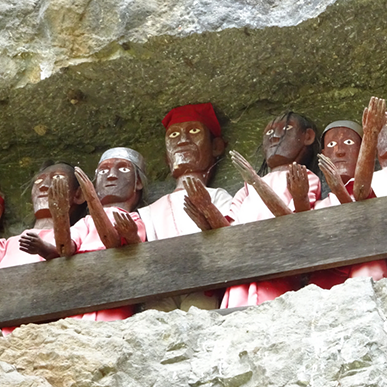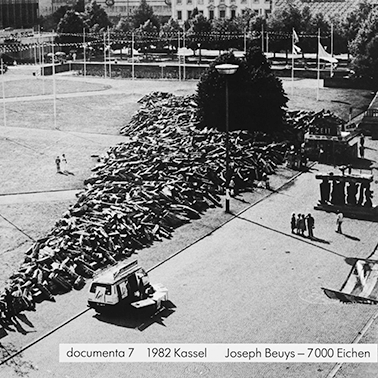
‘9000 BC: Domestication’, in other words: how humanity began living together with animals 9000 years before Christ. Sheep would have been domesticated first, then goats and dogs. That message is hidden in this elm wood sculpture, in which a hand symbolically pushes aside the curtain.
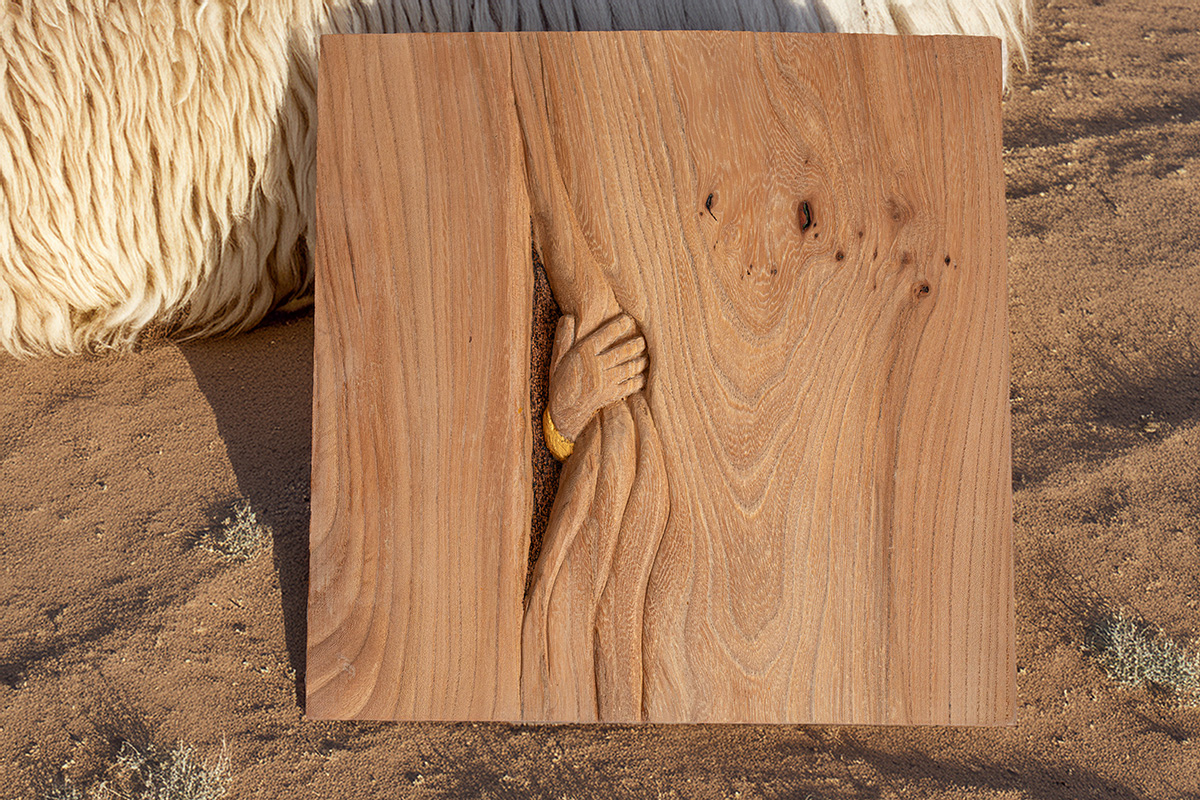
9000 BC Domestication (background of sheep in desert generated in Photoshop AI)
This human intervention has become an image that has had enormous consequences, to this day. Even for the well-being of the entire planet. To feed all those cows and pigs and sheep and goats, far too many forests are being cut down.
Elm wood has a beautiful, wild grain. Especially when there are still some knots in the surface, you can see hidden figures in it.
Stream of reactions on Facebook
When the sculpture was ready, I posted a call on Facebook without mentioning the title asking for comments. What are your associations? Within a few days I received more than 70 reactions and ‘likes’ on this post.
There were some very funny ones. I found this one particularly witty: ‘The last act: have many already left?’
I also received some beautiful ones to ponder. ‘Nature comes before mankind’. And: ‘The hidden holds on: wood’.
I myself saw a sheep or ram in the knot, but my Facebook friends discovered quite different animals in it. A deer or a little fox, for example. Or even this: ‘I think the spirit looks more like a giraffe looking into the water, where ripples have formed. Maybe because it has just drunk water.’
An image of transition
My idea of ‘domestication’ got a more general meaning in another reaction; that of transition. A friend wrote: ‘This seems to me the beginning of what will happen in the new year. It means renewal, letting go of the old’.
All in all beautiful discoveries. And wonderful what a plank of wild elm wood can evoke in creativity. It was not for nothing the most favorite wood species of the British artist Henry Moore, and even defining for his style. For me this response is a confirmation that I should continue to explore this path.
Let me therefore call it ‘Dendroism’: the art expression where the grain of the wood or the shape of a tree is the basis for the artwork.
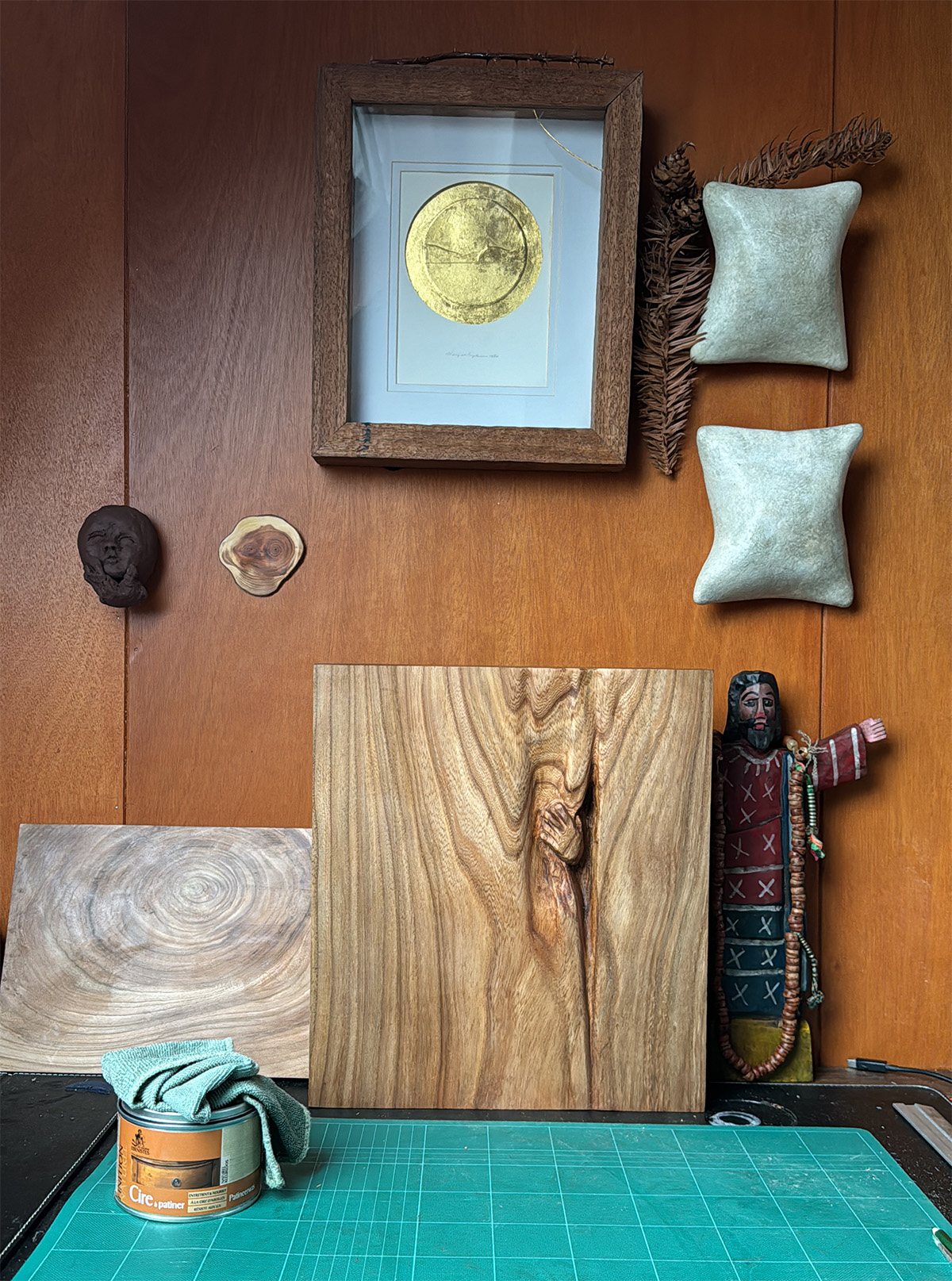
‘Stage Fright’, a preliminary study of a hand behind a theater curtain.
P.S. This work has an earlier version, a preliminary study. The hand is mirrored in it, to make the ‘theater curtain’ stand out better. In this piece of elm wood (from the same tree, felled in Utrecht due to Dutch elm disease) no double meaning is hidden. The title is therefore much easier to guess than that of ‘9000 BC: Domestication’. The preliminary study is simply called: ‘Stage Fright’. I suffered from it, in the years when I organized conferences on sustainable business and had to address a full room, certainly in the beginning. ‘Stage Fright’ hangs in my daughter and son-in-law’s living room.