Holy Shell is the name of a wooden sculpture that I made on request. The shape is based on the prayer shell that is a symbol of happiness for Tibetan monks.
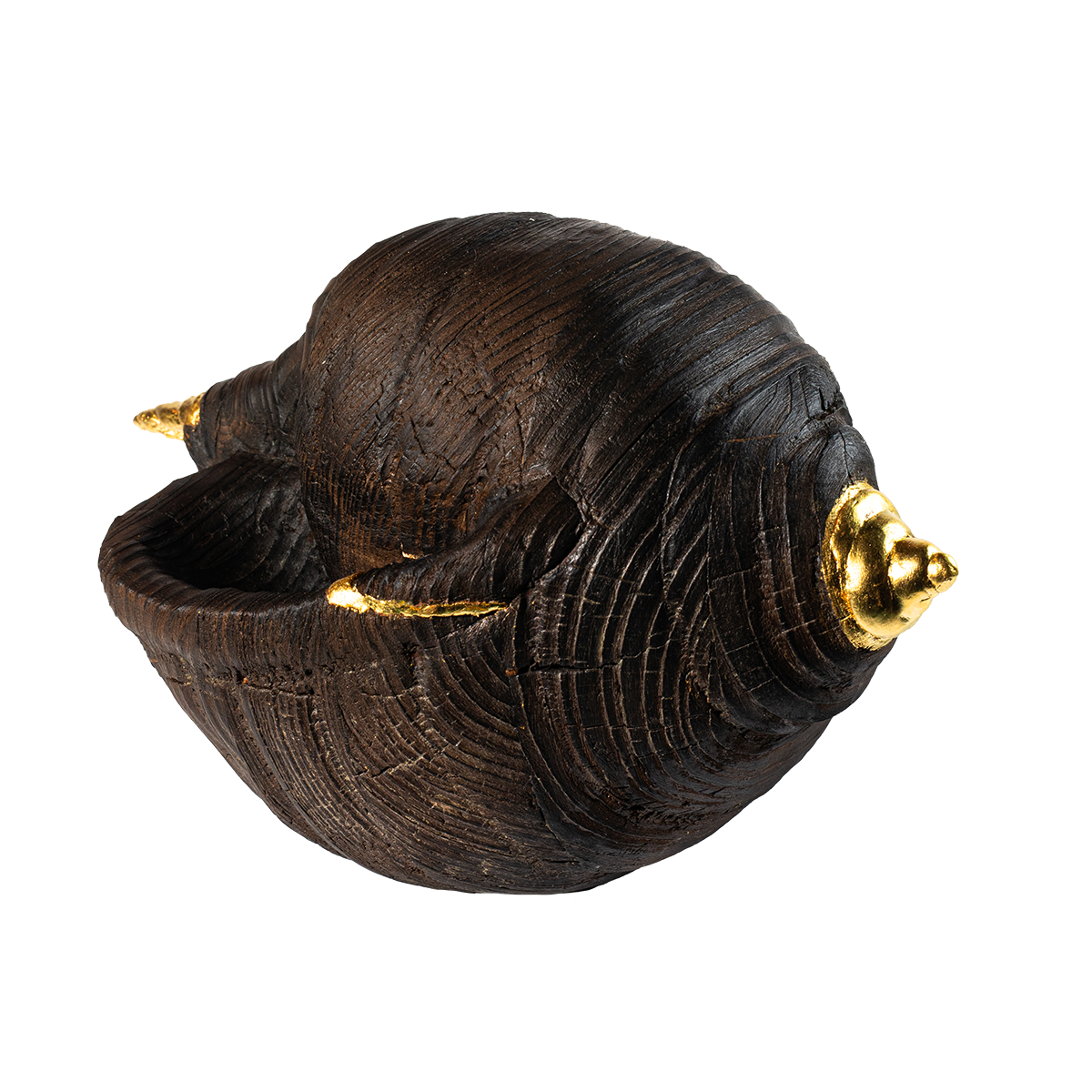
Holy Shell, made of cross laminated timber from industrial wood construction.
Holy Shell is based on an original ‘Tonna Sulcosa’ and made at the request of camerawoman Tijn van Neerven. Long ago these shells were brought from the Indian Ocean, along ancient trade routes over the Himalayas, to the Tibetan plateau.
Tijn saw my sculpture ‘Burning Ballerina’ hanging at our home, with her wide ballet dress of dark burned ‘cross laminated timber (CLT)’. Rugged yet very smooth in pattern, with striking annual rings.
Holy Shell as inspiration
A day later she called. “I was searching the internet for a shell for my collection. Suddenly I thought: Jan! Could you make a shell from that wood? With a golden tip?”
That was quite a request. Shells are perfectly designed housings for mollusks and crustaceans. They have been a source of inspiration for the development of the Golden Ratio, which unconsciously evokes a feeling of satisfaction and balance. I searched for examples on the internet and found beautiful, slightly oval-shaped shells, which are found in the Indian Ocean and South China Sea, such as the ‘Tonna Sulcosa’.

Ritual shell decorated by Tibetan monks (ca. 1750-1850), now in the possession of the Seattle Art Museum.
‘Yes, those! I like lobbed shells the most’, Tijn responded enthusiastically, when I asked if she meant these shells, which are convex and oval-shaped, with two tips. The opening consists of a wide cavity, spacious enough for the housing of a hermit crab. And she enthusiastically sent me photos that same day of these shells as they had been decorated by Tibetan monks, adorned with silver or copper and pieces of coral. These so-called ‘holy shells’ or ‘shankha’ had a deeply symbolic role in their rituals. The shell is one of the eight luck symbols (‘Ashtamangala’) in Tibetan Buddhism. It was also used as a wind instrument during rituals (the ‘dung-kar’) and as a sacrificial object.
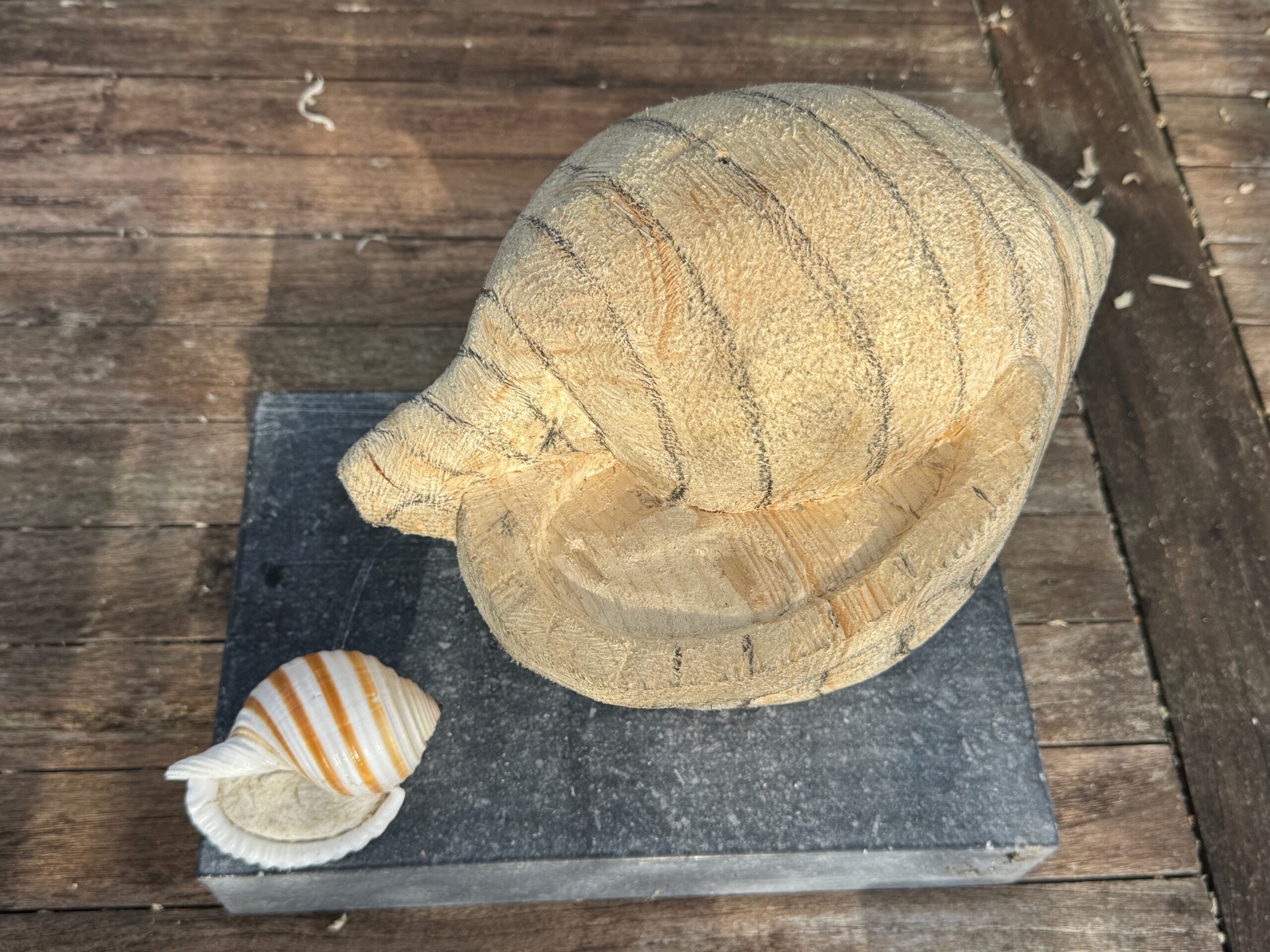
Holy Shell, carved in wood following the example of a real 9 centimeter shell.
Beautiful story. But what a challenge. Could I even make that cavity for the crab in that spruce wood? Such a thin wooden wall cracks immediately. If not from the tension in the wood itself during the hollowing out with a gouge, then afterwards from burning with the gas torch.
In any case I had to make the sculpture more than twice as large as the 9 centimeter long shell, which I could acquire from a collector on Marktplaats. You can never replicate such a perfect shape without a ‘real’ specimen as an example. When I tried to record the perfectly curved shapes with a caliper, I was amazed again and again at Mother Nature’s brilliant design capabilities.
Swirling ball of fire
Holy Shit! How do I make such a Holy Shell? We strive for perfection but know that we will never achieve it. And fortunately so. Perfect bodies carved from marble are so boring. Only when things are just not right do the brains start to spark, to correct. Through that tension something happens. You look again. And again. Real art is the art of imperfection. And fortunate coincidence.
Processing spruce wood with the gas torch is spectacular: the shell transforms into a swirling ball of fire. When cooled, a smoking block of firewood remains. What could be hiding under that shiny black? Professional face mask on. Start sanding, with a soft copper brush. And hope it will look like a weathered chalet in the Alps; dark brown burned by sun, snow, frost, rain and the years. I still think back with nostalgia to the way these planks were processed in Villa Calluna in South Tyrol.

Under the charred top layer of the Holy Shell hides a magnificent landscape; the raised annual rings look just like little waves.
Under the charred package lurk disappointments and surprises. A few too many cracks in the end grain of the wood. The thick rim of the shell had still burst in one place from the heat. Good for a golden edge of Japanese repair art: Kintsugi.
A bit smoky, still
Fortunately, a beautifully undulating surface of annual rings emerged on the top and bottom of the sculpture. Almost a calm sea, with rippling waves. After the first processing I hollowed out the ‘living space’ of the shell a bit more, giving the sculpture more depth and power. Burn very lightly again… No cracks, this time!
With moldable epoxy I sharpened the tips of the shell again, which had been too flattened by the fire. Perfect spots to gild nicely with 24 carat gold leaf. Nice French polish wax over the wood. After a day of polishing to a shine. Done.
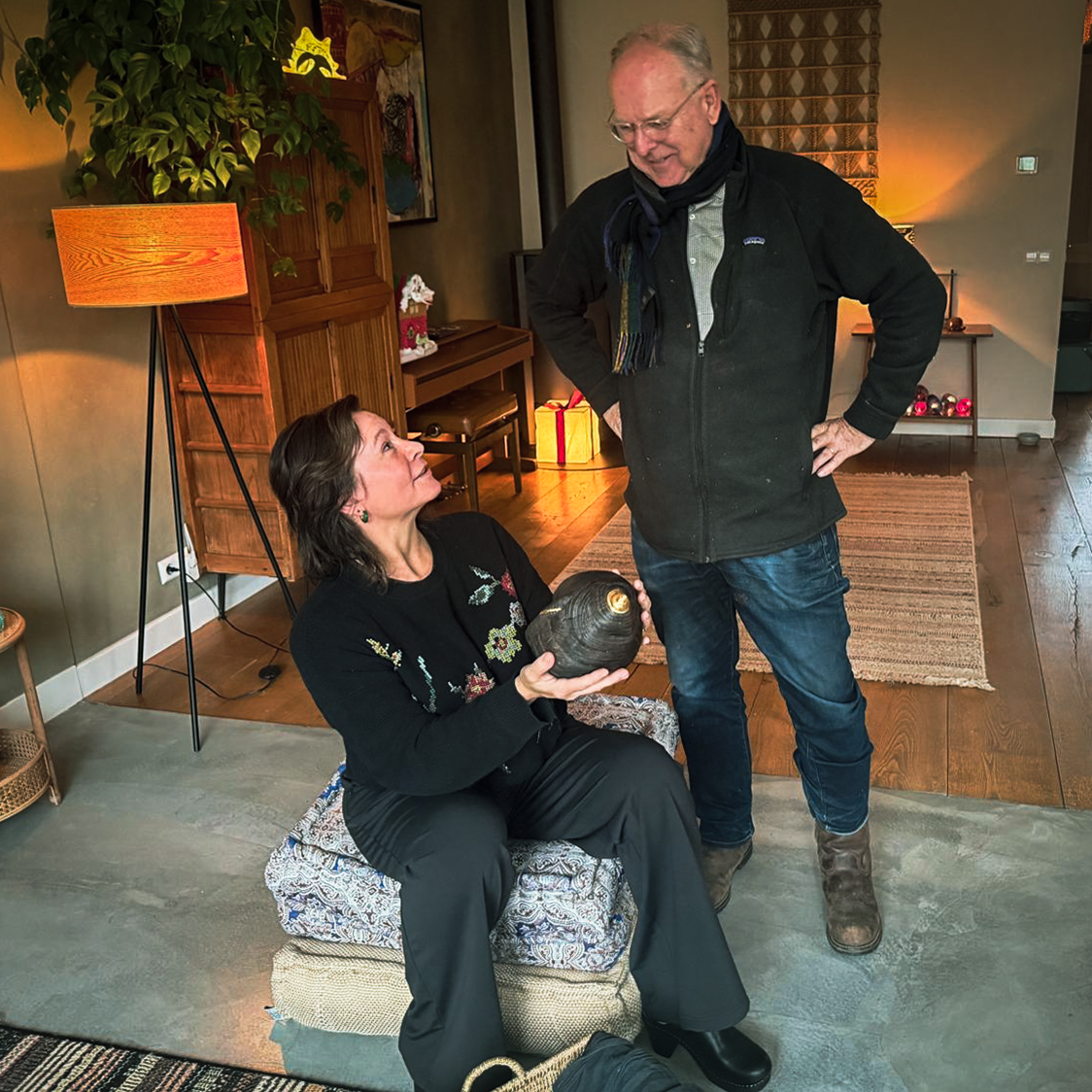
Holy Shell delivered to camerawoman Tijn van Neerven, for the living room.
Tijn was happy with it. She stroked the rounded annual rings of her Holy Shell for a long time with her hands. “It still smells a bit smoky,” she said. And that was true. It should only have been the smell of incense…
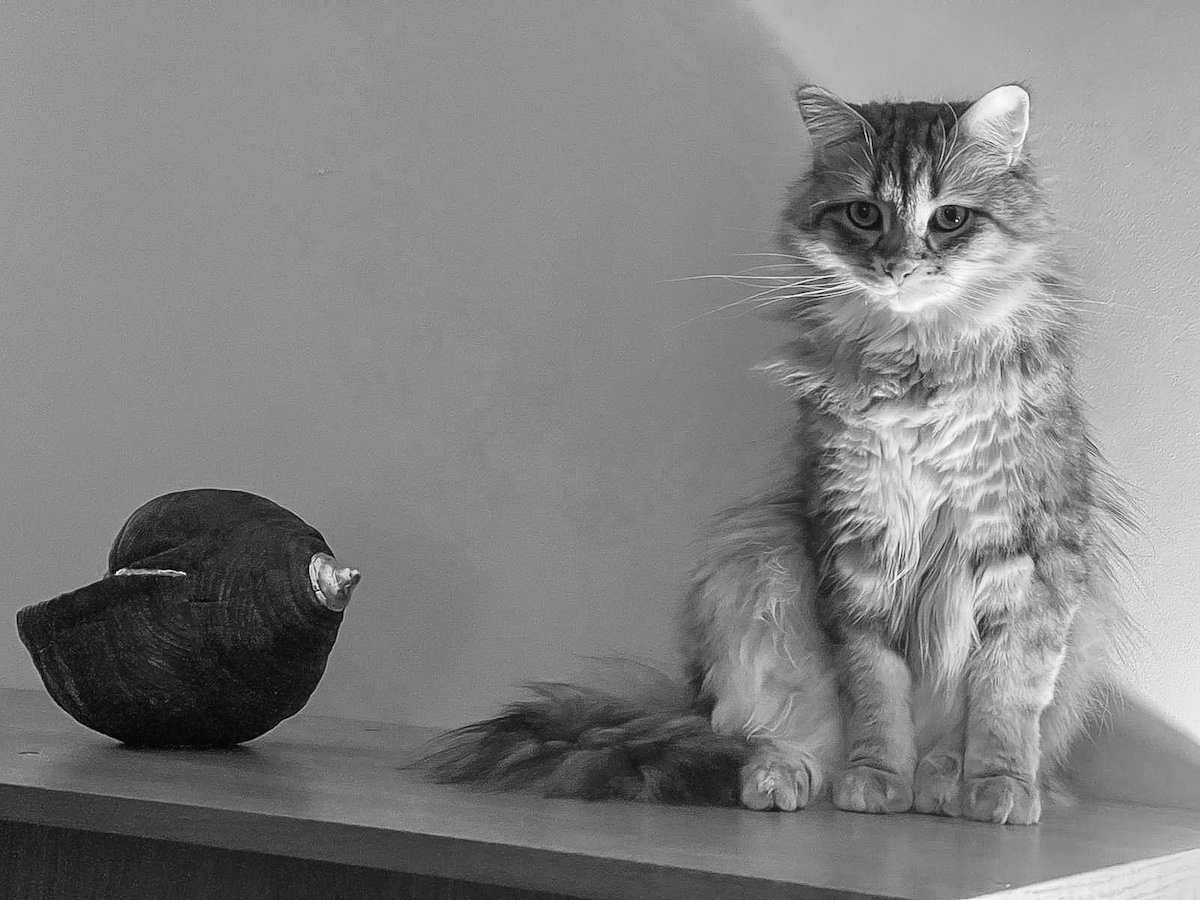
Jan Bom, November 25, 2025 (at the end of December 2025 Tijn sent this photo of one of her cats with my Holy Shell).