Wind ripples. Ripples, in English. The sea creates them on the beach when the water retreats at low tide. The wind creates them in the drifting sand in the dunes.
On a very windy day on the beach of IJmuiden I saw how they formed. In the middle of the drifting sand I tried to change the structure of the ripples. I drew the contours of a classical eye on the high slope of the ripple, as a wood carver would carve it. Such an eye can form quite spontaneously underwater, when there is a slight wave motion and people unknowingly break the fixed pattern by walking over the sand. On the beach my plan existed only for a very short time. The wind with the drifting sand very quickly returned the ripples to a more natural form. I watched the drawn eye disappear before my own eyes.
Unreachable dunes
Wind ripples also evoke memories for me, of the wide beach near Haamstede, at dune crossing Verklikkerpad. When the sea retreats, an enormous sandy plain forms there. Warning signs tell tourists: Be careful! Yet people regularly end up in mortal danger, surprised by the incoming tide, which quickly fills hidden channels, after which the safe dunes suddenly become unreachable.
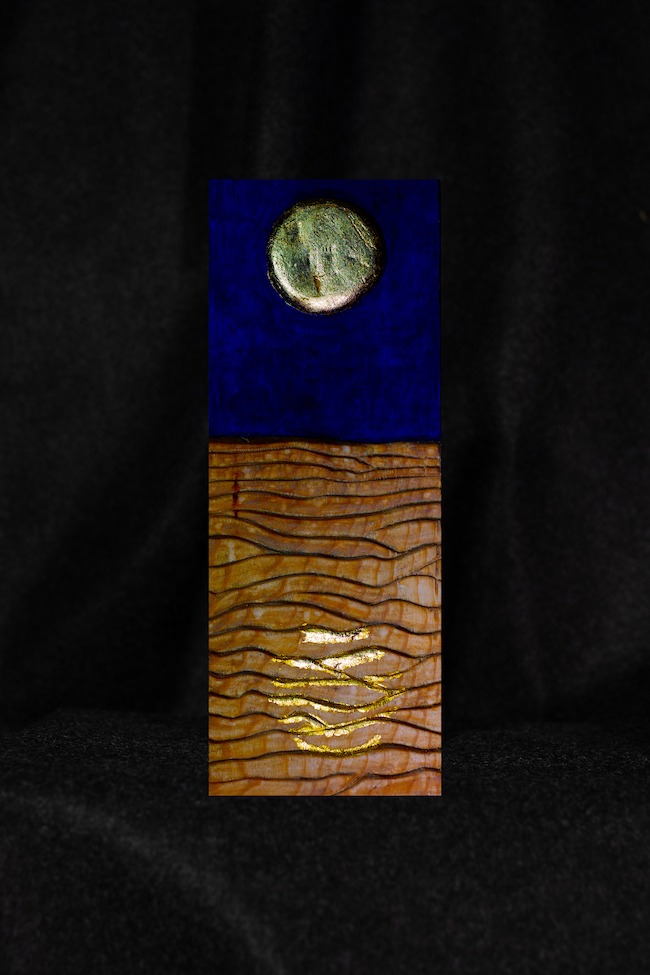
I thought for a long time about whether I could carve that pattern of ripples in lime wood. It turned out to be easier than I had thought – or maybe I had studied it long enough. I chose a somewhat wild, irregular shape, which you sometimes encounter. I wanted to subtly incorporate that ‘sand eye’, on the side, as a hidden layer that most people will miss.
Moonlight in the wet sand
Later I will carve a more regular structure of sand ripples on a large scale, perhaps in oak wood. Again with a full moon, reflected in the wet sand? Perhaps. It is especially important that this sculpture hangs beautifully in the sunlight, both for the shadow effect of the sand ripples and for the gleam of the gold leaf layer.