The Willow Crown is a crown of gnarled willow wood. It gives my princess something mythical. Deep shrinkage cracks in the bust create a dramatic effect. With her ‘blonde bob’ hairstyle as a helmet she stares into the distance.
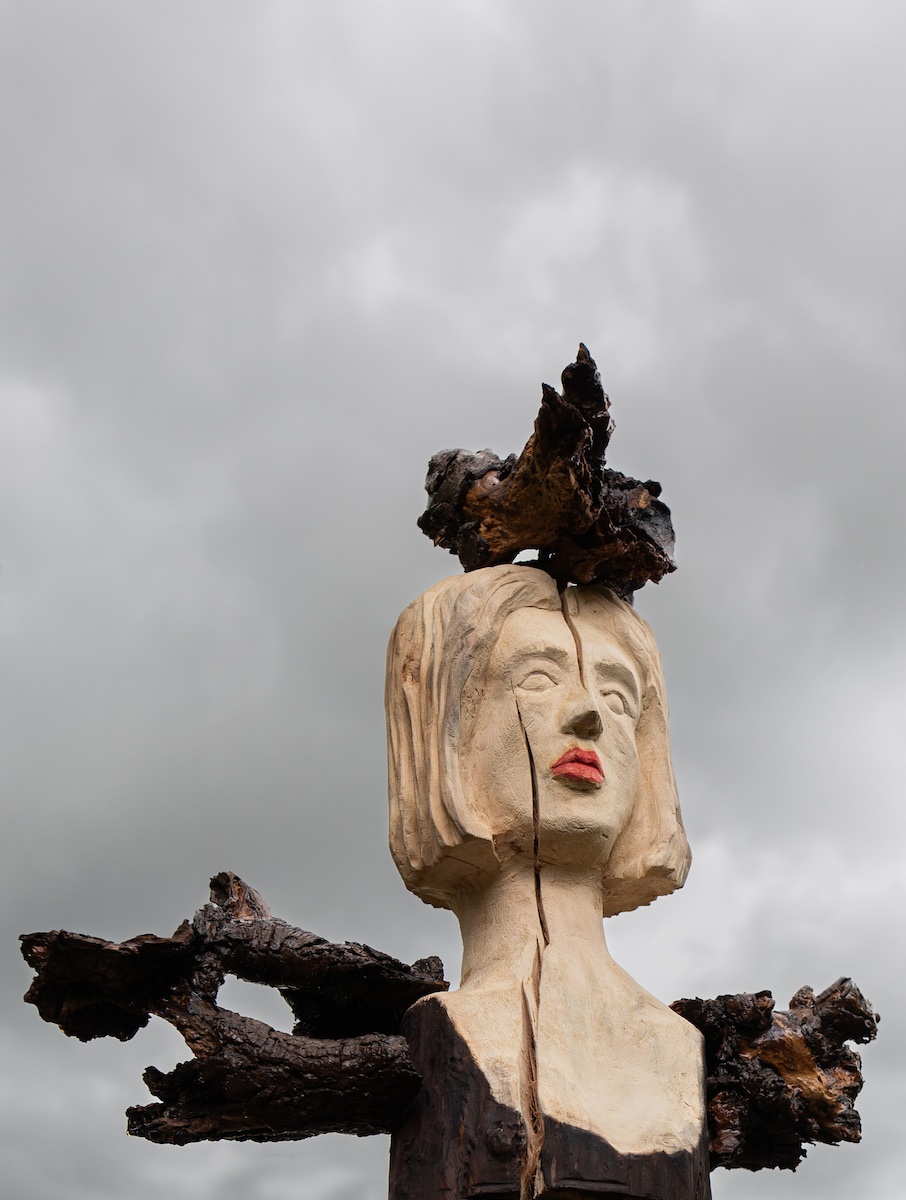
The Willow Crown, carved from a sugar maple trunk, with attachments of preserved willow wood.
Completely rotten. That’s how I found the pieces of wood about a year ago, broken off from a pollard willow during pruning. I could push a hole into the decayed pieces with my thumb. But they were so beautiful in shape. Round and sharp at the same time. Hard and soft. Light and dark. Smooth and rough. I picked up the pollard willow heads very carefully and left them to dry in the shed.
Eco-friendly epoxy
This spring I blew off the dust and started the experiment. With eco-friendly epoxy I painted a sealing layer. The plastic also penetrated deep into the surface, also into the many holes that woodworms had drilled. After a good day of drying the delicate willow stumps had transformed into rock-hard, shiny objects. In one of them I saw the shape of a crown. In the other the opened jaws of a wolf. Now I still had to carve a head underneath.
On the estate Oud Zandbergen in Huis ter Heide a tree falls now and then due to disease, old age, or a storm. Always a pity, but new trees take their place again. The wood carvers’ association Guts en Klopper, which rents a studio on the estate, may select ‘harvested’ wood for their own use. Thus a substantial sugar maple trunk became available, the tree from which Canadians tap their famous maple syrup in spring.
Blonde bob
To stay in the mythological atmosphere, I chose as an example a young woman with a blonde bob, the trendy hairstyle that most resembles a historical helmet. The advantage of still wet wood: it carves very easily. The disadvantage: the fresh wood is far from finished working.
In the heyday of wood carving, craftsmen knew exactly what to do with too fresh oak wood. When there was no time to let the felled tree dry for many years, they sawed the trunk lengthwise into two pieces. And also hollowed out the wood extra at the back of their sculpture. This way they prevented their sculptures from splitting. And they kept their customers satisfied, in those days mainly churches.
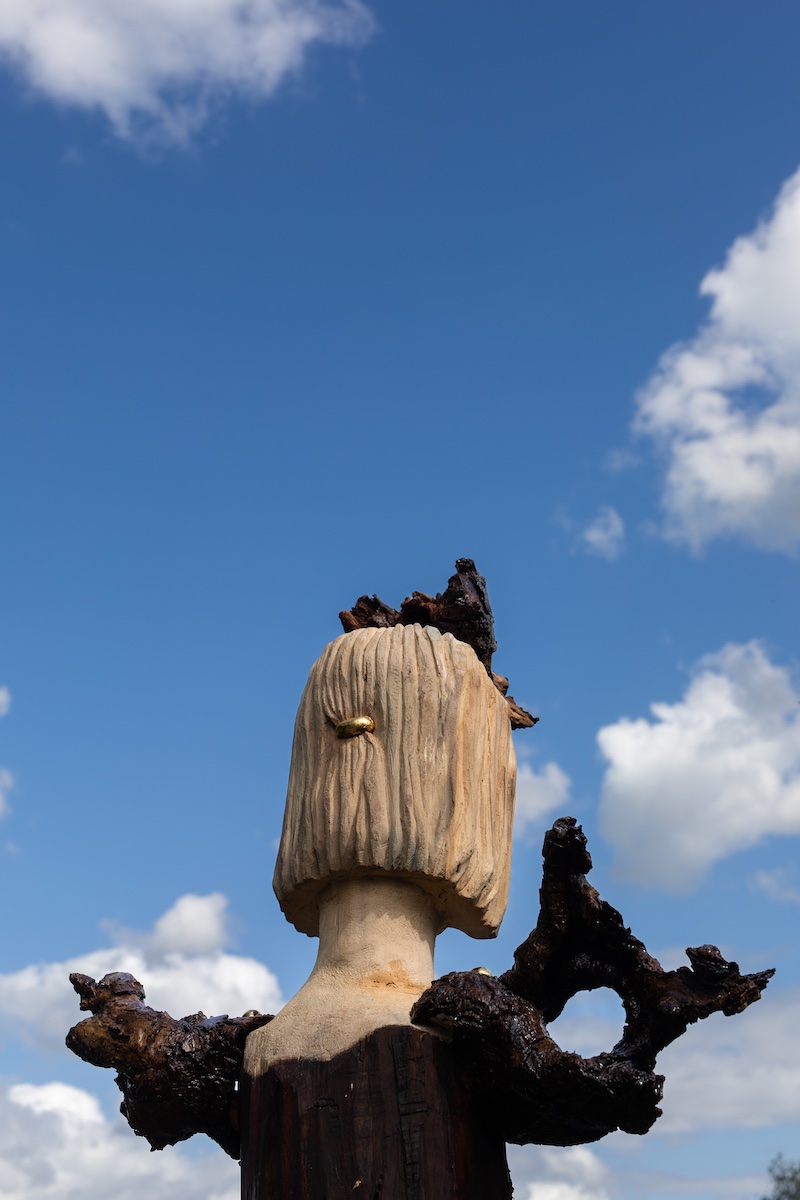
The Willow Crown. The back of the sculpture with blonde bob hairstyle and ponytail.
The British artist Henry Moore, who wanted to use the complete elm trunk for his reclining figures, found another solution. He made sufficiently large hollows in the wood, creating even drying without shrinkage cracks. Those large holes partly determined his characteristic style.
The other extreme is David Nash, who with sturdy wooden pegs constructed precisely a box of wet oak planks. Through drying and shrinking enormous cracks appeared in the wood in the following years. Nash was precisely after that; he made nature a co-creator, a fellow artist.
I myself didn’t have to wait years. Already after carving out the little head enormous cracks appeared from both the bottom and top of the trunk, which went straight through the face. Every week that I came to the studio, the cracks had deepened further. “Pack the sculpture in a plastic garbage bag, that slows down the splitting”, advised one of my fellow wood carvers.
Split personality
But I started to appreciate the two shrinkage cracks more and more. Wasn’t this precisely what I was after; following the stories that nature itself tells in the wood? Wasn’t I busy collecting numerous examples of this for my book about ‘Dendroism’? Shouldn’t I better count myself lucky with this unexpected gift?
I left out the plastic bag. But did hope that the tip of the crack, which had now reached halfway up her sharp little nose, wouldn’t continue to her mouth. I drilled ‘ventilation holes’ both in the head and in the base of the bust, as an extra possibility to let moisture evaporate from inside the trunk.
Nature gave the sculpture an extra dramatic dimension unsolicited. “Split personality?”, my wife asked dryly, when I lugged my little princess up the stairs. I gave her one more sealing layer of ‘invisible oil‘ on a water base, also used to finish wooden floors.
Staring into the distance
With long screws I finally attached the willow knots on her head and on her shoulders, like epaulettes. Removable, to make the sculpture less vulnerable during transport. With gilded heads on the long iron pins.
The Willow Crown. There she was. And yesterday, with the arrival of the first grey rain clouds after the record-dry spring of 2025, she posed for me in the garden, staring into the distance. Deep in thought, as the wooden sculptures of Stephan Balkenhol also always have their own thoughts.
Jan Bom, May 23, 2025
Again with thanks to Tom Ligthart, for thinking along and apt remarks.