Whale watching is an unforgettable experience. I still remember how gracefully those giant humpback whales dived, off the coast of Nova Scotia in Canada.
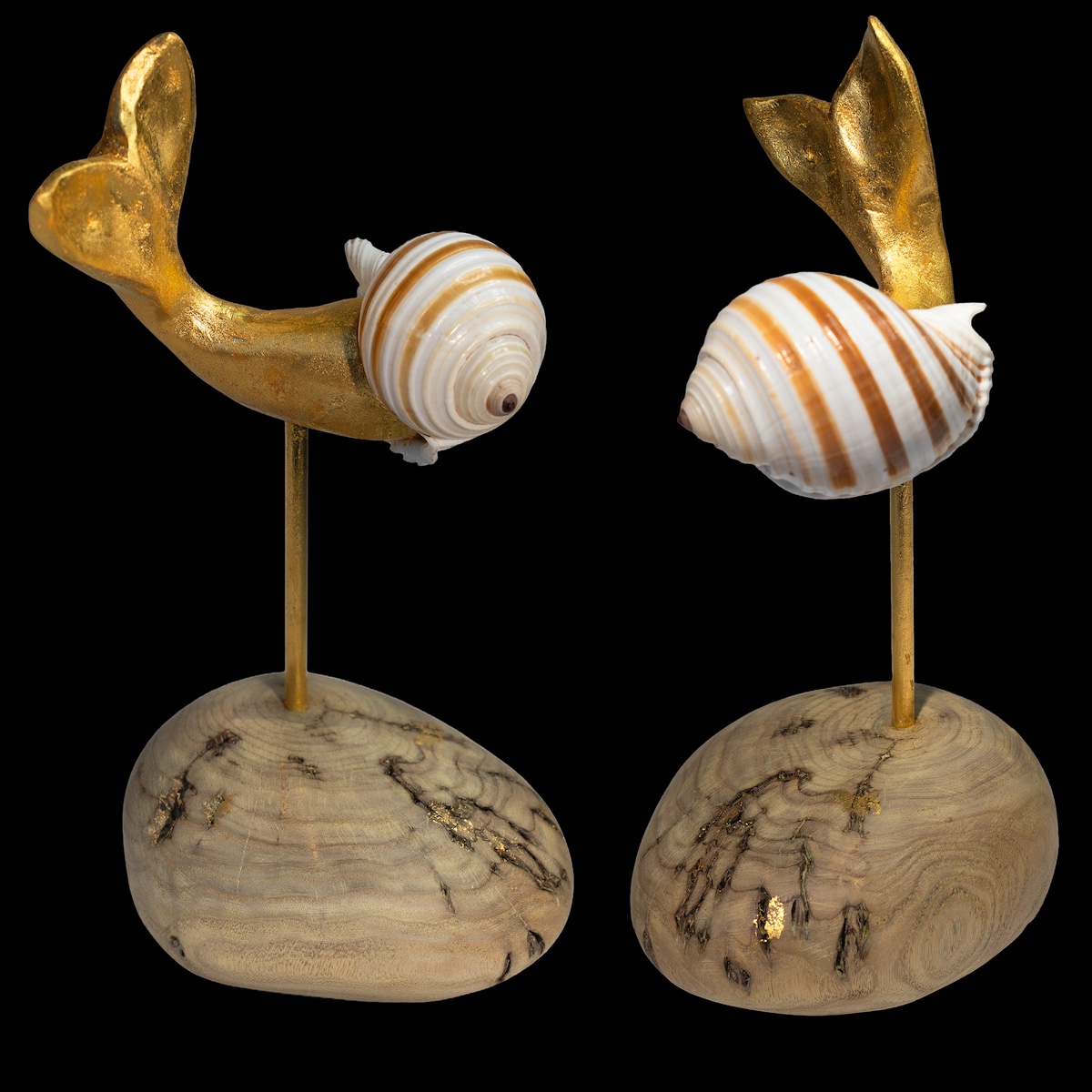
Whale Watching is a sculpture that allows me to relive an unforgettable experience at home, every day.
Whale watching. A surreal combination of two remarkable natural forms: the dive of a whale and a shell. I tried to enhance the movement of the diving tail by extending its line into a tropical shell, the Tonna sulcosa. Another natural wonder.
I carved the tail from linden wood and gilded it. The base, made of catalpa wood (also known as the ‘trumpet tree’), is inspired by the smooth pebbles that wash up on the beaches of Canada.
Holy Shell (commissioned work)
The shell had been waiting for this project for some time. I originally bought it for a commissioned sculpture called Holy Shell.
Long ago, these shells were transported from the Indian Ocean along ancient trade routes, crossing the Himalayas to the Tibetan plateau. Shells are perfectly formed homes for mollusks and crustaceans. They have often been associated with the Golden Ratio, which unconsciously evokes a sense of harmony and balance.

I searched for examples online and found beautiful, slightly oval shells from the Indian Ocean and the South China Sea, such as the Tonna sulcosa.
Tibetan monks decorated these shells with silver or copper and pieces of coral. These so-called “sacred shells,” or shankha, played an important symbolic role in rituals. The shell is one of the Eight Auspicious Symbols (Ashtamangala) in Tibetan Buddhism. It was also used as a wind instrument in rituals (the dung-kar) and as an offering object.
‘Rolling stone’ as a base
On the beaches of Nova Scotia, flattened wave worn pebbles wash ashore—so-called “rolling stones.” At an auction by woodturner Joost Kramer in Utrecht, I acquired five catalpa trunks. Beautifully patterned wood.
From a rough piece with a branch, I carved a wooden stone to serve as the base. While I was gilding the tail, a tiny flake fell onto the base and would not come off. In fact, it felt right. It visually connects the base and the sculpture. Better to leave it as it is.
Jan Bom, March 29, 2026