Wonderstones of burned wood, stacked on top of each other like cairns, the ancient primitive signposts in the mountains. Together they form a face, with a high stacked hairdo. Carved from a remnant of industrial spruce wood, intended for sustainable prefab wood construction.

Wonderstones, the front view of my sculpture of burned spruce wood.
Spruce wood is terrible wood for a wood carver to work in. It splinters, with a careless strike of gouge and mallet a huge chip can come loose. The ‘skin’ cannot be sanded smooth, because holes appear in the wood and even cracks. I didn’t know what to do with this sculpture, while it was initially such a beautifully smooth block of waste wood.

Sanding smooth the enormous wall panels of cross laminated timber (CLT) at the Derix factory in Germany.
I was allowed to take the wood for free, from a factory just across the border in Germany that specializes in the production of so-called ‘cross laminated timber’ (CLT). These are perfectly sawn spruce parts, without knots, that are glued crosswise on top of each other with an environmentally friendly glue. This creates a building material that is just as strong as concrete, only much lighter and not environmentally harmful. On the contrary: an enormous amount of CO2 is stored in wooden houses: softwood about 920 kilos per cubic meter of wood.
Standard work on local wood
I did research on the future of wood construction in the Netherlands, in which these prefab panels play a crucial role. I went on a working visit with Peter Fraanje, a specialist in the Netherlands in the field of wood construction. Before the turn of the century he wrote the standard work ‘Natuurlijk bouwen met hout’ (Natural building with wood), which I was allowed to place on the website for sustainable developments P+ after digitization.
There, at the German Derix factory, quite a lot of waste wood is created, for example when a door opening or a window is sawn out of a wall panel. The remnants are given a destination, in the form of pellets for wood stoves and power plants. But still, it is downgrading of a beautiful, natural raw material. Those beautiful pieces of ‘waste’ are very desirable. What can you as a sculptor in wood make of that? Can this ‘waste’ also be upgraded to an art object?
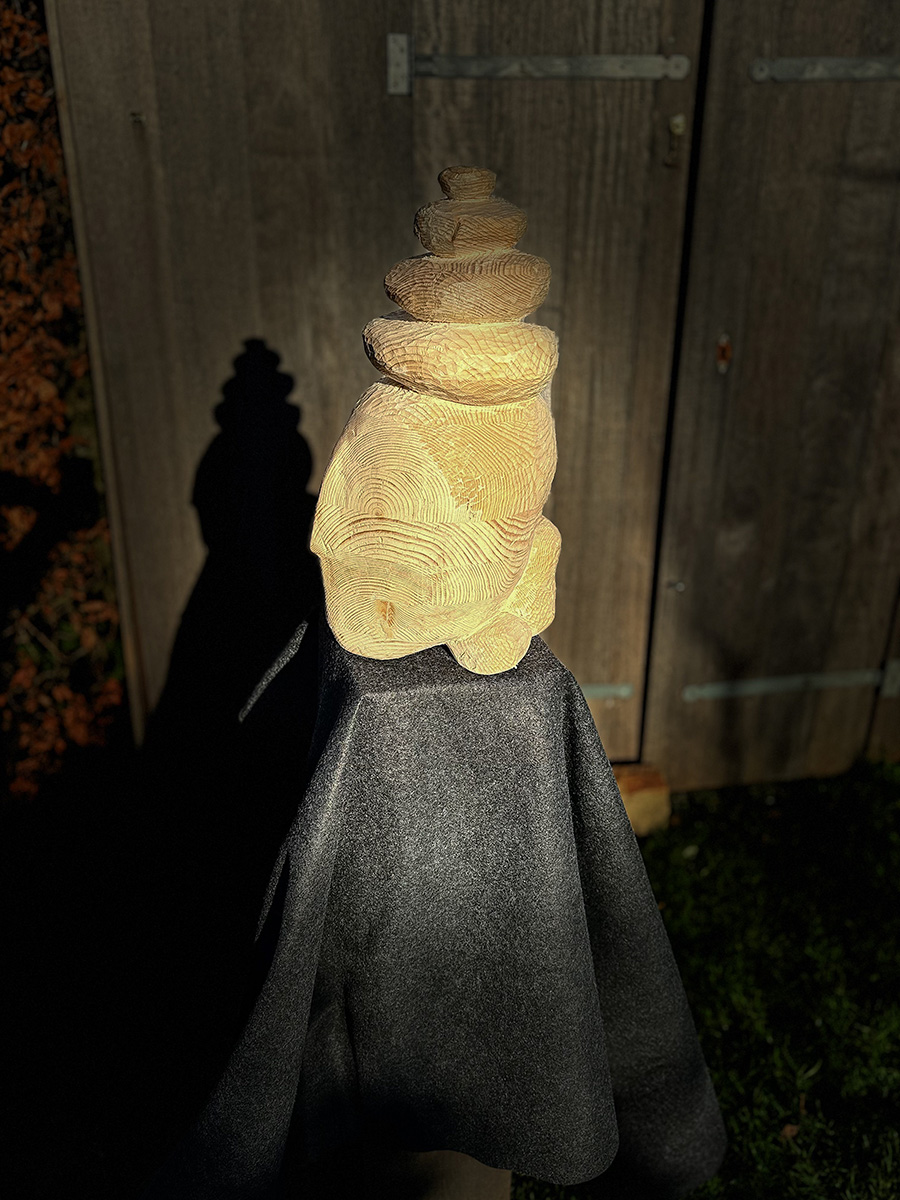
Wonderstones, the spruce wood in January 2024, not yet burned and also not yet hidden under a layer of red bole.
That turned out to be very disappointing at first. Carving in the fast-grown spruce wood was one big frustration. Ugly. I eventually gave the surface, which couldn’t be sanded smooth, a thick layer of ‘red bole’ (a mixture of fine clay and iron oxide), to then be able to gild it. That never happened. Covering such a large sculpture completely with 24 carat gold leaf I associated too much with the worship of the Golden Calf. Too much. Too expensive, also. Too flashy.
So the reddish-brown clay-like sculpture stood for over a year and a half in a corner in the stairwell to my study. As inconspicuously as possible, even though I walked past it every day I don’t know how many times.
Wonderstones didn’t burn easily
In journalism there is an expression that indicates that for the sake of the tension arc in an article you have to cut the nicest tidbits and facts. Kill your darlings, it’s called. On a rainy summer day I decided to repeat a failed experiment with linden wood on this block of spruce. I got my gas torch out of the closet again and set fire to the sculpture in the back of the garden. Which wasn’t even that easy. Residents of wooden houses really don’t need to worry that the solid wooden panels of their house will quickly catch fire. You really have to make quite an effort for that.
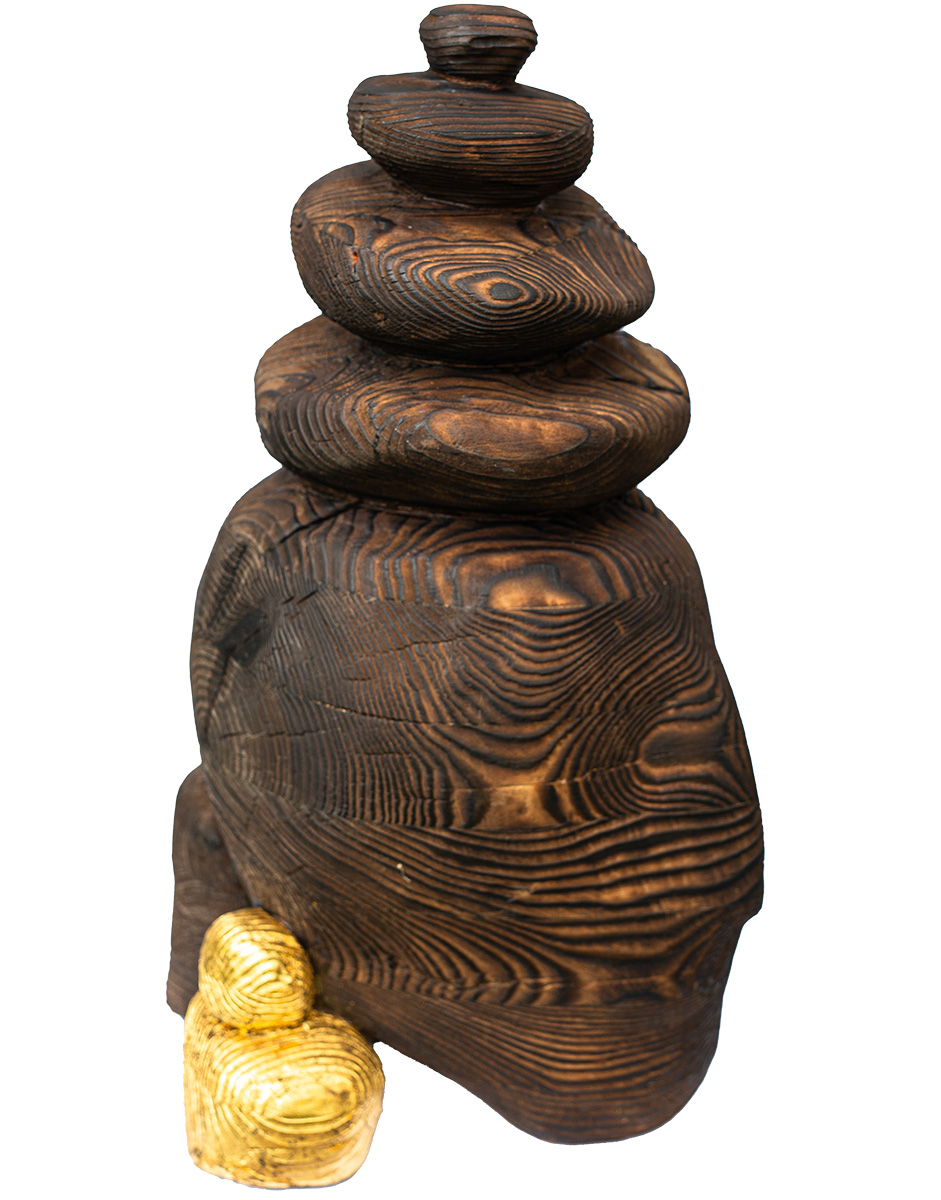
Wonderstones, side view, with gilded ‘stones’ where the head rests against: 43 cm high and 25 cm wide.
Under the charred top layer a wonder turned out to be hidden. After brushing away all that soot with a brass brush, the annual rings turned out to be much less burned than the soft wood in between. The most beautiful wood patterns emerged, like a relief. The crosswise stacked beams appeared in unexpected fault lines. The skin of the sculpture was after burning smooth in the deep parts and in other places just as weathered as old wooden rows of breakwaters on the beaches of Zeeland. It was Dendroism par excellence. What a surprise.
I then changed the name I had had in mind for the sculpture all that time. The somewhat provocative ‘Stoned’ – as a reference to the spiritual stacking of stones – now became ‘Wonderstones‘. A good year and a half after the very first processing I burned that name definitively into the base of the sculpture with my pyrography pen.
Jan Bom, July 27, 2025.