Antony Gormley also began with wood, the British artist who in the Netherlands is best known for his monumental crouching figure at the harbour of Lelystad. In the early years of his career, he dissected trees in an almost scientific manner.
Many major twentieth-century artists began working in wood when they were searching for directness (carving instead of modelling), resistance of material, growth, structure and inner form. On wowwood.nl I have already presented many famous names who worked with wood at the beginning of their careers. It occurs so often that I dare to call it an ideal starting point for an artistic career.
A few examples. Karel Appel assembled the sculpture Windmill from scrap wood in the difficult years after the Second World War. The British sculptor Henry Moore developed his visual language by carving into wet elm, where the material itself forced him towards organic forms. Constantin Brancusi carved his first versions of the Endless Columnin wood. Barbara Hepworth also began with wood, developing her characteristic pierced forms within it. Ossip Zadkine carved more than a hundred sculptures in wood before becoming known for his monumental works in other materials. Before Paul Gauguin discovered “direct carving” in Tahiti, he had already produced woodcarvings in France, even carving his own clogs. Giuseppe Penone is of course the key artist of Dendroism, literally revealing the younger tree within the trunk, and he continued working in wood throughout his career. But even Pablo Picasso carved wooden sculptures during his “African period,” which formed a prelude to Cubism.
Two formative years
The British artist Antony Gormley worked in wood for no more than two years, from 1978 to 1979, yet these were formative years for his artistic themes. His wooden constructions were visualisations of the statement he developed at the Slade School of Fine Art: “Ultimately, works are gifts of the products of nature and culture to each other. They are an attempt to stop time and re-present the world.”
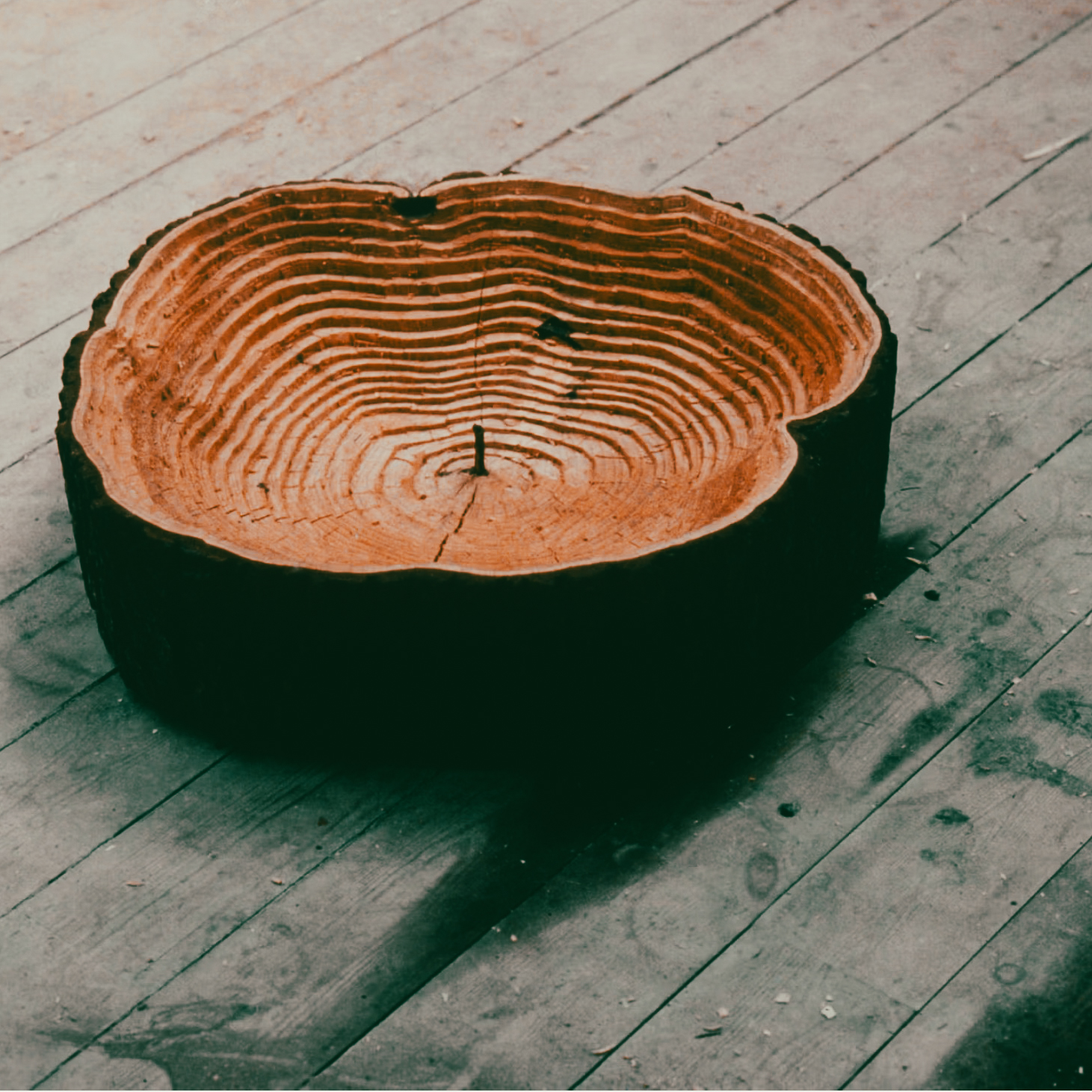
On his website, he describes this period beautifully in his own words: “In the late 1970s, I abandoned any thought of inscribing ideas into material and tried to find a way of revealing the inherent subject within the material: the tree within the tree, the seed within the wood. The first works were simply an unpeeling of logs to reveal the first years of growth underneath the bark, or the form of potential growth in seed.”
“This was polarised in works such as End Product: a seed-shaped form made from the base of an elm tree. This work was completely burnt and shows the navel points where branches once extended from the cut surface.”
“My relationship with wood and trees ended with Fallen Tree, where the wood from the entire tree, including the branches and all the sawdust from being cut, was dropped from the original height of the tree onto the floor, forming its own constellation of material.”
“Prior to that there were two experiments: one, Flat Tree, in which the main trunk of the tree was laid out in a spiral starting at the centre with the top of the tree; and Rearranged Tree, a thirty-year-old pine tree arranged into thirty piles from one to thirty pieces.”
As an archeologist
Antony Gormley is now one of the most influential sculptors of his generation. He was born in 1950 in London and grew up in an intellectual environment in which discussions about art, religion and philosophy were central.
After studying archaeology, anthropology and art history at Cambridge University, he travelled through India and Sri Lanka in the early 1970s, where he encountered Buddhism. This experience formed the basis of his later exploration of the relationship between body, space and consciousness.
When Gormley returned to England and continued his studies at art schools in London, he began experimenting with materials closely connected to nature. He described this as revealing “the tree within the tree, the seed within the wood.” By carefully peeling or opening up trunks, he exposed growth rings and hidden structures.
In Italy, Giuseppe Penone was working on a related idea, revealing the “inner tree” within a trunk by carving it out.
The embedded meaning
These early wood works already demonstrate Gormley’s fundamental attitude: material is not a carrier of an idea, but a partner in which meaning is already embedded. In a sense, these works resemble an almost archaeological approach: uncovering what is already there.
Soon, however, his focus shifted from the tree to the human body. From the early 1980s onwards, Gormley began making casts of his own body, first in plaster and later in lead and iron. This shift does not represent a break, but rather a transition from wood to the body as a “natural given.” Just as he sought inner structure in wood, he attempted to define a space in the body that is both physical and existential.
Based on electricity pilots
Over the following decades, Gormley developed an impressive body of work. His sculptures have been exhibited worldwide and have received numerous awards, including the Turner Prize in 1994.
A key aspect of his later work is the move towards large-scale sculptures in public space, often using industrial materials such as cast iron and steel. One of the most striking examples in the Netherlands is Exposure (2010) in Lelystad. This 26-metre-high sculpture of a crouching man stands at the boundary between land and water, looking out over the Markermeer. The structure is composed of thousands of steel elements, inspired by the lattice structures of electricity pylons in the polder landscape.
Exposing internal structures
With this work, Gormley transforms his original approach once again: the body is no longer a closed mass, but an open network of lines in space. The sculpture functions as a three-dimensional drawing in which inside and outside coincide. In that sense, he returns to his early wood works, where revealing internal structures was central.
His work has also been shown elsewhere in the Netherlands, for example in exhibitions at Museum Voorlinden.
What continues to fascinate is the consistency in Gormley’s oeuvre: the relationship between body, space and landscape. Whether working in wood, lead, iron or steel, he repeatedly addresses the same question: what does it mean to occupy space as a human being? His early wooden sculptures are not a footnote, but a point of departure. It was in wood that he learned to see what is hidden — an attitude that continues to resonate in his later monumental works.
Jan Bom, march 25, 2026