Arne Tjomsland started mass production of wooden animal figures: his polar bear souvenirs saw orders of 500 pieces at a time. Also beautifully stylized was his arctic musk ox. Not sanded smooth, but with a pattern of delicate stripes suggesting the thick fur. Thick leather symbolizes the horns.
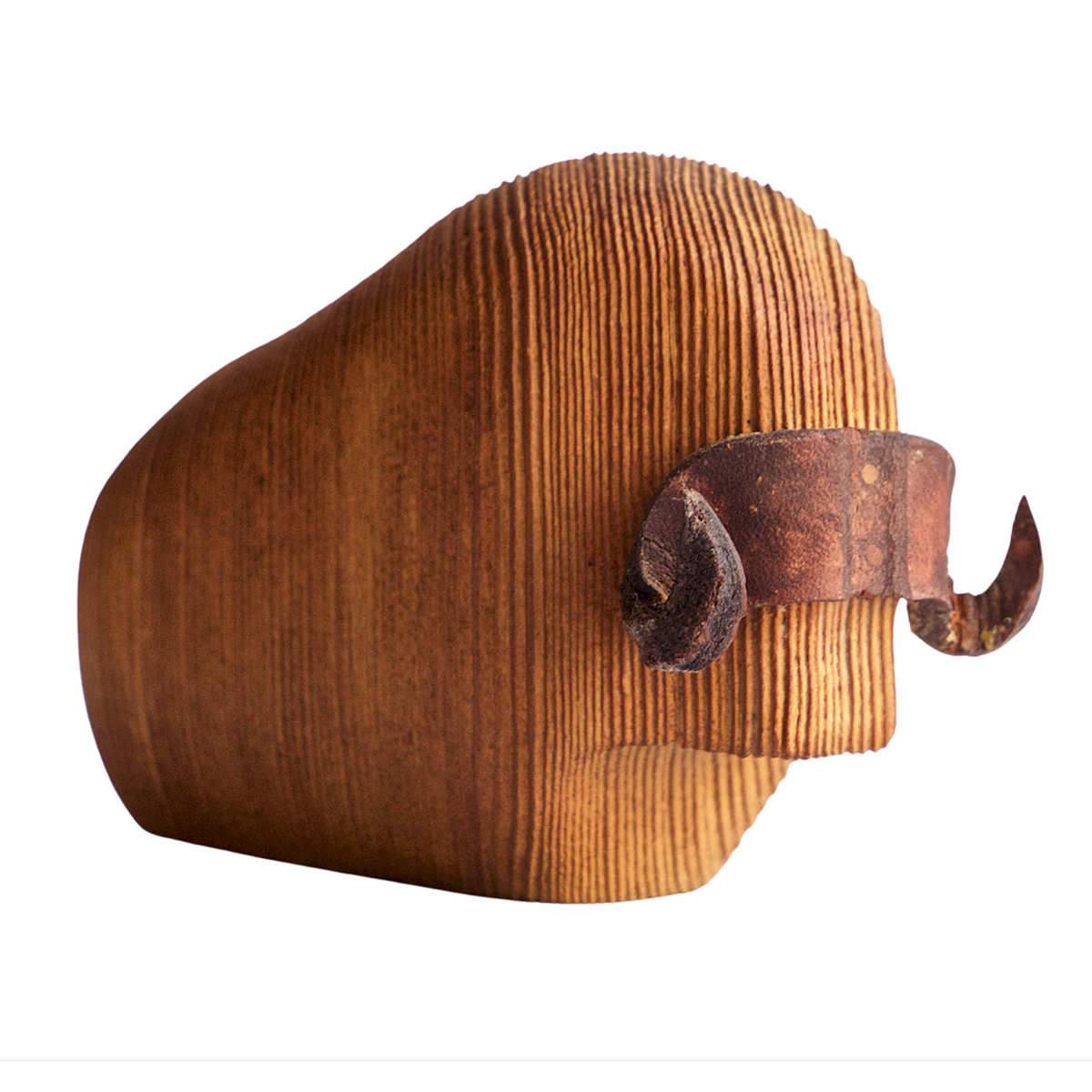
The arctic musk ox, stylized to the extreme by Arne Tjomsland.
The Norwegian sculptor Arne Tjomsland (February 7, 1915 – 1970) knew how to capture the soul of the northern animal kingdom in wood. His stylized polar bears, seals and musk oxen belong to the icons of Scandinavian modernism.
What began as artisanal wood carving grew into mass production, without losing the purity of form and material. Each figurine still breathes the silence of the polar landscape. His work embodies the essence of Scandinavian design from the 1950s: pure lines, natural materials and a restrained, almost poetic simplicity.
The power of a line
Tjomsland grew up in an environment where nature and form study went hand in hand. His father, Mikael Tjomsland, was a taxidermist at the Zoological Museum of Oslo. As a child, Arne spent countless hours there among the stuffed animals. That direct interaction with animal forms and anatomy became the breeding ground for his later oeuvre. Where his father strived for the most realistic reconstruction possible, Arne sought the essence of form — the power of a line, the tension of a posture.
In the forties and fifties Tjomsland worked as a graphic designer and illustrator, among others for the magazine Bonytt, which was leading within modern Scandinavian design. He also designed for the newly established Kon-Tiki Museum of Norwegian explorer Thor Heyerdahl. Here he further sharpened his sense of archetypal simplicity. On the advice of goldsmith Torolf Prytz he started a small workshop at home where he could work with wood and walrus tusks.
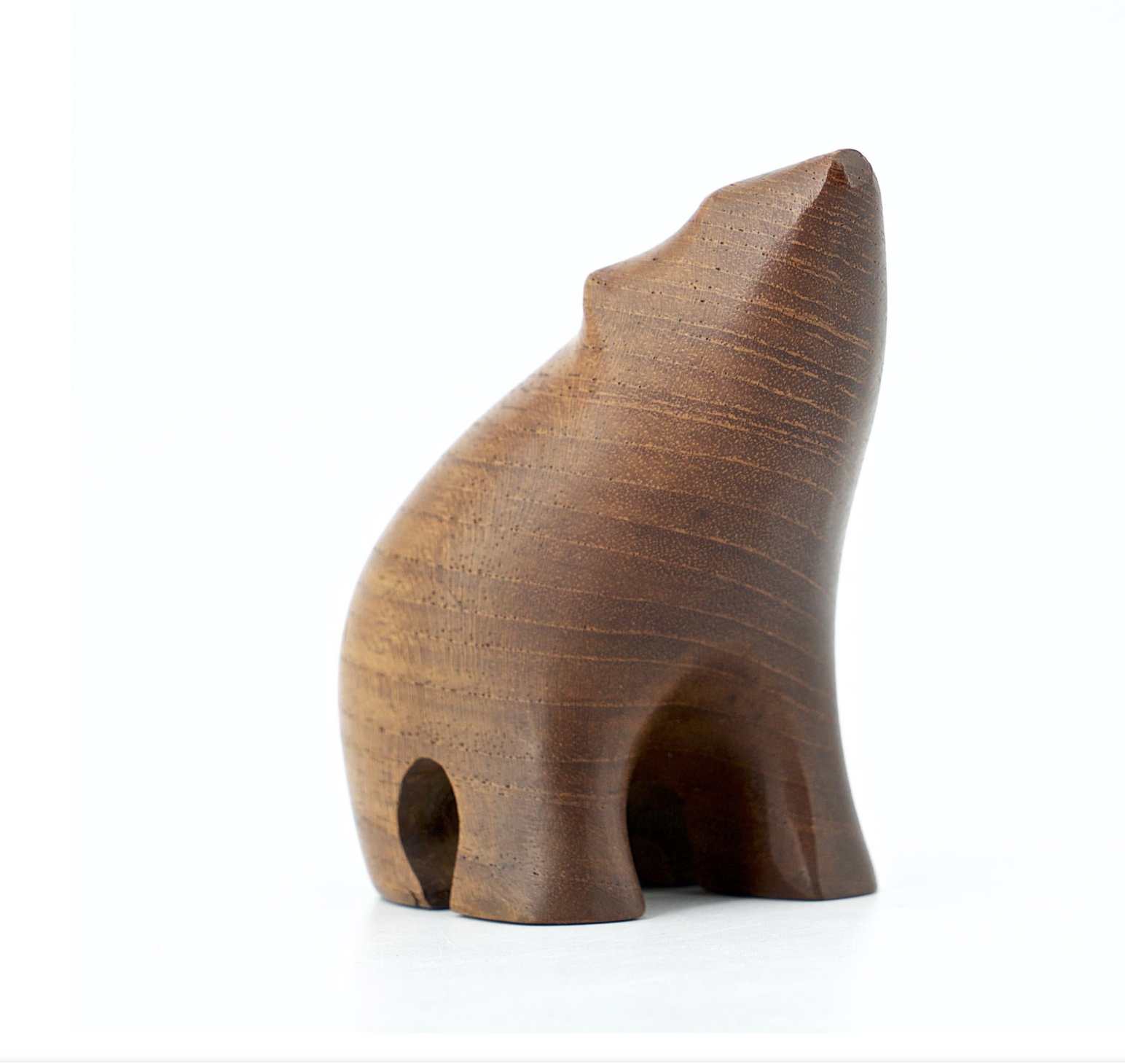
Tjomsland’s success started with the stylized figurine of a polar bear.
His first wooden sculpture from 1954, a stylized polar bear, marked the beginning of his fame. The polar bear — compact, with rounded shapes and minimal details — embodied both the robustness of the Arctic animal and the soft lines of modern Scandinavian design. The simplicity was deceptive: each sculpture was thought through to the grain of the wood, with a subtle tension between smooth surfaces and lively wood patterns.
The popularity of his designs grew rapidly. Tourists in Norway sought tangible memories of their journey through the icy north. Tjomsland knew exactly how to capture that feeling. SAS Scandinavian Airlines ordered 500 copies of his polar bear at once — a scale that was unattainable for the individual craftsman. That moment marked his transition from artisanal production to industrial design.
Furniture factory took over production
Around 1955 the Norwegian furniture manufacturer Hiorth og Østlyngen in Skøyen (Oslo) took over production. The collaboration made it possible to manufacture Tjomsland’s sculptures in larger numbers: Arne Tjomsland started mass production. The artist continued to supervise the design and finishing, so that each piece maintained the balance between series production and artistic precision. This created an early example of design that bridged the gap between art and utilitarian object — a democratization of aesthetics.
Yet Tjomsland continued to experiment with refinement. His stylized musk ox is a striking example: this time not polished, but with a pattern of delicate stripes suggesting the fur while also making the craftsmanship visible. Where the polar bear stood for pure simplicity, the musk ox showed a subtle play of rhythm and texture.
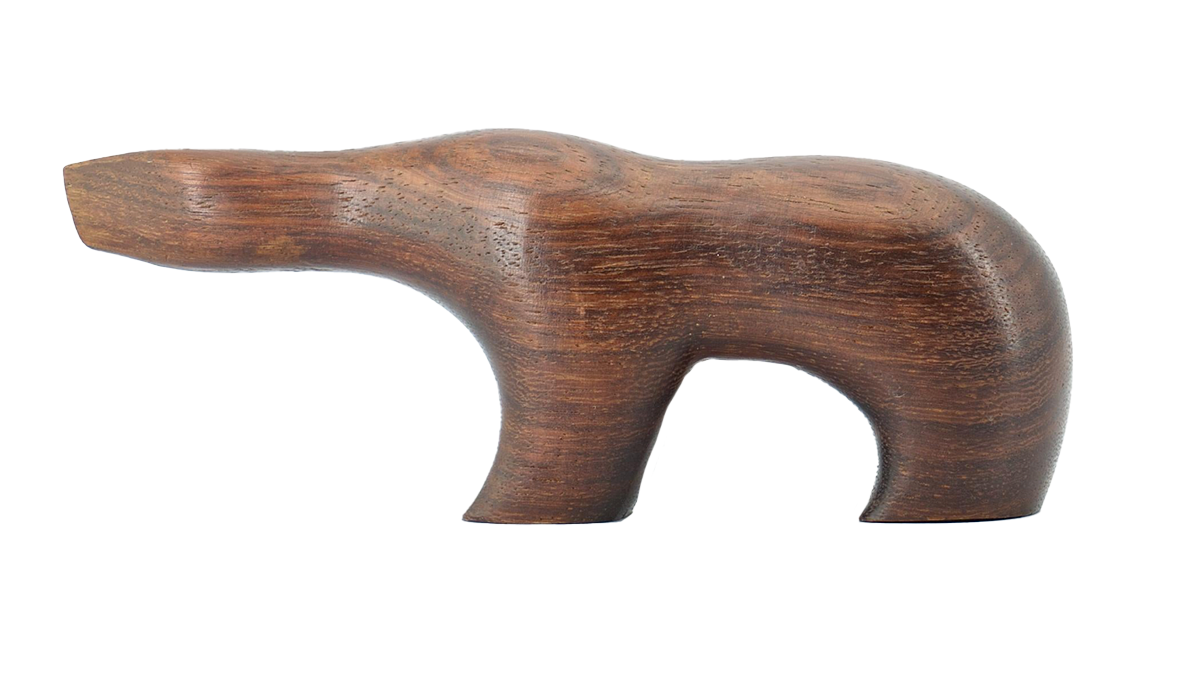
Arne Tjomsland started mass production with polar bears like this one.
In 1954–1957 the exhibition Design in Scandinavia traveled through the United States and Canada, also featuring work by Tjomsland. His animals found eager buyers there and became icons of a new, northern modernity: warm, natural and human in their simplicity.
Arne Tjomsland died in 1970, only 55 years old. He left a legacy that blurred the boundaries between art, craft and design. His stylized animals grew into symbols of Scandinavian refinement — silent witnesses of a man who knew how to capture the soul of a polar bear in a block of tropical wood, such as teak, in Scandinavian softwood, or in the teeth of the walrus.
Arctic ox now 1316 euros
The once so cheap souvenirs of his animals return today on auction sites, where substantial amounts are being asked. On the website 1stDibs, amounts between 1200 and 3400 euros are asked for his polar bears. His arctic ox from 1959 is for sale there for 1316 euros.
In wood carving it is mainly the people and animals of the nativity scene that are also produced in mass production. The more finely carved, the more expensive the small figures. The best-known example is the company Anri, founded around 1912 by Anton Riffeser. The company is located in the village of St. Ulrich (Urtijëi) in the Grödnertal (Val Gardena), a region in South Tyrol with a centuries-old tradition of religious wood carving. It is still a valley where world-famous North Italian woodcarvers carve their figures. No longer tiny, so they fit in a nativity scene, but life-size and lifelike. Val Gardena is a ‘place of pilgrimage’ for lovers of wood carving. Tjomsland never made it that far in Oslo.
Jan Bom, October 5, 2025