Type ‘wood carving’ into Google and mostly figurines from Bali appear. On Marktplaats and Etsy there is always some wood carving from this Indonesian island for sale. But according to former art dealer Frans Leidelmeijer, almost all those busts and masks should be counted as tourist souvenirs. With nostalgia he looks back on the period 1930 – 1970. That’s when the craftsmen of Bali reached great heights with their own version of the Art Deco art movement.
A collection of beautiful art sculptures can be found in the book ‘Art Deco Sculptures from Bali’ by former art dealer Frans Leidelmeijer. He became known and beloved through the TV program Kunst en Kitsch (Art and Kitsch). Leidelmeijer regularly saw them come by, the former Dutch East Indies returnees who wanted to know how much their Balinese souvenirs would be worth. Was it art? No, unfortunately. It was often kitsch.
It started with an anecdote
The Balinese heyday in Art Deco started with an anecdote. Western artists had settled on the island and began collecting the work of traditional craftsmen. The Balinese carved their representations mainly as decorations for temples and palaces. They were gods and demons, in the traditional Hindu-Balinese style. But they also decorated doors and made musical instruments.
Not only artists managed to find the green paradise of Bali at the beginning of the last century. The very first tourists also came to visit the green fairytale island. They wanted to imagine themselves like the French painter Paul Gauguin in the South Pacific, among all those bare breasts – and young boys, Leidelmeijer adds. Two important artists were the painters Walter Spies (a German) and Rudolf Bonnet (a Dutchman). They managed to interest the first tourists in authentic wood carving. They gladly took a tangible memory of their dream trip home with them.
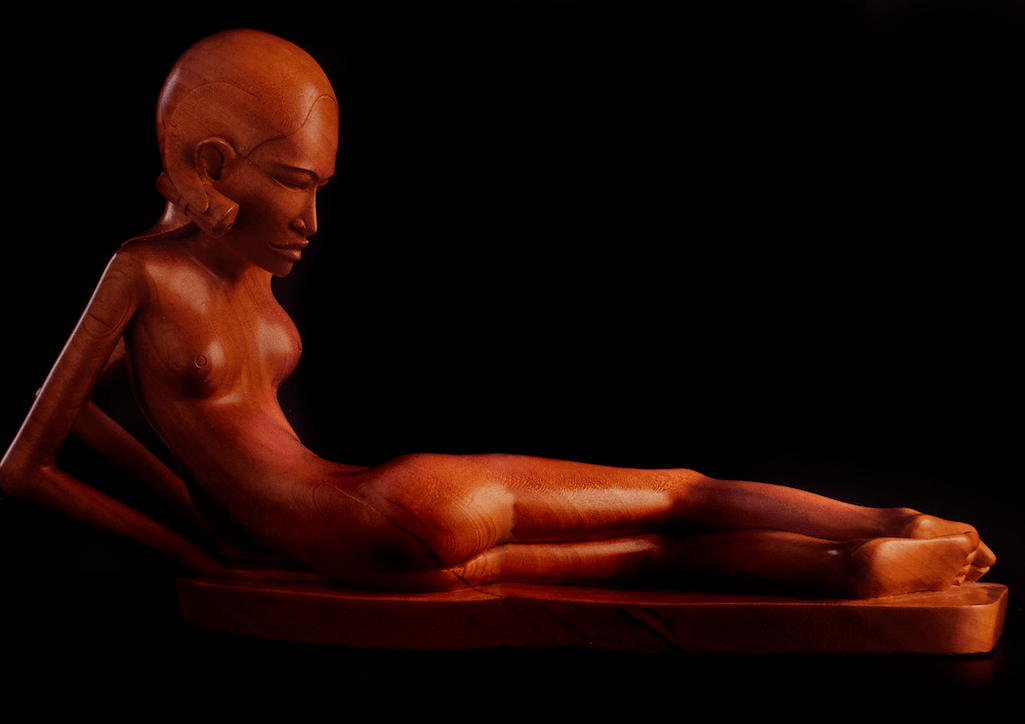
The artists also provided the Balinese wood carvers with wood to work out their ideas. They even had to make sketches first, which were improved. For one such commission, a craftsman received the instruction from Walter Spies: you can make two figurines from this trunk. Yet he didn’t. Perhaps because of the ‘magical powers’ of the beautiful tropical wood, he delivered a single sculpture of a very elongated temple dancer. She was somewhat reminiscent of a tall Wayang puppet, which is carved from stiff leather.
Serene, Oriental, mystical
The facial expression of the dancer was very refined. Serene. Oriental. Mystical. A new movement within Art Deco was born.

Frans Leidelmeijer retrieved the name of that first artist from anonymity – although he still cannot be found on the internet. In his book he writes: “In Bali, the stylization and deformation of sculptures began in 1930 with the legendary sculpture of the Lelong dancer by I Telegan, influenced by the elongated Balinese female figures of Mexican-American painter Miquel Covarrubias that he made for his book ‘Island of Bali’.”
Many followers of I Telegan in turn remained unknown. Leidelmeijer: “In the west, the Art Deco period formally ends in 1940. The Balinese sculptors, on the other hand, continued working in this style after the war, making them difficult to date. These sculptures were also rarely signed.”
Anonymous or not, Balinese Art Deco produced showpieces of wood carving art. Super-slim women and men, with almond-shaped eyes. Arms and legs as thin as needles. Fingers as long as tree roots. The Balinese, who are close to nature, let the bodies grow like the slender stems of climbing plants. The detailing of their work was phenomenal.
Pumped-up praying Buddha
A reaction to all those slender forms was inevitable. A second Art Deco wave depicted people and animals as fat, pumped-up creatures. It produced the archetype of the ‘weeping monk’. At first glance it looks like an almost round ball, but it does represent a human curled up, the bald head folded in the open hands. It is perhaps the best-selling souvenir in Bali. Nice for on the windowsill, but it doesn’t have much to do with art anymore. It has become a mass-produced product.
Meanwhile those first generations of tourists are passing away. The same goes for the Dutch former East Indies returnees and the original inhabitants of Indonesia who settled in the Netherlands after independence. Their children get the household contents and wonder: what do we do with those sculptures? The somber masks of dark wood are especially not very popular. Without a memory of a beautiful trip or a dear past, they represent no emotional value. What do you do with such an angry Monkey King Sugriwa? No one wants them, while the calming Buddhas can’t be stocked fast enough.
At auctions and sales websites there is therefore all kinds of things for sale. The Balinese sculptures are super cheap. When a piece of a finely carved crown has broken off during rough transport, it’s not even worth having it restored. Seasoned collectors also know: pay close attention to whether people themselves have started gluing.
A stuffed three-room apartment
Sometimes this collecting mania goes too far. The website of ‘Bart-Laurens’ shows a three-room flat where every piece of wall and cabinet and little table is covered and filled with Balinese wood carving. He writes about his collection: “Barong masks were made to ward off evil spirits from homes. I currently have about 35 of them hanging on the walls of my apartment. Who knows, maybe these contribute to me experiencing little influence from strange forces.”
When Bart-Laurens encounters something special, another sculpture must be sold to make room. He receives about 500 visitors per day on his website and has emerged as a free advisor, because he has been an enthusiast for so long. And yet his collecting mania simply started with an heirloom from his mother, the female half of a set of ‘Javanese bridal figures’, also very popular in the 1950s and beyond. Sometimes with beautifully carved busts. But often also quickly made, in mass production in ‘artist villages’ in Bali like Ubud, which became the center of handicrafts after 1947.
My mother-in-law also has such a set, but a very beautiful one. Brought home in the 1950s by my father-in-law, who sailed professionally on the Holland-America Line, from Amsterdam to Jakarta. The groom even has a real serrated knife, a kris. It hangs on his back.
And back to square one
Bart-Laurens is not the only one who can’t stop. While Leidelmeijer limited himself to 100 pages in his standard work on Balinese Art Deco, the self-taught Roland Smeets went on to 300 pages with his ‘Understanding Balinese Woodcarvings’. Smeets has also deeply delved into the subject and even developed his own theories. For example, he writes about a wooden sculpture of a Balinese beauty with enormous drops on either side of the head: “These are in my opinion based on the thick braids of artist Covarrubias’ wife.”
Anyway, Balinese wood carving came full circle. It went from souvenir to art object. But it’s now back to square one, from art object degraded to souvenir. A pity that this fantastic fantasy has been lost. You have to search carefully in the galleries around Ubud to find something special.