Does Isamu Noguchi bend down for a soap, a posture about which many risqué jokes exist? It is a posture best avoided in communal shower rooms of prisons. However, the work is listed under a very descriptive title: Boy Looking through Legs.
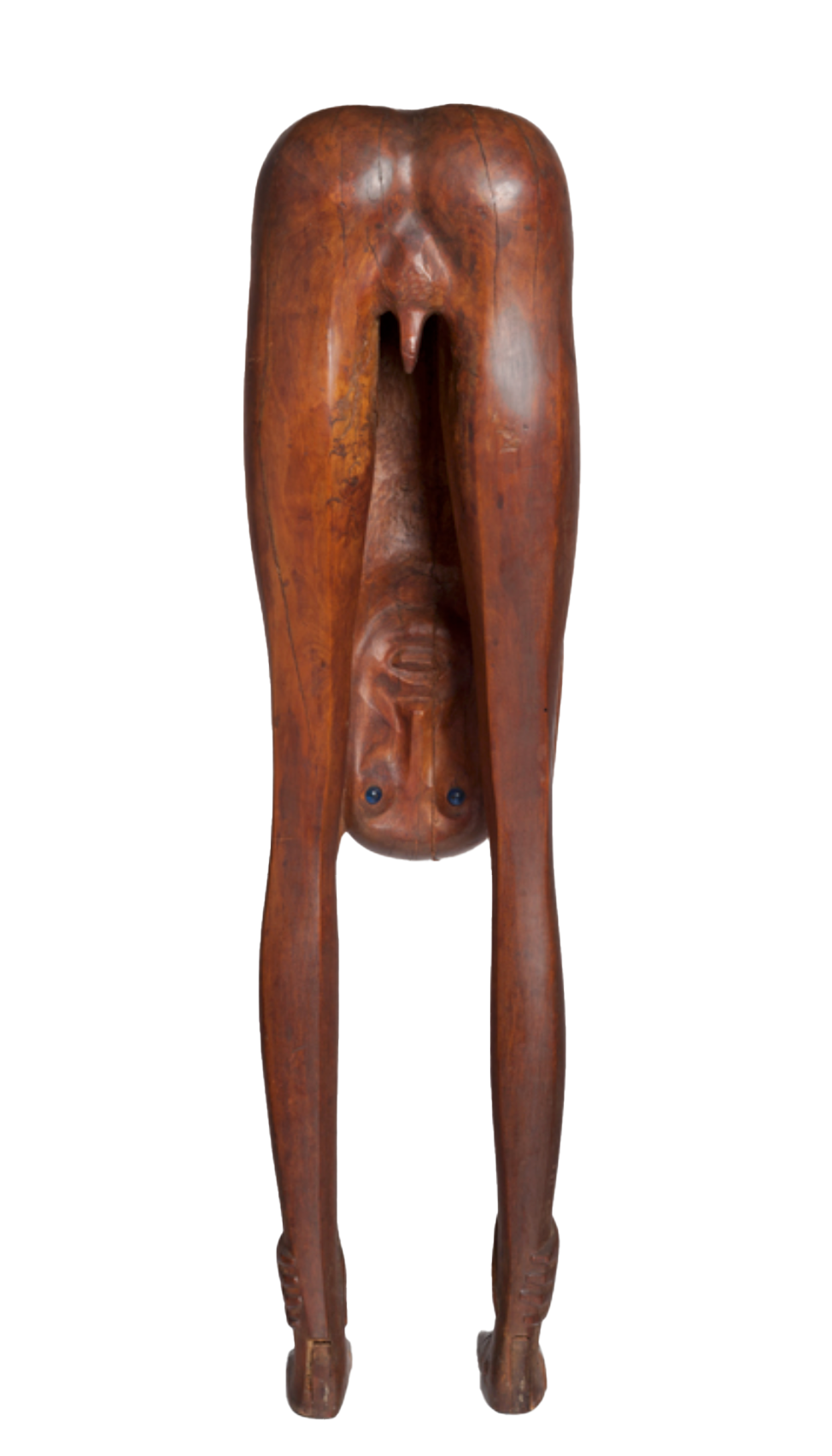
Does Isamu Noguchi bend down for a soap, or does he view the world upside down?
Isamu Noguchi (1904–1988) was one of the most versatile and influential artists of the twentieth century. He was born in Los Angeles as the son of a Japanese poet and an American writer. In his work he combined this dual cultural heritage with a lifelong search for form, space and matter.
Noguchi was not only a sculptor and maker of public artworks, but also a designer of furniture and lamps. The Noguchi Museum in New York presents numerous works that show his astonishing diversity.
The world from bottom to top
Back to the wondrous sculpture of the young man who seems to bend down to pick up a dropped soap. It is a self-portrait that Noguchi made around his 29th year. The work is not primarily seen as sexual by curators. Rather, the artist portrays himself as a little boy viewing the world upside down, literally from bottom to top. The beads as blue eyes give him an astonished look. The world suddenly looks so different. It is a funny posture of toddlers (not of teenagers), which appears frequently on the internet under the title ‘Boy looking through Legs’.
Noguchi must have meant by this that he is searching for an identity, because his American-Japanese background makes him feel different from others. He reinterprets the world. So no erotic joke. And also no reference to homosexuality. After a relationship with an Indian woman, he was married from 1952 to 1957 to a Chinese-Japanese actress. From 1959 until his death he had a close friendship with art agent Priscilla Morgan.
The essence of the material
Noguchi’s artistic training began in the United States. In Paris he learned under the influence of Constantin Brancusi how direct, organic forms can reveal the essence of material. He was fascinated by how sculpture relates to space — not only as an object, but as part of the environment and as an experience for the viewer.

Noguchi designed a coffee table in 1944 that is still in production at Vitra.
Although Noguchi later became best known for his large works in stone and metal, he first worked with wood from the mid-1940s. Much of Noguchi’s conceptual approach to material is also visible in his furniture designs, such as the iconic Noguchi coffee table (1944). The table consists of two organically shaped wooden base pieces and a heavy glass top — a classic in modern design that unites sculptural and practical aspects. New price (2026): 3,700 euros.
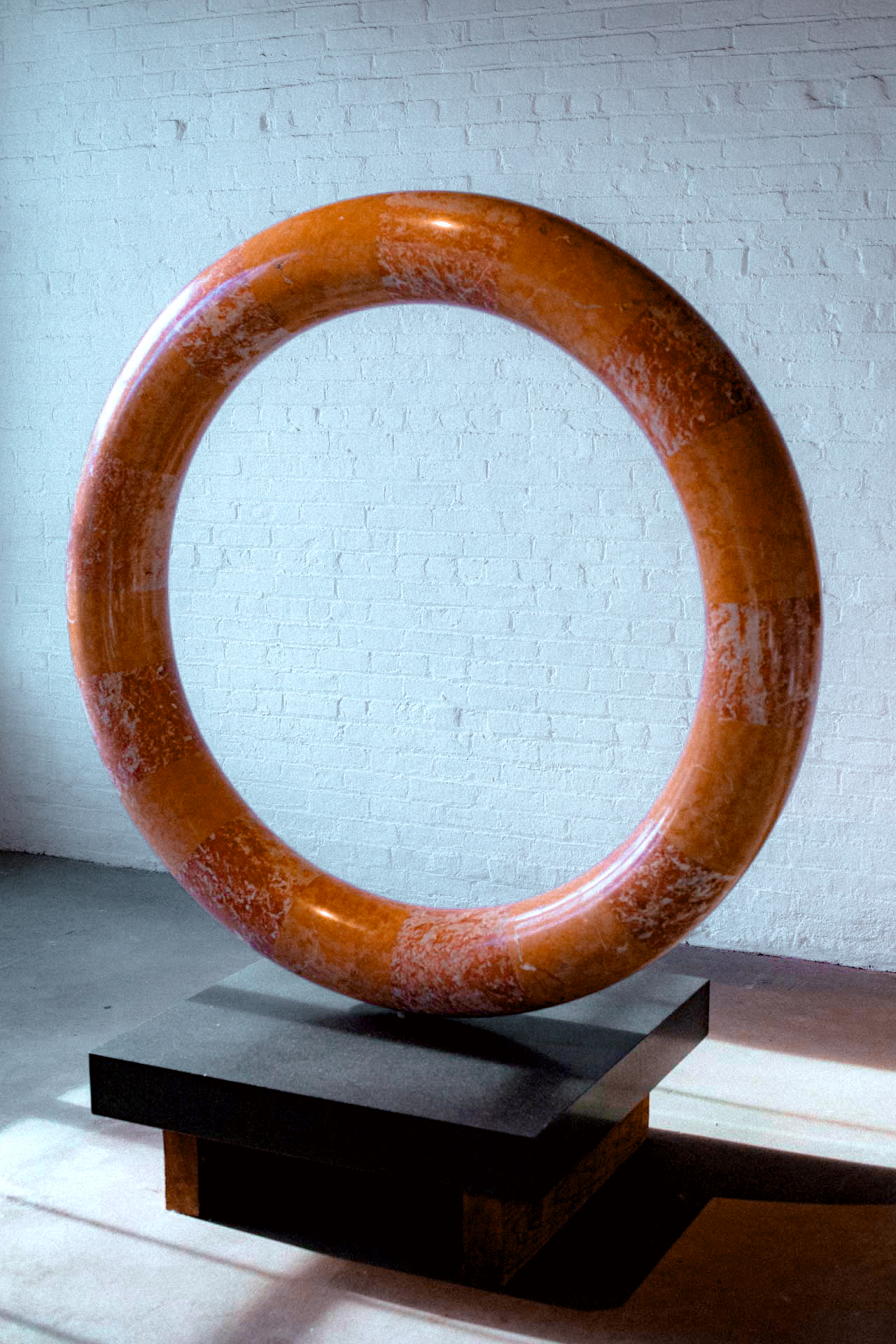
Sun at Noon, Noguchi’s early exploration of circularity, in Spanish marble.
His most beautiful work I find the enormous circle Sun at Noon (1969) of Spanish marble and the replica thereof in black granite Sun at Midnight (1973). Noguchi was fascinated by circular forms — as symbols of the sun, of wholeness, and of the infinite. He used them both in small abstract sculptures and in monumental public works.
And also this time these were not references to sexuality, but to space, emptiness, nature and timelessness. They are concepts that later became very relevant in sustainability and circular design.
Jan Bom, January 10, 2026