Dave Harmsworth is Dutch speed carving champion. Every year he saws about a hundred sculptures from dead trees with his chainsaw. From cormorants, badgers and owls to trolls. Not to mention: the archangel Gabriel with dragon. A huge sculpture in Schalkwijk. Harmsworth only needed four days.
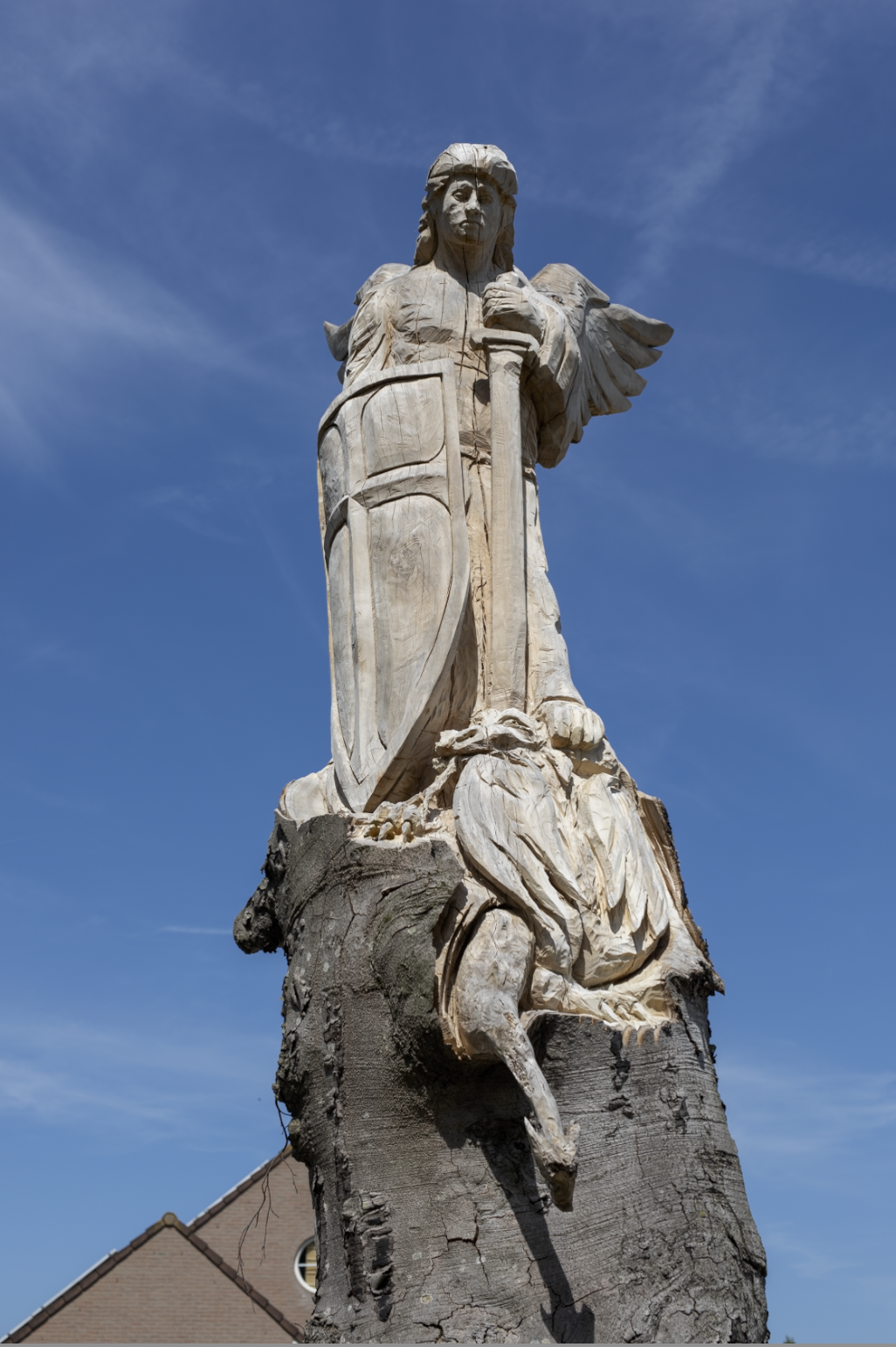
Dave Harmsworth needed four days to transform a dead weeping beech into a living monument.
The Brit Harmsworth (1978) won the annual Dutch ‘carving’ championships (sculpture sawing with a chainsaw) multiple times. He consistently finished in the top 5. In 2018 he was also first in speed carving, the competition event where participants have only limited time to make a sculpture. It earned him so much recognition that he can now spend half his time making ‘tree saw art’. Almost all his commissions come in through ‘word of mouth’.
The other half of his existence he is a professional tree caretaker with his company Treeworks, the profession that brought him to the Netherlands. “I found a fascinating urban landscape in the Netherlands. How can you maintain ecosystems here by paying good attention to trees? I hope to contribute to the appreciation of nature, because there is so little of it here.”
Raven and dove, death and life
He gave up art school for it, even though it was with regret. “It will come later anyway”, he says now. He stayed in the Netherlands for good after meeting his wife here.
It is not only the extreme speed of working that makes Harmsworth stand out. His many animal and bird figures are popular with the public. In the heart of Maartensdijk he transformed the trunk of a dead beech in two days into a many meters high monument for the petting zoo, including an accurately carved rooster, dove, goat and pig. He is prouder of the raven and the dove at the Soestbergen cemetery in Utrecht, symbols of death and life. The raven stands on an enormous hourglass, the dove on a pillar, full of symbolic figures.
Ideas during speed carving
Not that his plans are drawn out in detail beforehand. At most he has a plastic figurine of a rooster in his hand, which serves as an example when sketching the contours on the rough trunk. “I look at what is possible with the tree and the remaining pieces of branches. While I’m working, I come up with new ideas, which I work out on the spot. The end result is therefore often surprising even for me. That makes the process so fun.”
Because of his speed of work, Harmsworth’s costs remain very reasonable. That’s why not only municipalities, church boards or organizations know how to find him, but also private individuals. He makes the bust of a cow for a farm in one day. Or in a few days a robust memorial bench with a huge owl for a dear deceased. The work agenda of the speed carving champion is always full.
Around his workshop in Groenekan he moves gigantic ‘rescued’ tree trunks with heavy equipment that he had to remove from gardens. Sometimes this includes wood that is not or hardly available from the fine wood trade. “I have trunks of cedar wood and lime lying around. Would you like a few planks of Golden Rain, Laburnum? It is hard and dark wood with a very light edge of sapwood. Very beautiful, that contrast.”
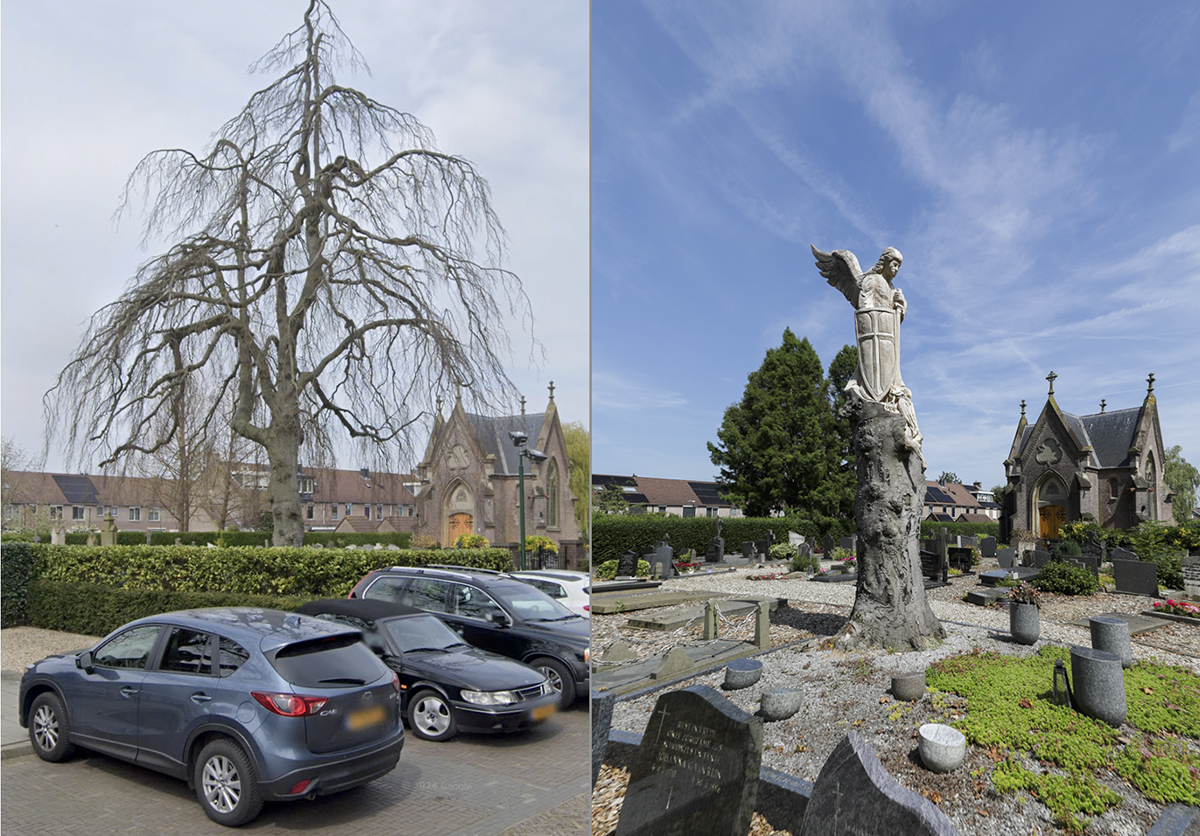
Before and after the arrival of Dave Harmsworth: from dead weeping beech to angel watching over the graves.
When he saws sculptures somewhere, local media and TV (sometimes also national) always report on his activities. It produces photogenic images: someone who from a cherry picker provides a huge wooden angel with a shield and sword.
That happened in 2024 at the Roman Catholic cemetery in Schalkwijk. From the trunk of a dead weeping beech he brought out the archangel Gabriel in four days, including high angel wings. Very practical: “I got those wings from a thick side branch, which I didn’t saw off too short. It is a tribute to that tree.”
That is not an unimportant detail, because sawing a sculpture from one piece can extend the lifespan of a wooden outdoor sculpture in the humid Dutch climate. “Although that also depends on the type of tree. An oak sculpture that is nicely in the wind can become very old. The wood does turn gray, but you have to learn to appreciate that.”
No decay with natural oil
Sun, weather, wind, rain, fungi and insects do their best to destroy wooden outdoor sculptures as quickly as possible. Harmsworth: “Decay is part of nature. Wooden sculptures in the open air cannot be preserved forever. But with regular maintenance with, for example, natural oil, a sculpture can certainly remain in good condition for twenty years.”
It is a well-known phenomenon. Anyone who has ever taken the trouble to look up where the oldest totem poles of the First Nations on the American and Canadian west coast stand knows that wooden outdoor art decays. The oldest totem poles do not go back further than the early 19th century. They can only be found in Alaska, where the frost provides extra preservation.
Only in Ketchikan in the US and also on the Haida Gwaii islands in British Columbia in Canada are these early cultural expressions still intact. All older totem poles have fallen apart everywhere, even though they were carved from durable cedar wood. The proudly presented totem poles in the Royal Ontario Museum in Canada are younger; from the late 19th century to the early 20th century.
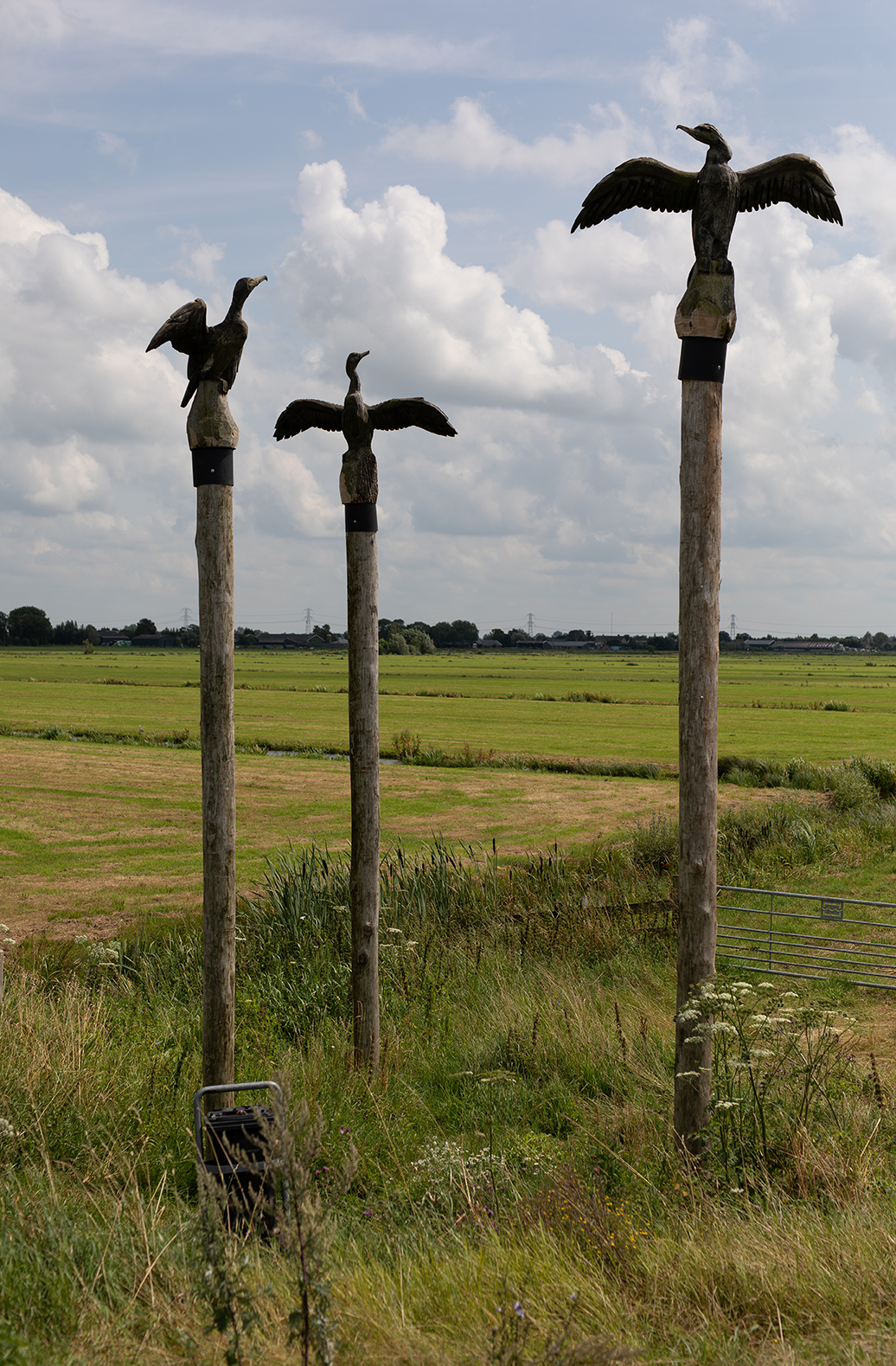
When some of Harmsworth’s sculptures also threatened to decay, this even led to a municipal action. His magnificent group of three cormorants at observation tower ‘Wierickewachter’ in the meadows of Driebruggen threatened to disappear.
The birds painted in ‘bilsen black’ had been placed on the trunks of dead poplars, but those poles turned out to decay very quickly, due to wood rot at ground level. After the well-preserved birds were temporarily stored, they got their old spot back on fresh tree trunks. There they have been drying their wings in the sun again since spring 2024.
Varied collection of machines
Harmsworth gladly shares his passion with other lovers of nature and wooden sculptures. At an evening of ‘Guts en Klopper’, the association of sculptors in wood in Huis ter Heide, he spread out all his tools on the workbench.
From large to small chainsaws, to a varied collection of grinders, drills, routers, sanders and sanding brushes. The table was full of them. It was proof that a title like ‘speed carving champion’ does Harmsworth an injustice. “I use them all to finish the sculptures”, Harmsworth said about his arsenal of auxiliary tools. How many gouges does he have? “Just one.”
So with this wood artist it certainly doesn’t stop at perfectly mastering the chainsaw, a tool that is mainly associated with destruction, the brutal cutting down of forests, or old avenue trees.
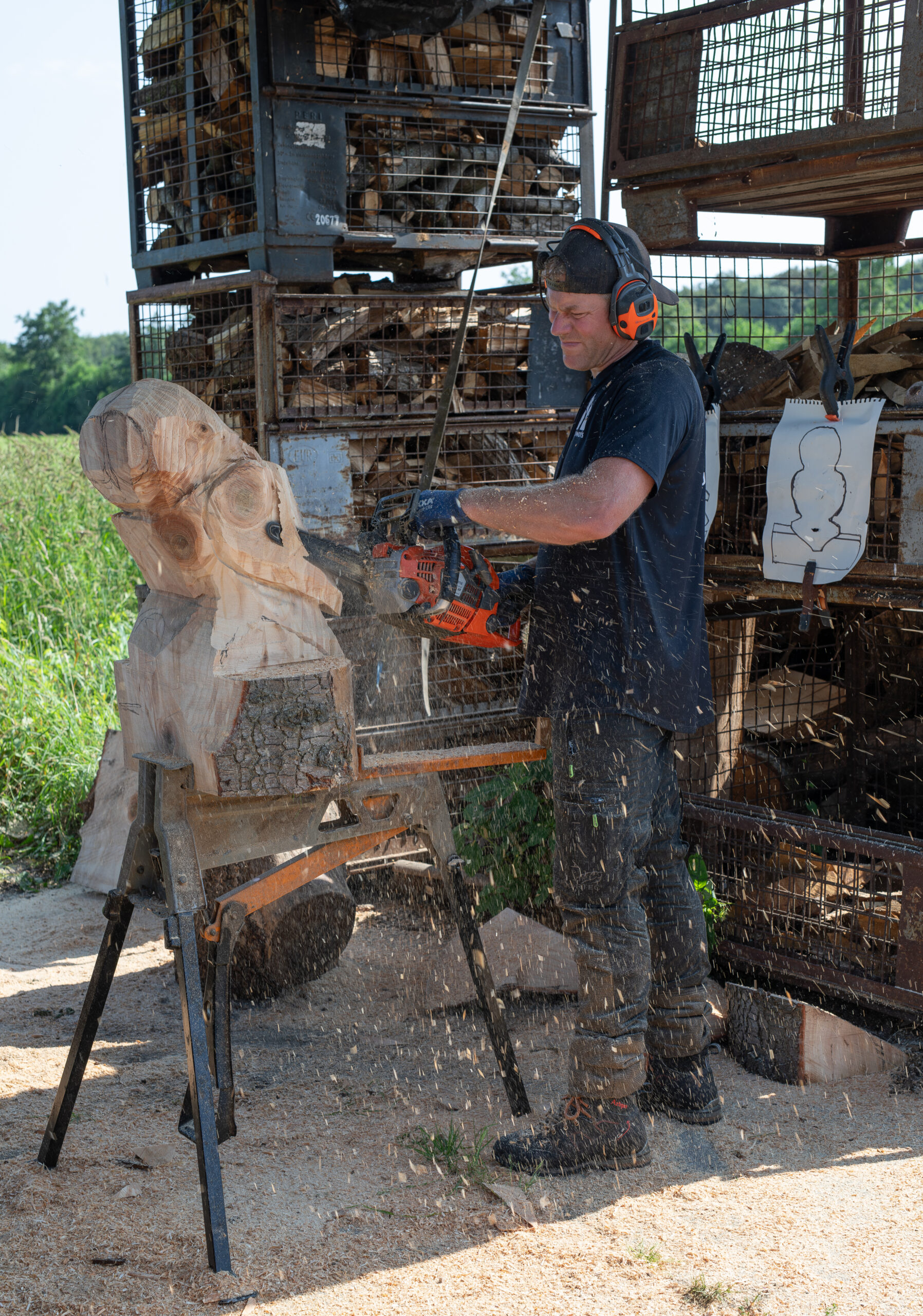
Dave Harmsworth, speed carving champion, behind his workshop in Groenekan.
Harmsworth developed sculptures with a beautiful balance between coarse expression and natural forms while carving. From him you don’t see clumsy wooden blocks, like those that so often appear with beginning woodworkers.
Harmsworth creates dynamic figures full of life, such as those found in the many wood workshops in Val Gardena (in Italian East Tyrol). Here there is even a separate art academy dedicated to the centuries-old wood carving tradition of the mountain inhabitants. Many woodworkers from this valley today know how to present their works at international art fairs like Art Miami.
Goldsworthy and Lingl
Harmsworth himself rather names the British landscape artist Andy Goldsworthy as someone he admires, and the German Jürgen Lingl-Rebetez, with his robust raw lion heads and other animals, such as wolves and panthers.
That dynamic I also increasingly seek in the sculptures I make myself. Every reason to invite Dave to put his chainsaw into a trunk of cedar wood for me. He was willing to bring out the rough forms of the owl of Minerva from it, over half a meter high (62 centimeters, with base). He didn’t need detailed working drawings again. The drawn outline of the sculpture: seen from the front and from the side, was sufficient.
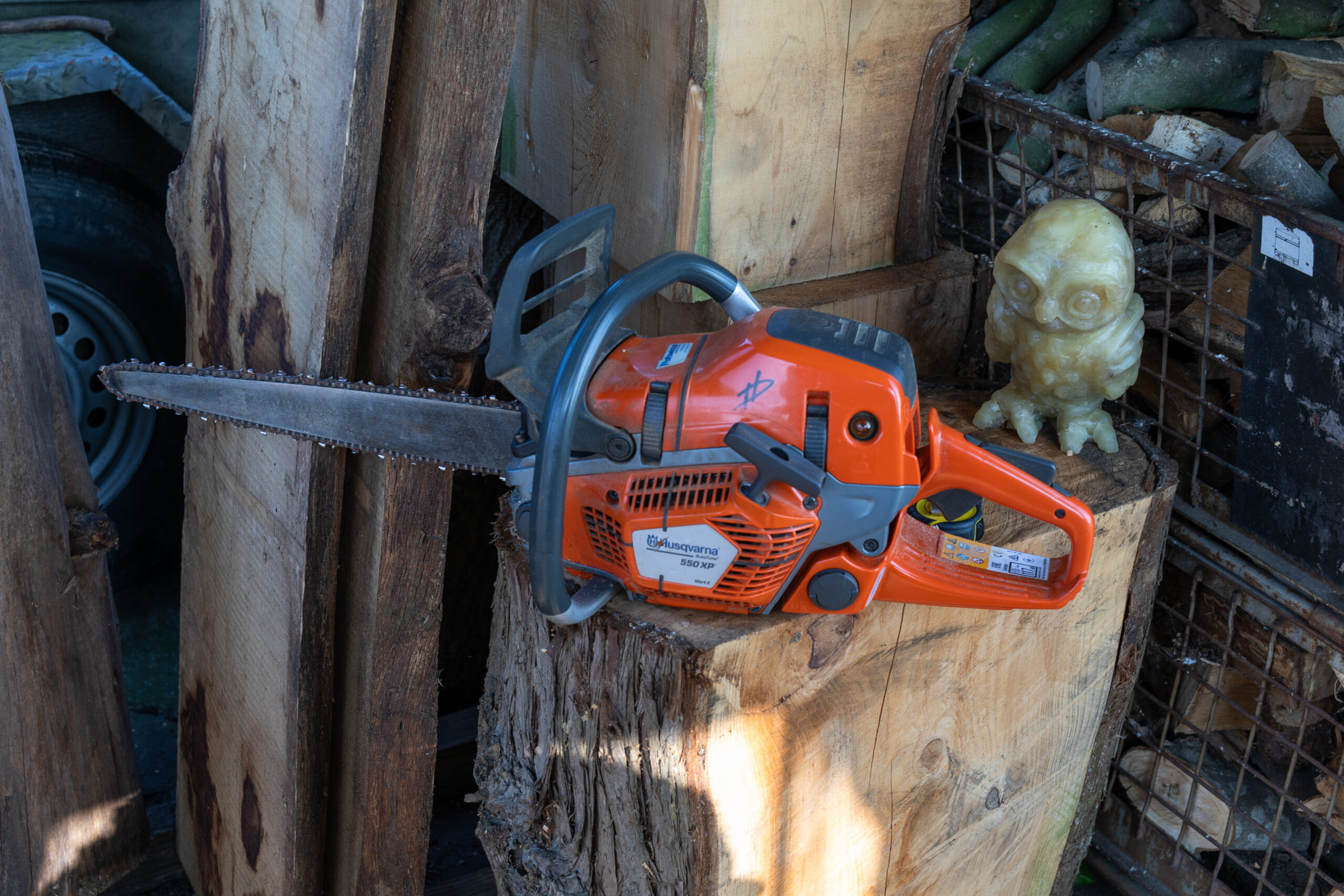
A model in blank wax of a ‘mythological’ little owl, a sculpture-in-progress commissioned by the Leiden student association Minerva.
My blank wax model at 1:2 scale provided guidance for the detailing of this sculpture, inspired by the owl of the Greek goddess Athena (the predecessor of the later Latin goddess Minerva). It is a little owl with large round hypnotizing eyes. It was depicted on Greek coins in ancient times, a tradition that continues to this day on the Greek version of the euro coin.
In three hours Dave had accurately extracted the sculpture from a substantial trunk of cedar wood in his workshop with three different chainsaws, ready for the finishing with my riffler rasps and gouges.
Harmsworth (and I) are making the ‘mythological’ owl commissioned by the Leiden student association Minerva, where the wooden sculpture will watch over parties and other activities high in the association hall.
Jan Bom