Ed Elliott burned an angel. That is to say: the top layer, the skin of the wooden sculpture. He turned this effect into a recognizable style feature. The annual rings in the wood that emerged through fire give his ‘burned’ sculptures an extra natural dimension that cannot be matched by any other material.
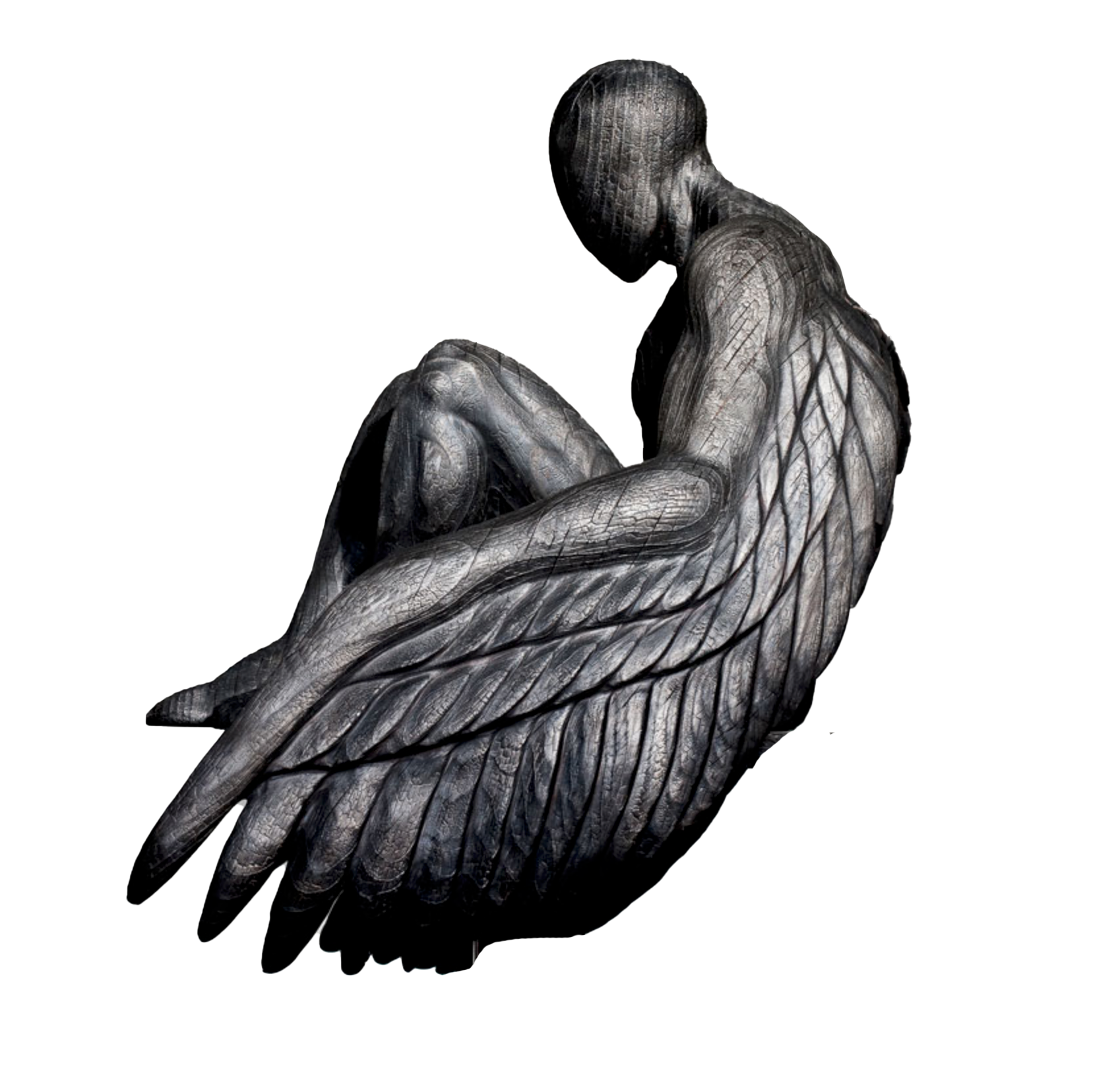
Charred Angel by Ed Elliott from 2018 (wooden original cast in bronze).
In the black charred and damaged skin both the violence of fire and the beauty of transformation resonate. What initially seems destructive thus becomes a signature of protection. I find it an intense and beautiful technique.
Wings on the arms
Among the most famous works of British sculptor Ed Elliott (1985) are his Angel Series. They are monumental wooden figures with spread wings, attached to the arms, instead of on the back. These sculptures situate themselves at the intersection of spirituality and physicality. The first of this series, Greer, is a kneeling angel, the wings spread on the ground.
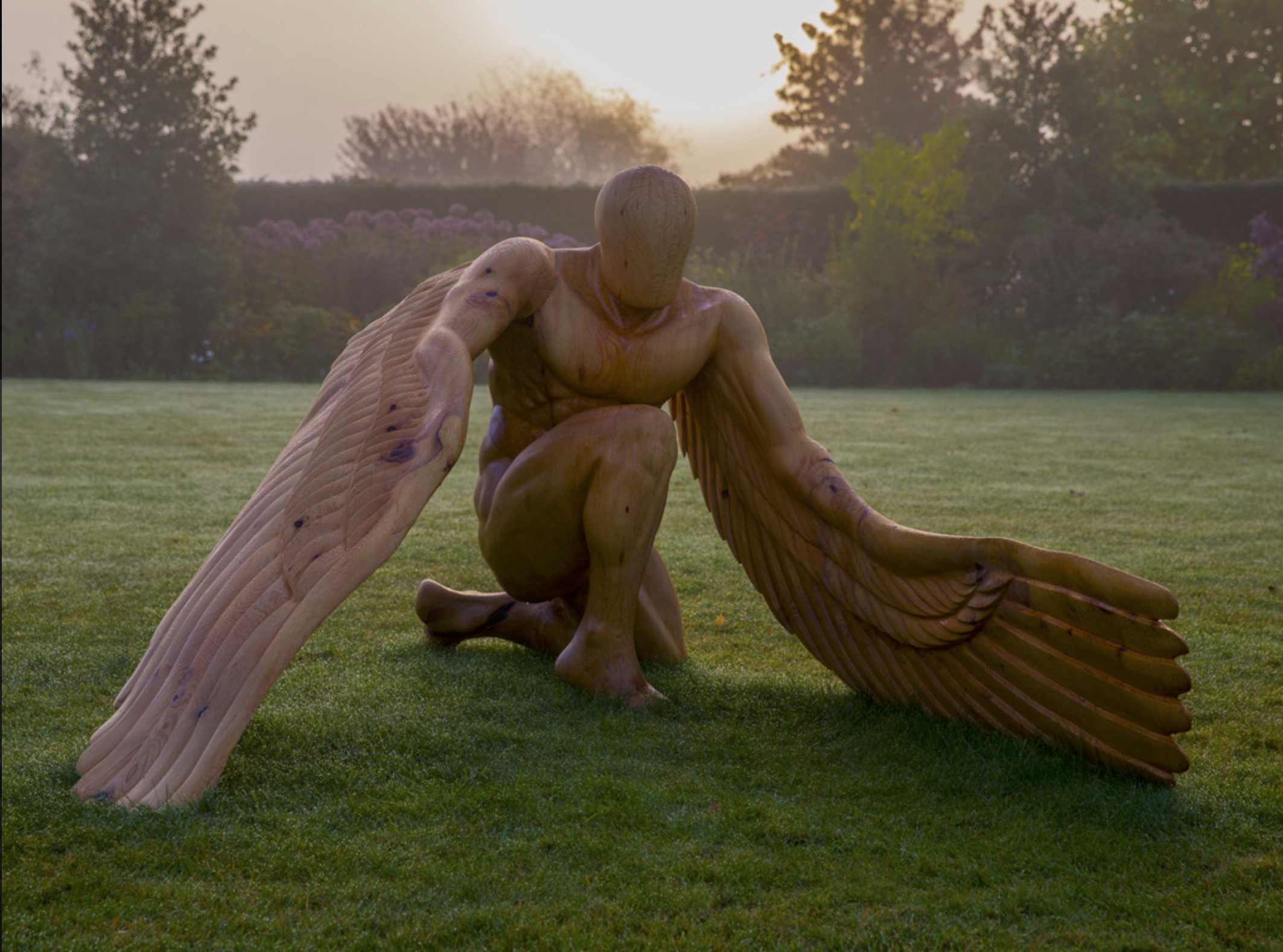
The sculpture Greer (Mottisfont Angel) by Elliott from 2011 (not burned) with a wingspan of 4 meters.
Unlike religious iconography, in which angels are carriers of a dogmatic message, Elliott’s angels embody both protection and vulnerability, elevation and heaviness.
Truth to Materials
The charred surface of some of his sculptures reinforces this tension: the angel appears as an elevated figure, but at the same time bears the scars of fire and transience. Grand, overwhelming, but also confrontational in its destructive dimension.
Methodologically Elliott connects to the concept of truth to materials, which was propagated by the modernist sculpture of the early twentieth century. In sculpture, the famous British sculptors Henry Moore and Barbara Hepworth adopted this concept, by looking at how the sea wears down driftwood stones and at the grain of wood in trees.
Japanese preservation technique
Elliott’s method begins with the rough chainsaw, followed by meticulous handwork with gouge, mallet and sandpaper. But then he sometimes applies a drastic post-treatment: he burns the surface. The soft wood between the harder annual rings burns faster, creating a landscape of rolling grooves, after the shiny black charcoal has been brushed off. As a wood type for this method he chooses cedar wood, among others, but also cypress (the Leylandii) and also yew.
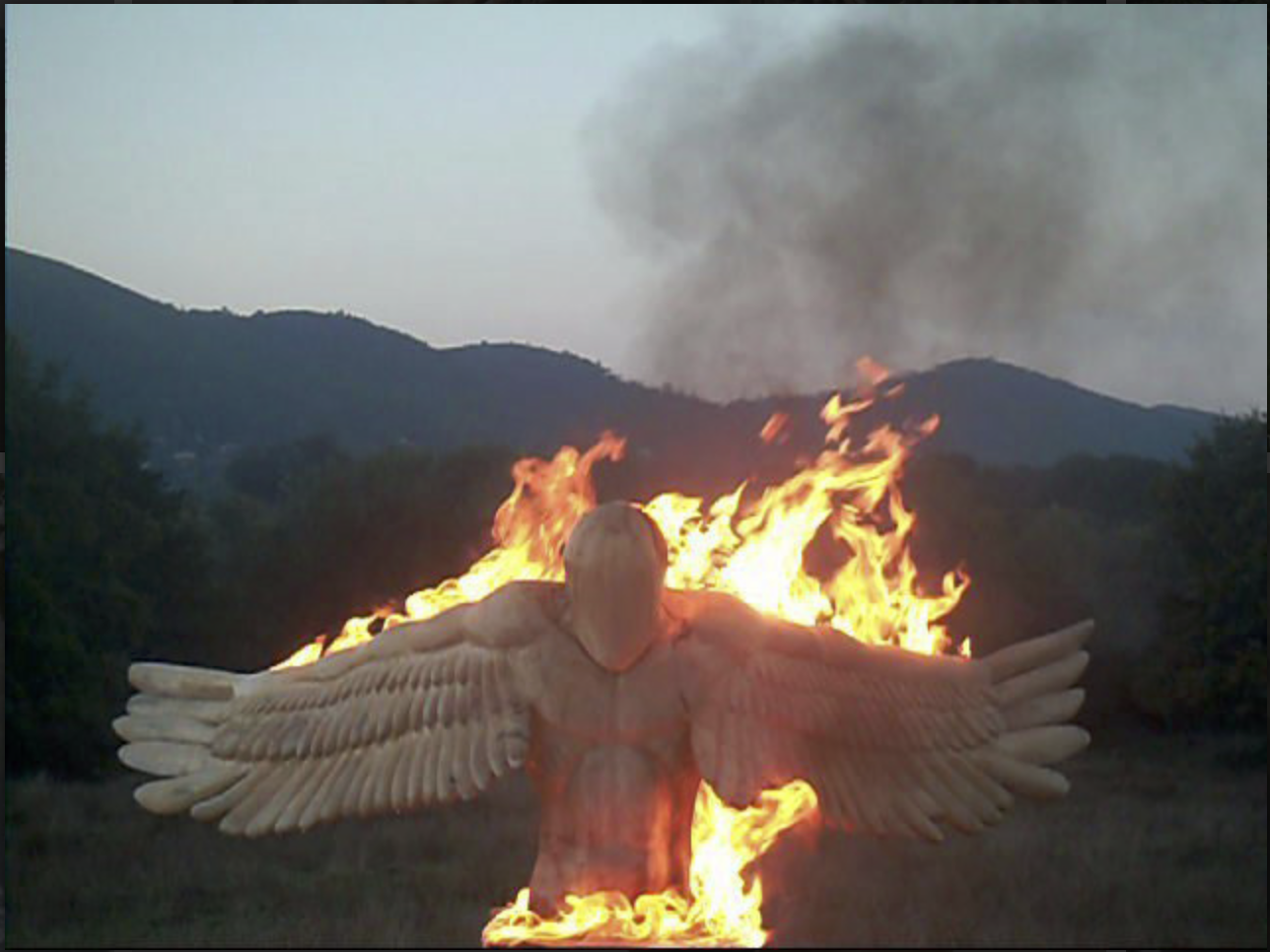
The sculpture ‘Burning Angel’ by Elliott from 2013.
This ‘charred’ technique is related to the Japanese method shōu sugi ban (焼杉板), in which wood is also charred in a controlled manner. This treatment creates a protective layer that makes wooden planks for homes more durable, more resistant to weather influences, while the black top layer adds a dramatic aesthetic. Other advantages: the wood is more resistant to fungi and insects like woodworm. The black top layer even acts as a fire retardant (!). Varnishing and paint maintenance is no longer necessary. In a P+ Special about wood construction a house in Amsterdam is shown – on page 4 – with exterior walls that have been treated with this Japanese technique.
By burning the skin of sculptures, Elliott moreover strengthens the dialogue with his material: fire becomes a fourth dimension, alongside design, processing and environment. The end result carries both the energy of nature and the traces of controlled destruction, giving his sculptures a charged, almost sacred presence.
Exploring organic forms
Wood as a sculptural medium has had an ambivalent status in the twentieth century. The previously mentioned Henry Moore and Barbara Hepworth used the material in the early phase of their careers to explore organic forms, but especially Moore soon switched to bronze and stone to make his works more monumental, and suitable for placing outdoors without problems. Moore saw wood as a material that was ‘too intimate’ for these ambitions, while Hepworth spoke precisely of the ‘direct dialogue’ that the material forces with the maker. Elliott especially aligns with this latter attitude.
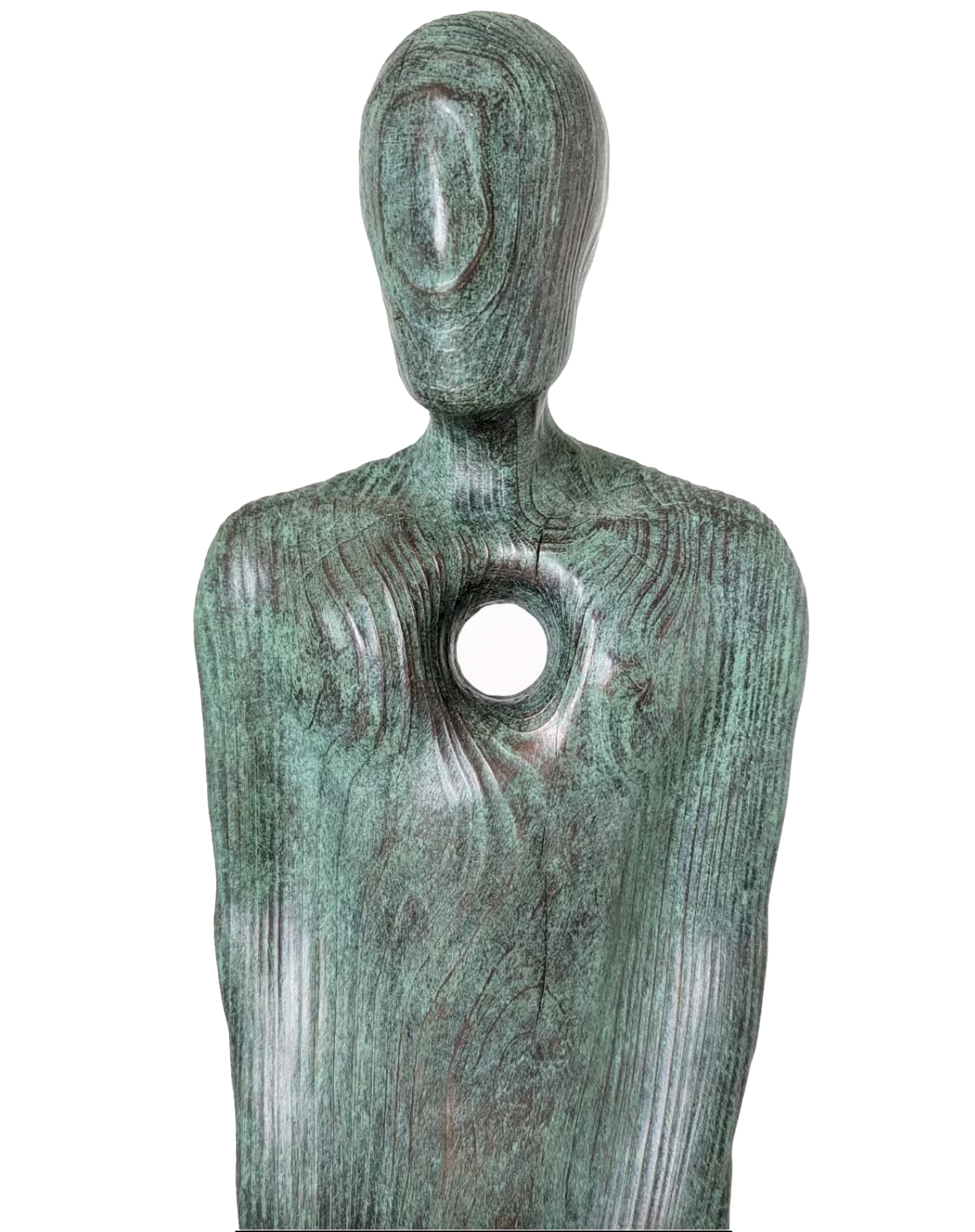
Elliott also casts his burned sculptures in bronze; the annual rings that emerged from the wood are still clearly visible.
Elliott regularly chooses to have bronze casts made of his wooden originals. It is a strategy that more artists apply. Not only can bronze sculptures stand outside better than an organic and thus eventually rotting material like wood. Bronze is moreover judged as ‘more valuable’ by the art market and public institutions. In this he balances between tradition and commerce, but always without losing the original appearance of the wood. The Westover Gallery has many sculptures by Elliott on display.
Between destruction and renewal
Ed Elliott’s work shows how the reappraisal of wood as a sculptural medium in the twenty-first century is not just nostalgia for the Medieval master woodcarvers. Elliott uses wood to conduct a current dialogue about sustainability, spirituality and the role of craft in art. The Japanese burning technique gives his sculptures not only physical protection, but also a symbolic charge that explores the boundary between destruction and renewal.
In a time when contemporary art is often dominated by conceptual works, Elliott reminds us that material, method and myth remain inextricably linked.
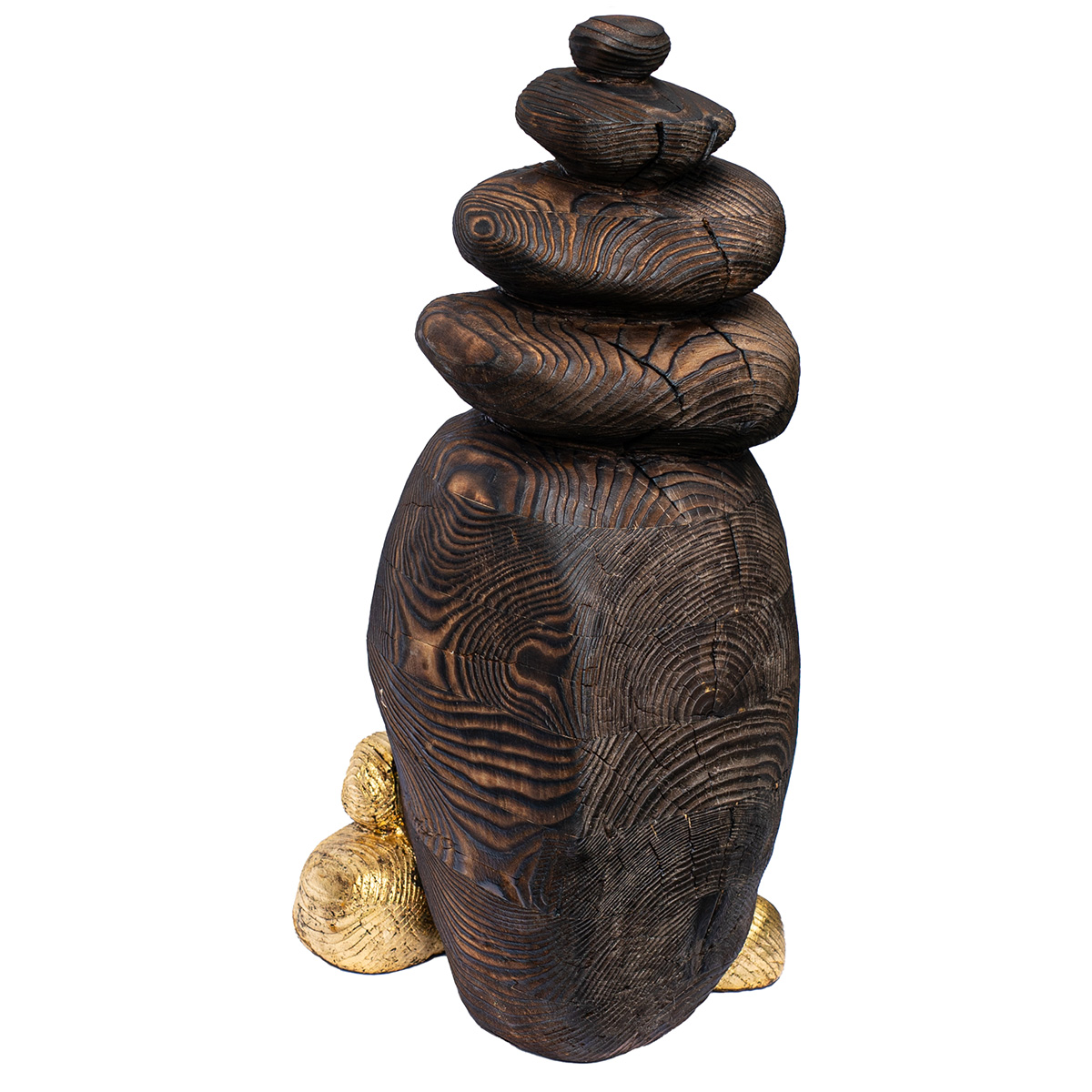
My own sculpture Wonderstones, cross-laminated timber (CLT) treated with a gas torch.
But Elliott is not the only artist who applies the shōu sugi ban technique. I myself use it to enhance the unique characteristics of Cross Laminated Timber (CLT), among others in the sculpture Wonderstones. I call these stories that emerge from the wood: Dendroism, after the Greek word Dendro (tree).
Other examples are:
+ Katrien Doms (Belgium), an interior architect, who mainly makes abstract panels for the wall.
+ Óscar Aldonza Torres (Spain) makes busts and sculptures in which charred olive wood forms the skin.
+ Dean Marino (Marino Piotti) (Italy) makes minimalist sculptures in wood, where fire enhances the texture and aesthetics.
+ And let’s especially not forget the Dutch designer Maarten Baas who made a sensation with his black burned furniture for Moooi.
Jan Bom September 15, 2025