Giacometti dreamed of a palace at night, at 4 o’clock in the morning. Influenced by other surrealist artists he constructed a fragile structure of wooden rods with abstract wooden sculptures inside: a female figure, a skeleton of some kind of flying dinosaur, a bowl with a ball in it.
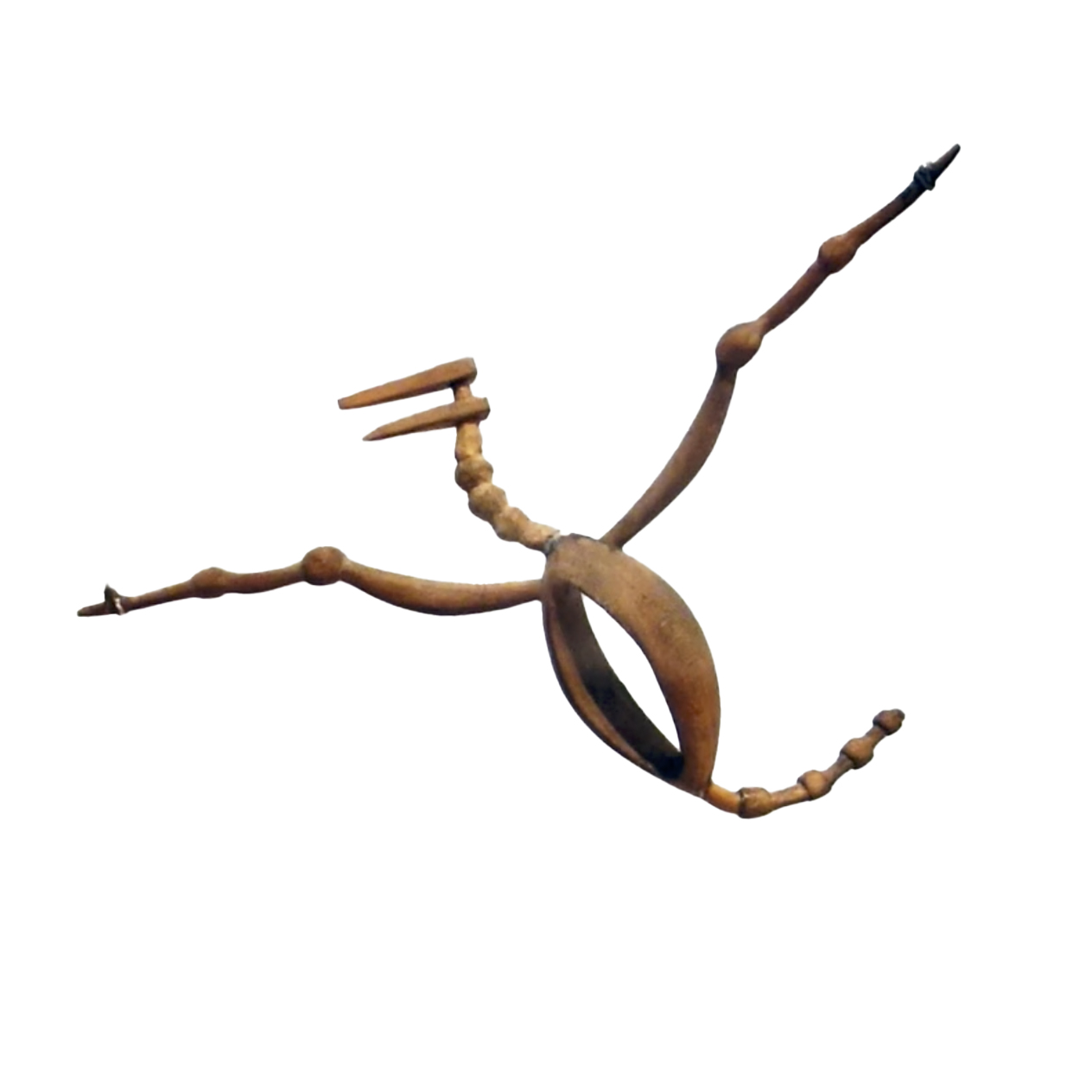
One of the dream images from Giacometti’s installation ‘The Palace at 4 a.m.’
It is not the first image that comes to everyone’s mind when it comes to the Swiss-born Alberto Giacometti (1901 – 1966). He became famous with his extremely elongated human figures. The men walking with legs wide apart, on their way to somewhere. The women with legs tightly closed, untouchable. But those sculptures only came into being after World War II.
Before that, in the summer of 1932, he processed dream images into an installation that was even more fragile than his later human figures. In the magazine Minotaure of the surrealist movement he described the making process of this composite sculpture: ‘The Palace at 4 a.m.‘
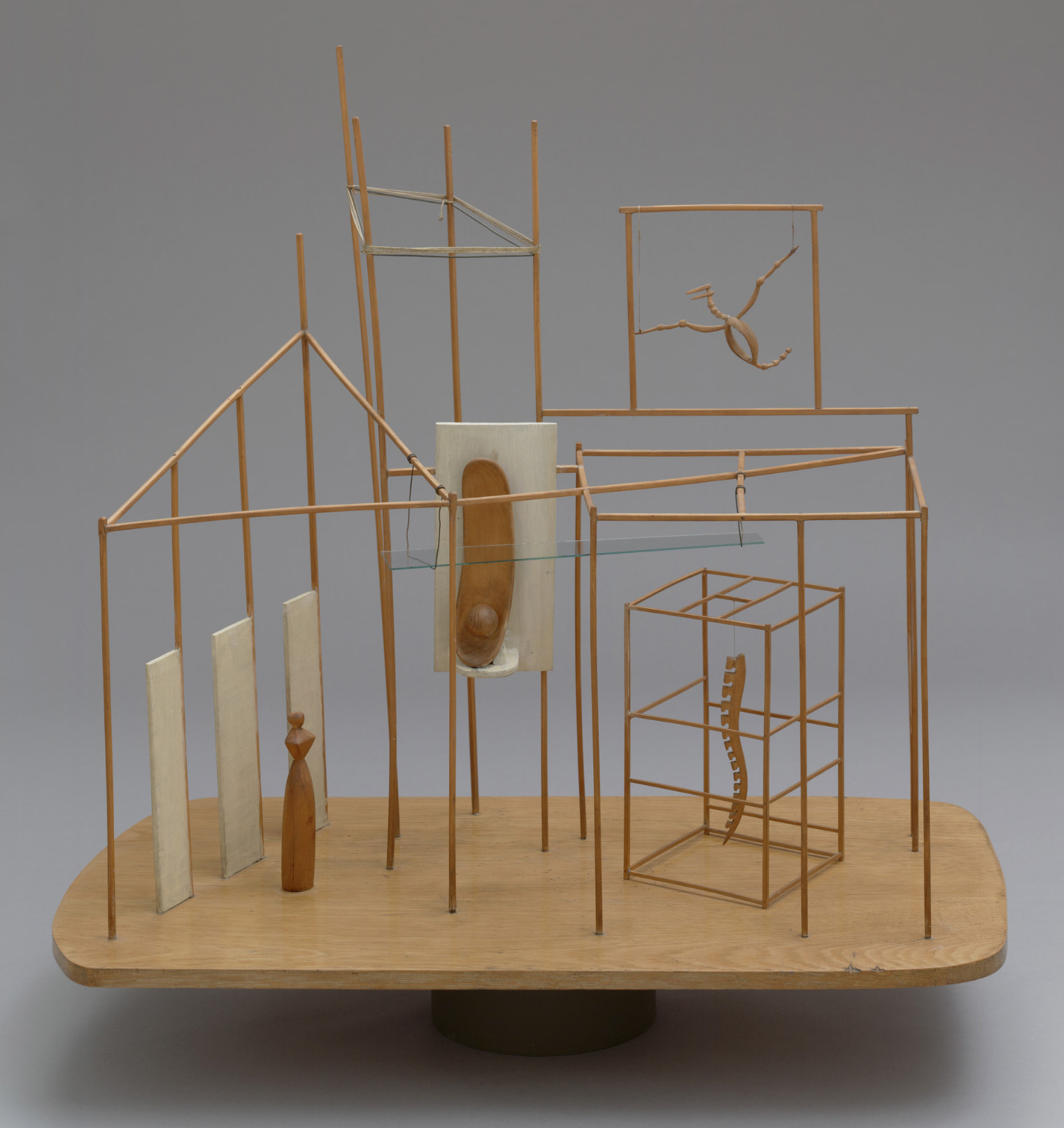
Giacometti captured a vision as in a dream in this sculpture.
Giacometti wrote: “The object gradually became clearer to me. The various parts took their exact shape and their specific place in the whole. By autumn it had reached such a reality that its execution took me no more than a day.” The process fit precisely with what the surrealists called ‘the automatic recording of visions as in a dream’.
The viewer becomes a voyeur
Within the thin, fragilely defined spaces of his palace, Giacometti connected the rooms from left to right with a thin plate of hanging glass. It further enhanced the vulnerable appearance of the structure. It also makes the viewer a ‘voyeur’, who looks down through a window uninvited.
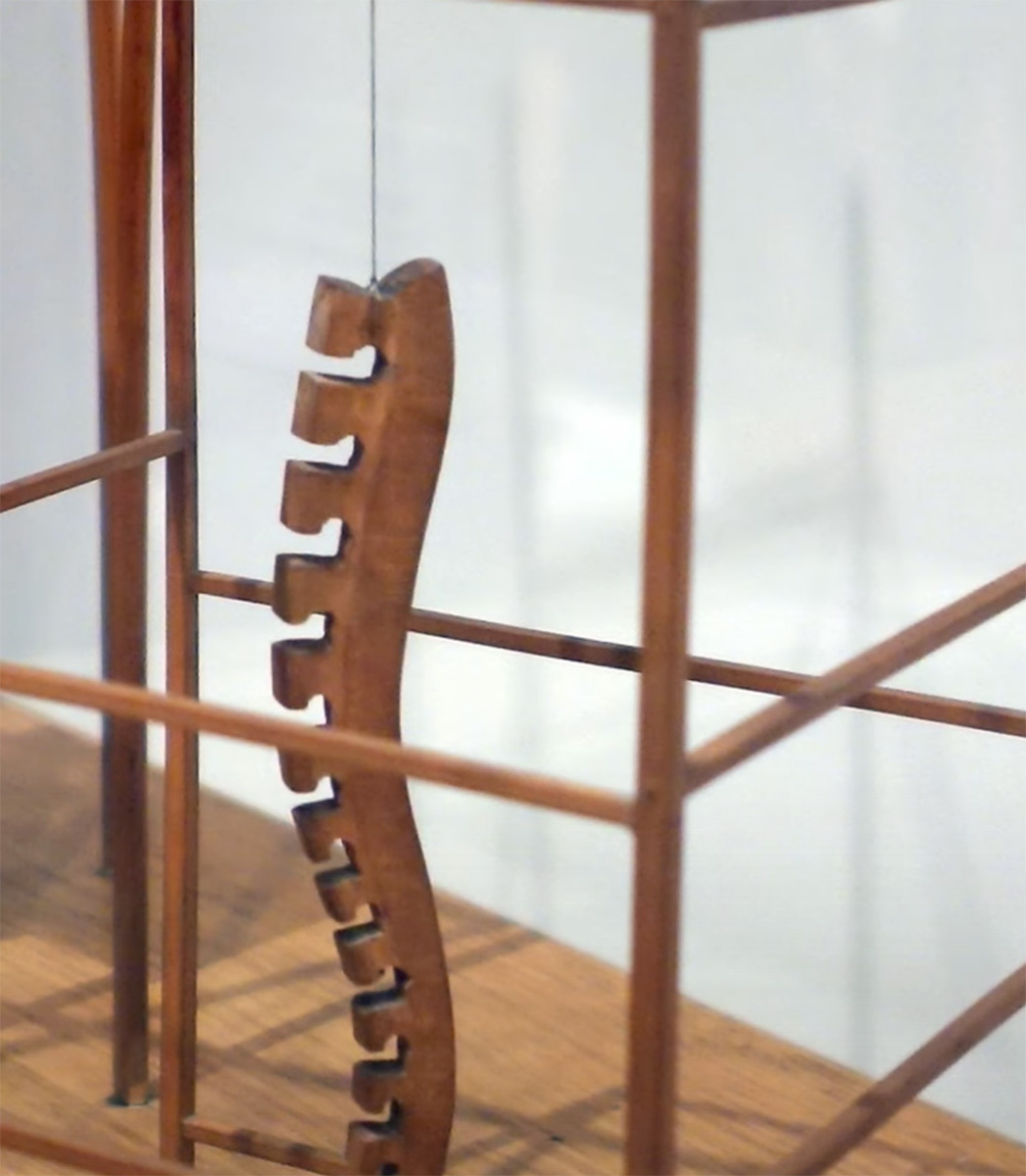
Detail from the installation: in the frame of wooden rods Giacometti hung a spinal column.
On the right float the skeleton of a delicate dinosaur-like bird and a winding spinal column. They are suspended in space frames or cages. On the left stands a chess piece-like figure of a woman in front of three panels. Abstract in form, but not yet as thin as his later sculptures of clay and bronze. In the middle stands an enigmatic elliptical form that the artist identified with himself. It is a strange and sexually charged figurine of an elongated wooden bowl with a ball in it, threatening to fall out. In a video on YouTube two art experts discuss the whole.
A fragile palace of matches
The installation as a whole has dimensions of 63.5 by 71.8 by 40 centimeters.
In his report in Minotaure Giacometti compared the whole to a ‘fragile palace of matches’. He would build it together with a lover of his from those years every night, only to often see it collapse again.
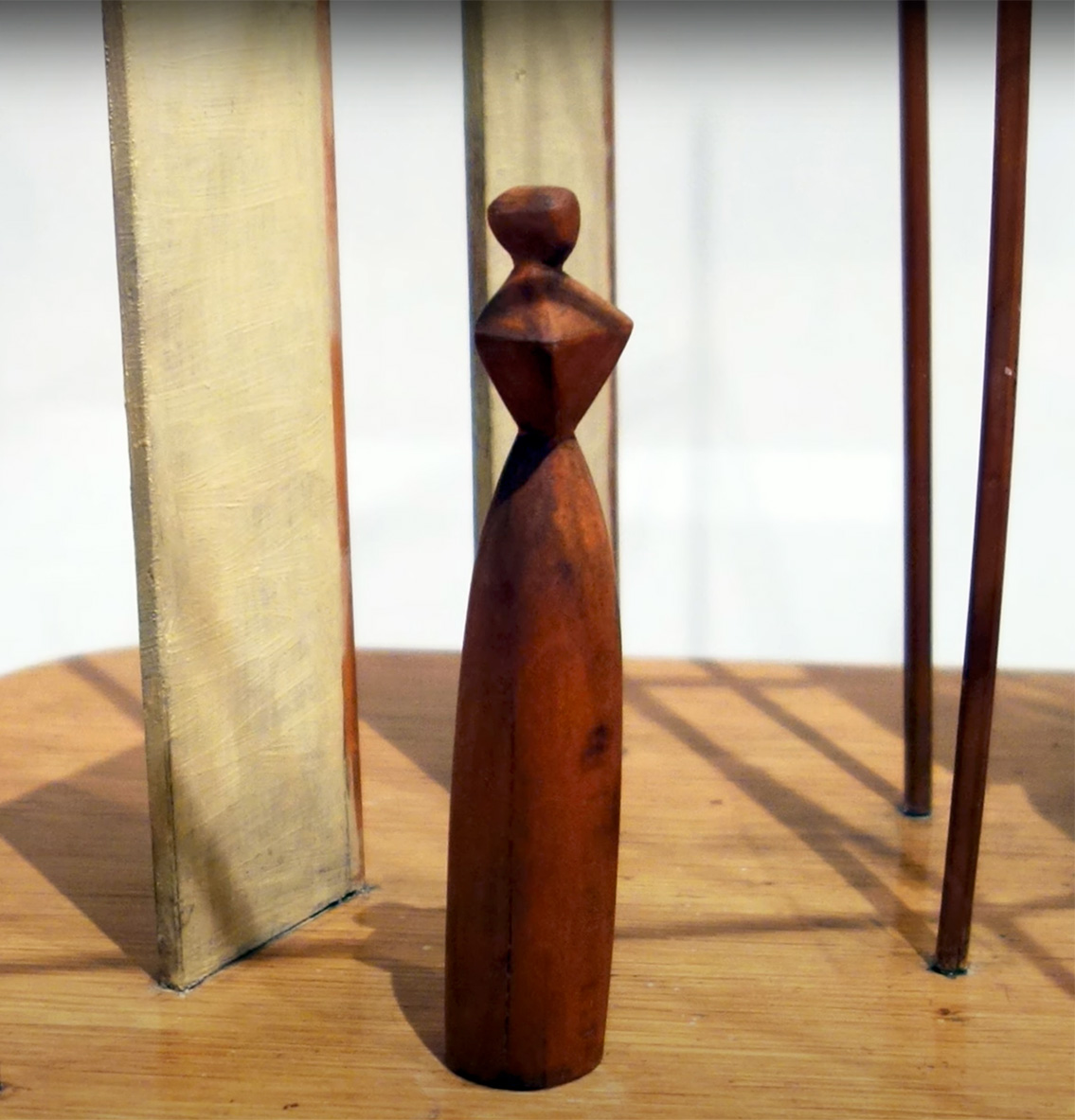
The female figure by Giacometti, not nearly as fragile as his later sculptures.
In the retrospective exhibition of surrealism at MoMA in New York in 2024 the curator states: ‘His words give voice to important surrealist preoccupations, including all-consuming desire, the power of memory and the relationship between Eros and Thanatos – love and death.’ A century ago, in 1924, the Frenchman André Breton drew up the surrealist manifesto, inspired by the works of psychoanalyst Sigmund Freud. This is the occasion for this commemoration, unexpectedly featuring this early, unknown work by Giacometti.
Text Jan Bom, October 30, 2024