Gregor Prugger has made a heart of wood. From the heart-shaped sculpture sprouts a bunch of branches that strikingly resembles the widely branched bloodstream in human lungs. This wood artist from Val Gardena tells a story that is already hidden in the wood. He only adds something of himself to it. I call that Dendroism.
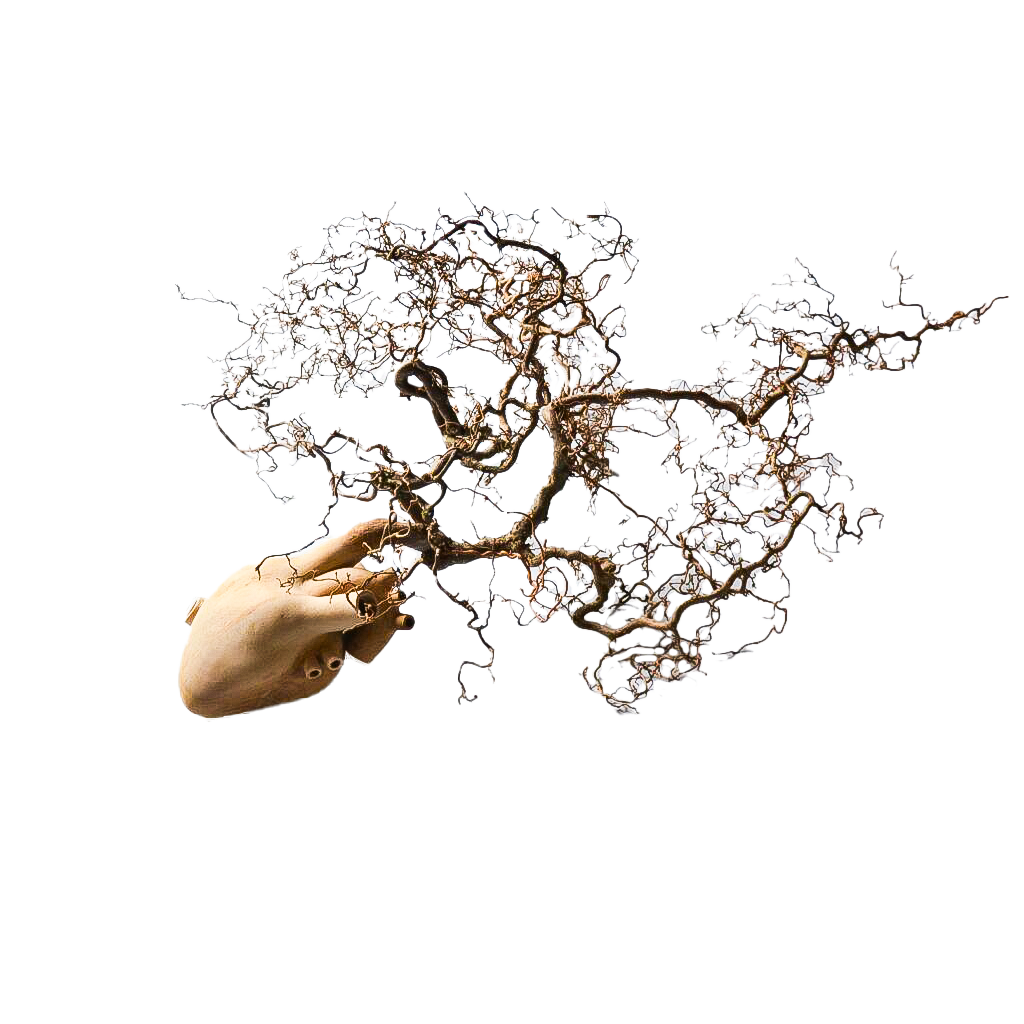
Gregor Prugger has made a heart of wood, partly carved, partly a bunch of branches. From the series ‘Incorporations’.
In numerous works by Prugger (born in 1954 in St. Ulrich/Ortisei, South Tyrol, Italy) clear echoes of natural forms emerge. Characteristic of this I find the way Prugger incorporates structures of roots, knots, rings and branches into a sculpture, as in the series Incorporations.
Prugger and Dendroism
Although he does not literally copy natural objects, his visual language often seems to have emerged from the association with organic growth, entanglement and rhythm. Sometimes he only accentuates natural lines so that they reveal almost abstract poetic forms. Other times he stays closer to recognizable trees, branches and root systems. The interaction between naturally grown forms and contours carved by human hands makes his work recognizable and unique.
Prugger is thus, of the well-known wood carvers from Val Gardena, the one who most closely aligns with the principles of Dendroism. The trees or the wood already hide the story within themselves. The artist at most adds his own elements to it. Incidentally, fellow townsman Willy Verginer also quite often mounts wooden branches and skeletons on and under his sculptures, so that a pink Bambi stands lookout high in a tree.
Sons of the Dolomites
Prugger belongs to a modern generation of artists from Val Gardena who continue the centuries-old wood carving tradition of their region and at the same time radically renew it. His contemporaries include Willy Verginer and Bruno Walpoth, who also still live and work in Ortisei. They are quite homebound, these sons of the Dolomites. Prugger even depicted this feeling in a sculpture, which he called Homesickness. It is a wild tree stump, partly rootstock, with two golden wings mounted on it. Wherever he was, he preferred to fly straight back to his roots.
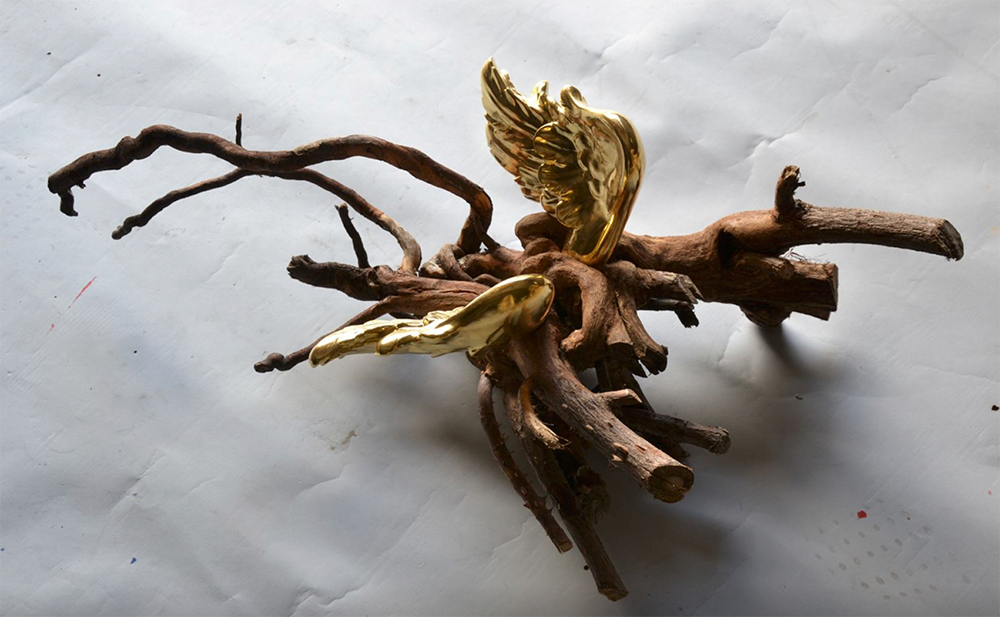
Homesickness, a sculpture by Prugger that makes clear how closely he is connected to Val Gardena.
Prugger’s artistic development is also deeply rooted in his childhood. He grew up in his father’s studio, also a wood carver. Here he learned the craft at an early age. After his formal education at the art academy in Florence, he returned to Val Gardena. There he first taught visual arts at the secondary school in Ortisei, then completed an intensive training in wood carving in his father’s workshop. Here he qualified as ‘Meister im Holzbildhauerhandwerk’ (Master in Wood Sculpture Craft). At 25 years of age he opened his own studio and began his career as an independent artist.
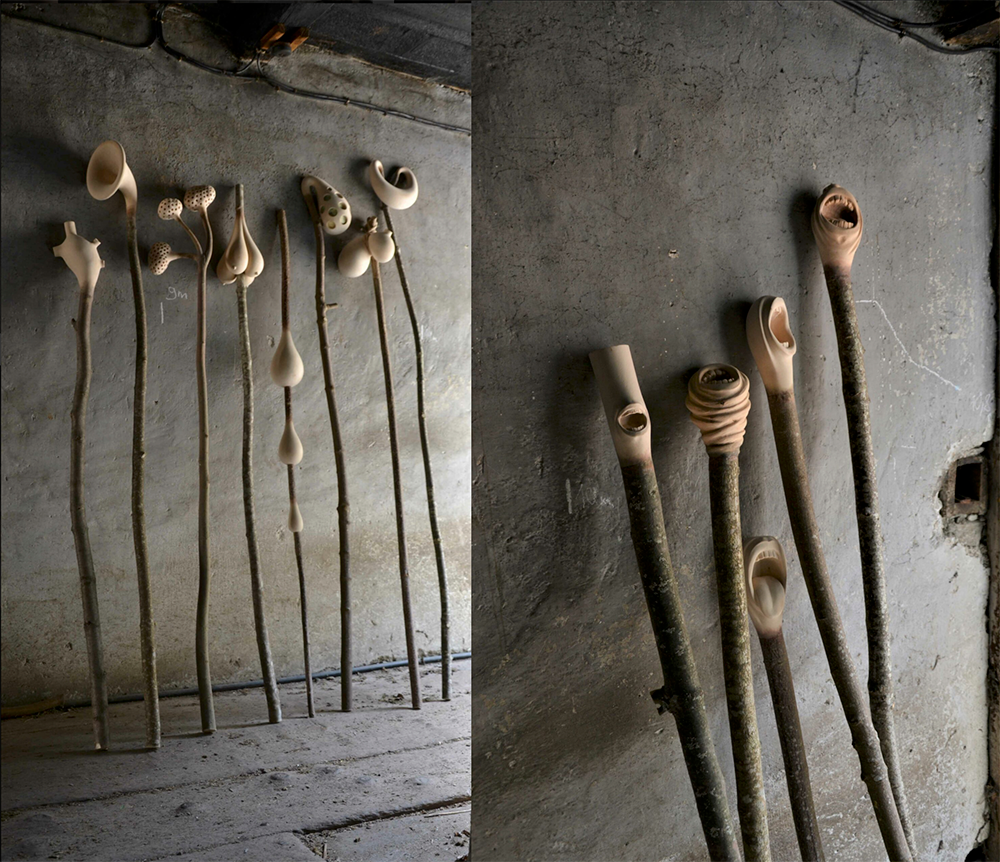
From his series ‘Ji de priac’: thick branches on which Prugger mounted open mouths and other organic forms.
Nature in the mountains is the central theme in Prugger’s work. He finds inspiration not in abstract ideas, but in the things he observes during walks. These can be natural forms, but also rhythms and structures in trees, plants, flowing water of mountain streams and the vertically rising rock formations. His approach is one of dialogue with nature. He therefore lives the entire summer high in the mountains, where he works in an old farmer’s barn. It is his base for expeditions in search of his sources of inspiration and visual poetry. Here he also receives groups of tourists.
Artworks that must decay
Prugger has a long exhibition history, both nationally and internationally. Since the eighties he has presented his work at numerous solo and group exhibitions, from Northern Italy to Germany and the Netherlands. For instance, he was on display at the CODA Museum in Apeldoorn as part of a group of Val Gardena sculptors in 2011 — an important moment that also brought his work to attention outside Italy. On the website Artsy quite a few of his works are for sale.
In addition he participated in international projects such as the Biennale Gherdëina with the Sculpture Forest Sanctuary project. Here his work, together with other artists, was placed in natural forest environments, using materials from the forest itself. The idea of these works was that they would decay over time and become part of the ecosystem again — a concept that stays true to Prugger’s artistic themes of nature and transience.
In 2025 Prugger received the Merit Ladin prize, recognizing his lifelong contribution to the culture and artistic heritage of South Tyrol. The jury especially valued the clear symbolism, ‘the poetic visual language and the connection between craft and idea’ in his oeuvre — qualities that emphasize his approach to wood and natural forms.
Jan Bom, January 18, 2026