Joseph Beuys planted 7000 oaks, one for each basalt block he had stacked high in the city of Kassel. The action of this German artist reflected the growing environmental awareness around 1980. The artwork radically expanded the boundaries of sculpture, performance, and social engagement.
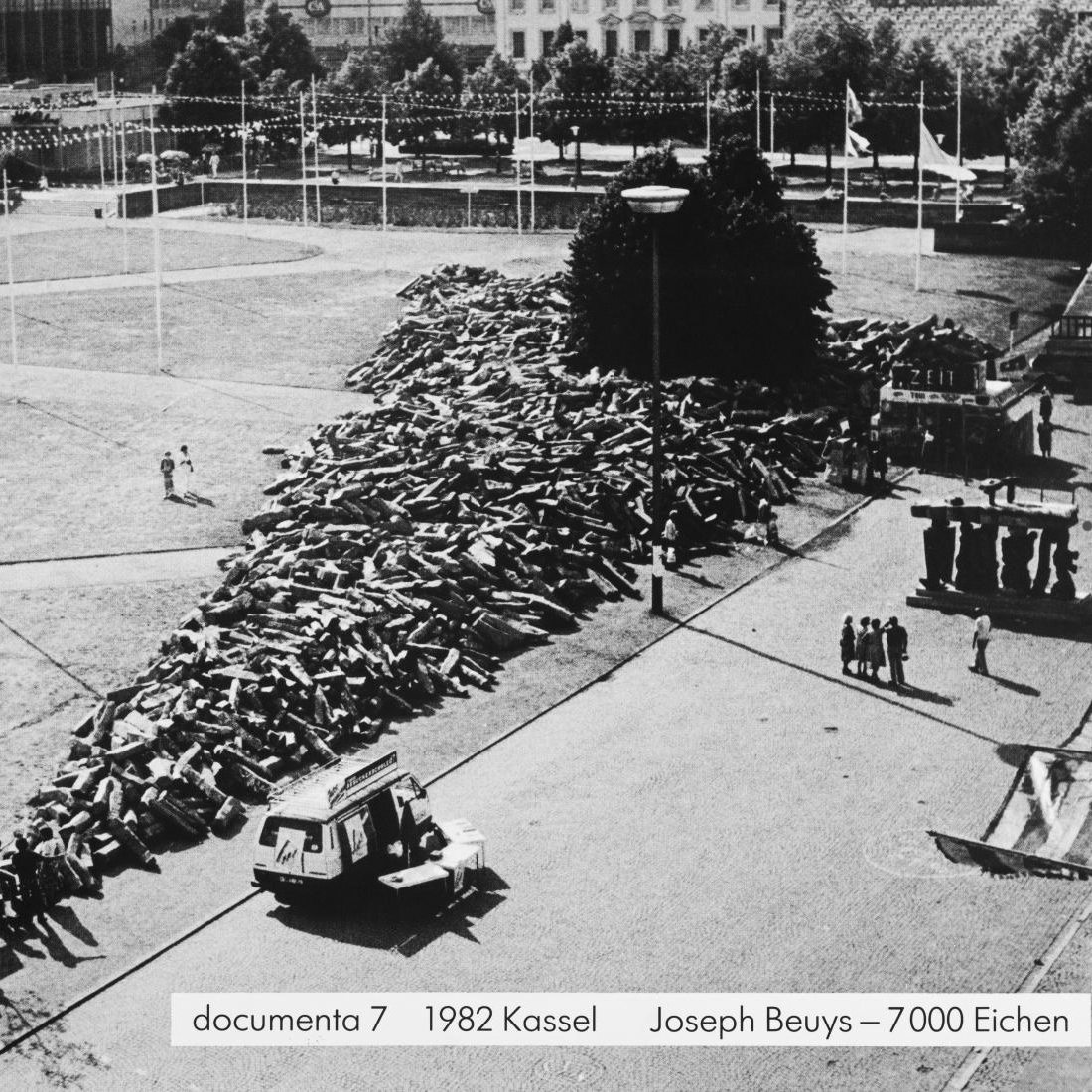
Joseph Beuys planted one oak tree for each basalt block in Kassel.
Joseph Beuys (1921–1986) is considered one of the most influential artists of the 20th century. Central to his vision was the idea that art could be more than aesthetic. It could also serve as a tool for social and ecological change. This idea became most tangible in his monumental project 7000 Oaks (1982).
Art as a Promise
This art initiative began as a promise: 7000 oaks would be planted across and around the city of Kassel. The basalt blocks served as markers, a physical indication of human intervention in the urban space. Once an oak tree was planted, a basalt block could be removed from the stack. Or, if there was room, placed beside the newly planted tree.
Beuys introduced the process of public participation. 7000 Oaks symbolized growth and transformation. The 7000 basalt blocks were not a permanent sculptural monument. They were not the endpoint, but a means to raise awareness. A symbol of action and society’s responsibility for a greener environment.
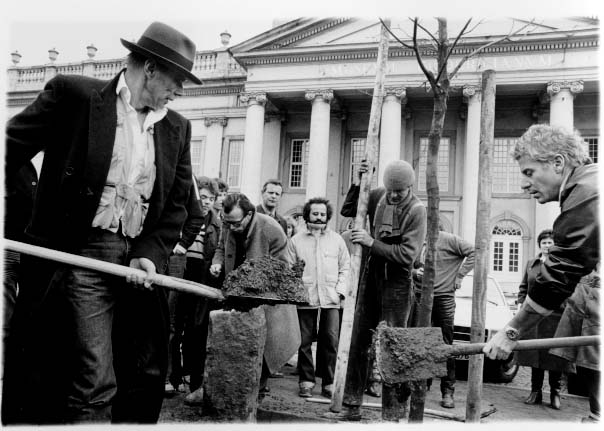
Beuys planting one of the oak saplings in Kassel, the first ecological art installation.
Born in Krefeld, Germany, Beuys was fascinated early on by nature and mythology. His experiences during the Second World War shaped his thinking. As a pilot, he was seriously injured. This trauma strengthened his belief that healing and transformation are fundamental forces, both for individuals and for society as a whole.
After the war, he studied sculpture and became involved with avant-garde movements. Here he further developed his ideas about art as a social process. For Beuys, the artist was not only a maker of objects but an active participant in shaping society and nature.
Art as an Activator
The choice of oaks in the project was deliberate. These native trees have long symbolized strength, continuity, and connection to the environment. Basalt, a durable volcanic rock, marked human responsibility toward nature. The project offered a radical reinterpretation of urban art. Not static objects, but a constantly changing network of living organisms that challenged citizens to participate actively. By involving people in planting and caring for the trees, Beuys turned the audience into co-creators of the artwork, making his idea of “social sculpture” concrete.
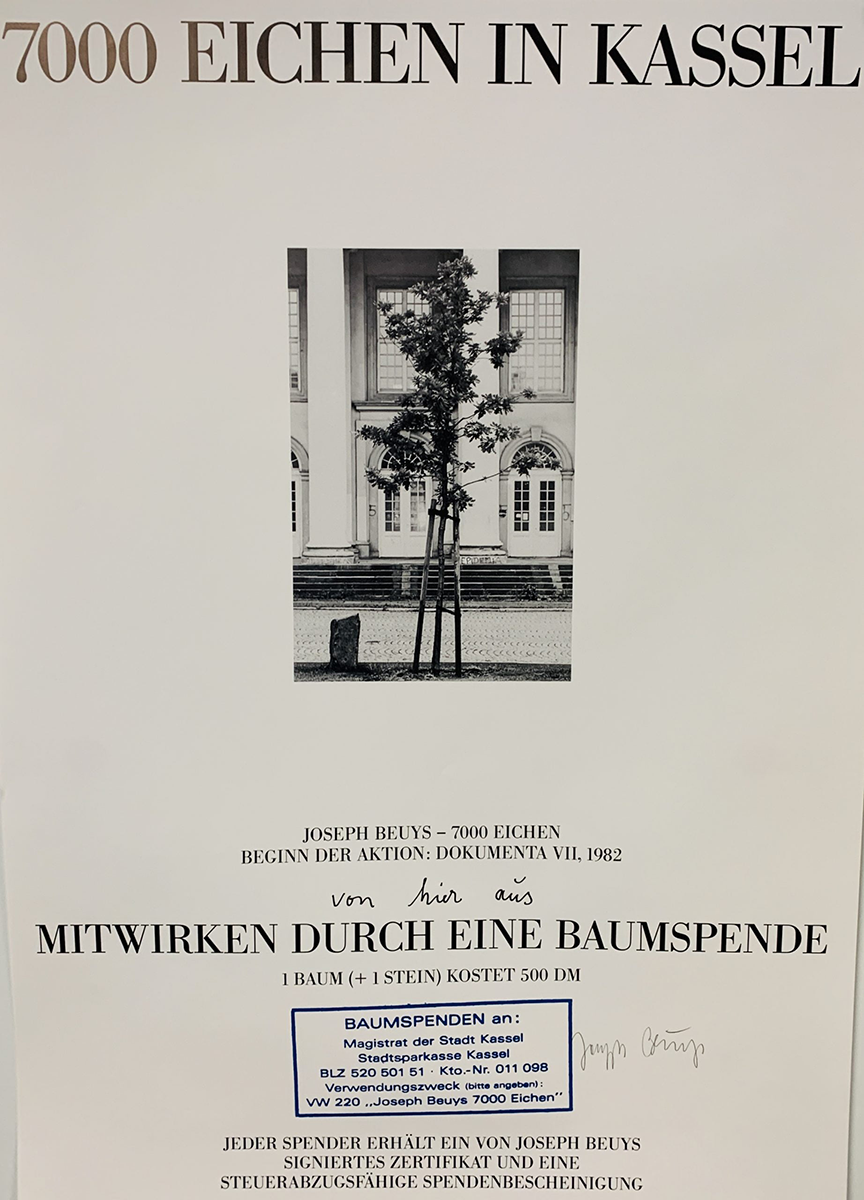
The prospectus of the art initiative: one oak tree and one basalt block cost 500 Deutsche Marks at the time.
7000 Oaks should also be seen in the context of the emerging environmental awareness of the late 20th century. In an era of industrial expansion and habitat loss, Beuys offered an alternative vision: a city where art, ecology, and social engagement come together. The project demonstrates that sustainable change requires time, collective action, and ongoing care. For Beuys, the process was as important as the final result. He emphasized that ecological thinking and citizen participation go hand in hand.
The Idea Spread Worldwide
After Beuys’ death, his idea was followed worldwide: in cities such as New York, Baltimore, and Los Angeles, trees were planted inspired by 7000 Oaks, often with participation from local communities and organizations. The target number was indeed achieved. Five of Beuys’ oaks can also be found at the Kröller-Müller Museum.
Exhibitions and educational projects such as Beuys’ Acorns in London have shown how the concept of participatory, ecologically conscious art continues to live on. Artists Heather Ackroyd and Dan Harvey collected acorns from the original 7000 Oaks in Kassel and grew them into young trees. In 2021, 100 of these trees were displayed on the South Terrace of the Tate Modern in London as a contemporary living sculpture—a tribute to Beuys’ intention to commemorate the relationship between humans and nature.
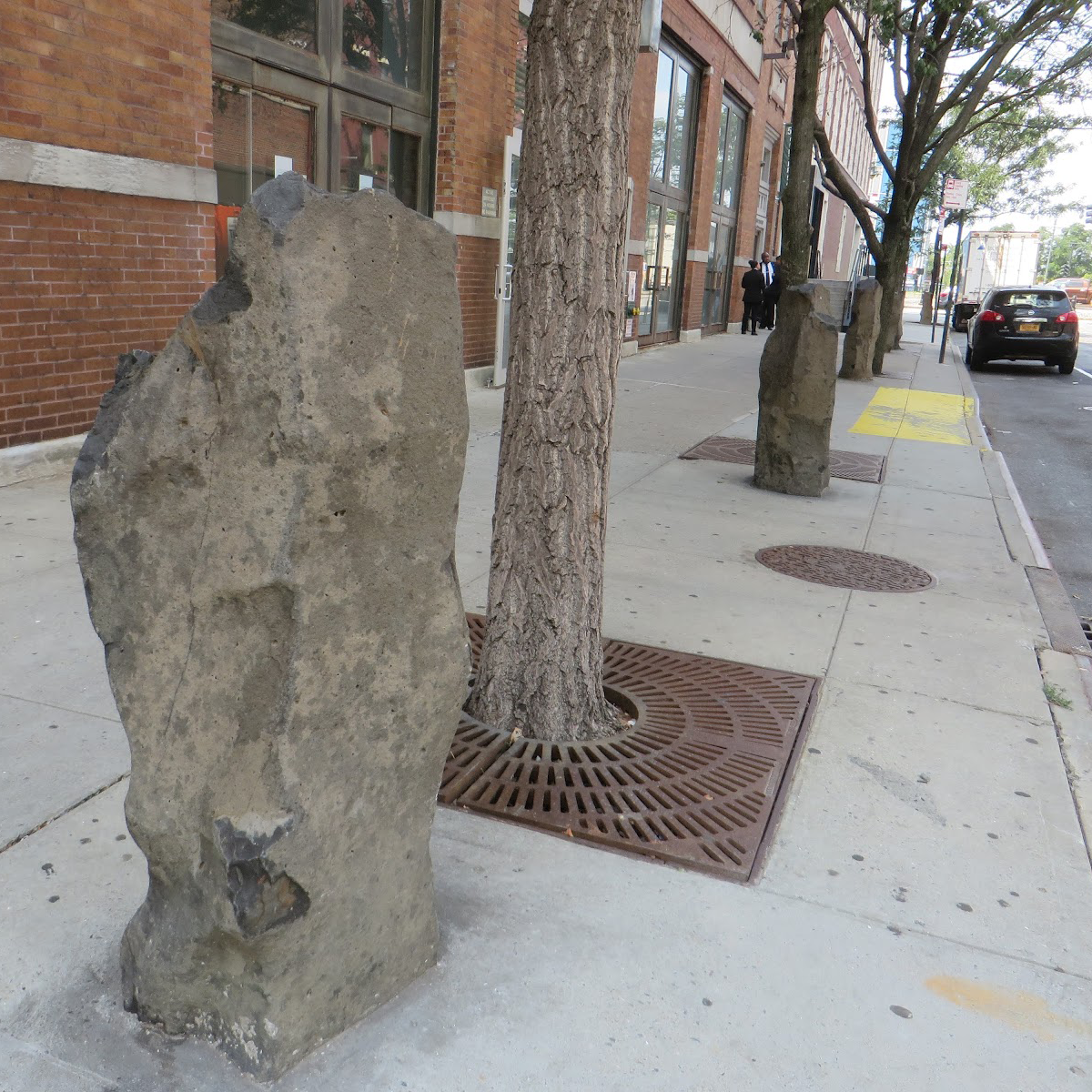
Follow-up in New York, basalt blocks and oak trees together on the sidewalk, 38 in total.
The project remains a living monument, a growing network of trees, and a global example of the power of art to promote environmental awareness and community spirit. Joseph Beuys showed that the role of the artist extends far beyond the studio: they can guide the transformation of urban and natural environments and be a voice for a more sustainable future.
Meanwhile, planting trees and preserving (tropical) forests has become even more urgent due to global warming. I find myself realizing only now the role Beuys played. This makes him a great artist, someone who, ahead of others, used his art to give form to new ideas.
Started with Woodcarving
One question remains: what is an “action artist” like Beuys doing on a website about woodcarving? The answer is easy to guess for those who have read earlier biographies of famous artists on Wowwood. It can almost be called a pattern. Many began their artistic careers carving wood before moving on to other materials. Gauguin, Karel Appel, Giacometti, Jean Arp, Henry Moore, Barbara Hepworth, Brancusi, Baselitz.
The same applies to Beuys. He was a student of the German artist Ewald Mataré, who during the Second World War was placed on the list of creators of so-called “Entartete Kunst.” Why? He had carved an abstract sculpture of a sleeping cat. The failed artist Adolf Hitler did not care for abstraction.
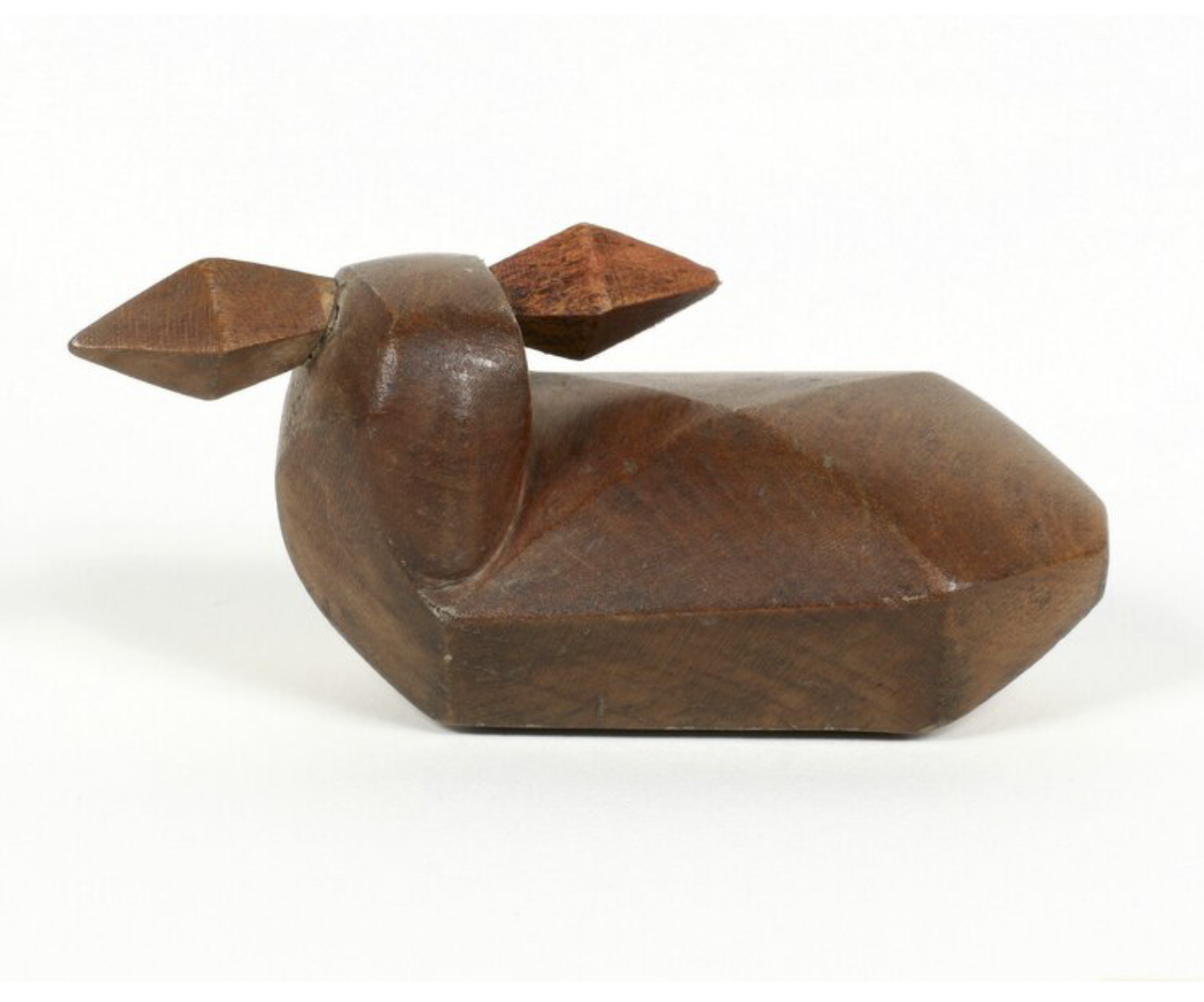
As a student of Ewald Mataré, Beuys created the sculpture Ohne Titel (Schaf) in 1948, carved from oak wood.
As a student, Beuys carefully observed the elegant animal figures made by his professor at the art academy in Düsseldorf. This is evident in the reclining sheep he carved from oak. Yet it is a sheep with a twist. Instead of ears, he gave the animal ornamental forms that somewhat resemble one of the “steps” of the Endless Column by Constantin Brâncuși.
Beuys’ sheep was exhibited in 2022 in a retrospective at the Kölner Dombauhütte under the title Frühe Jahre 1947–1955. Beuys carved the sheep in 1948, alongside other works such as crosses.
Jan Bom, 14 februari 2026