Louise Bourgeois carved seven eggs in wood and called them ‘Gathering Wool’. That is an English expression that stands for ‘the wandering of the mind’. Daydreaming. Floating mentally. Bourgeois used this state of mind in her studio to evoke ideas.
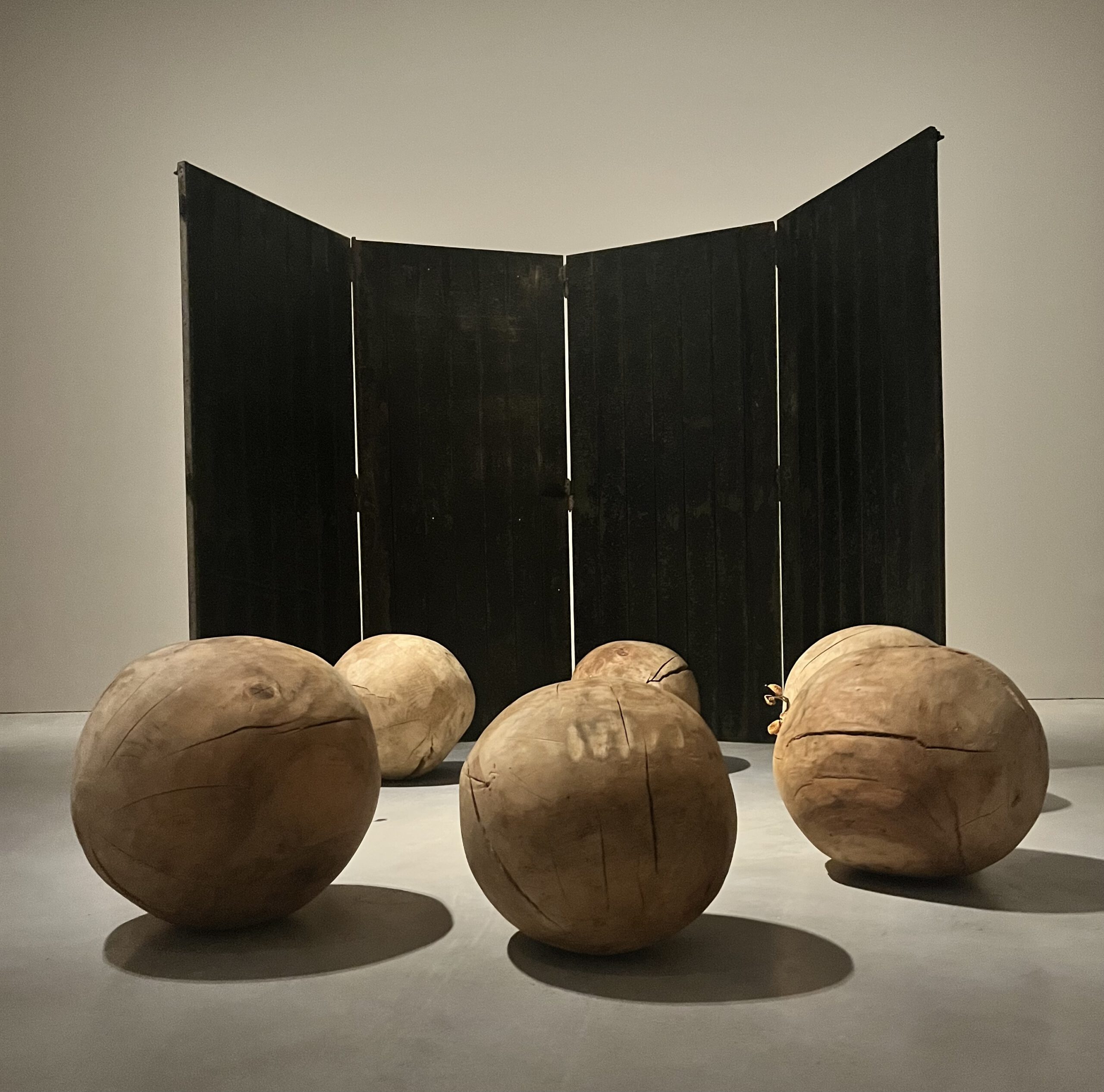
Louise Bourgeois carved seven eggs in wood. In this photo, one of them is just out of view.
Thought traces, fragments of dreams, speculations, suspicions, fantasies, intuitions. They formed the basis for her sculptural forms. The work of the French artist remains mysterious. Even to herself.
Certainly ‘Gathering Wool’ from 1990 was not a rational or pre-planned design. This sculpture too grew from intuition, the unconscious. The use of wood – warm, organic, full of spontaneous texture — represents vulnerability and growth for the artist.
A place to sink away in thoughts
The physical artwork does not only consist of round eggs lying in a circle. It also includes a semicircular screen of four wooden panels. This arrangement should create a contemplative, enclosed space — a mini-environment in which you can “sink away” into your thoughts.
Spontaneously, after carving out the spheres, mushrooms appeared from cracks in the still fresh wood. Bourgeois was happy to leave them there. For her, they contributed to the story of growth.
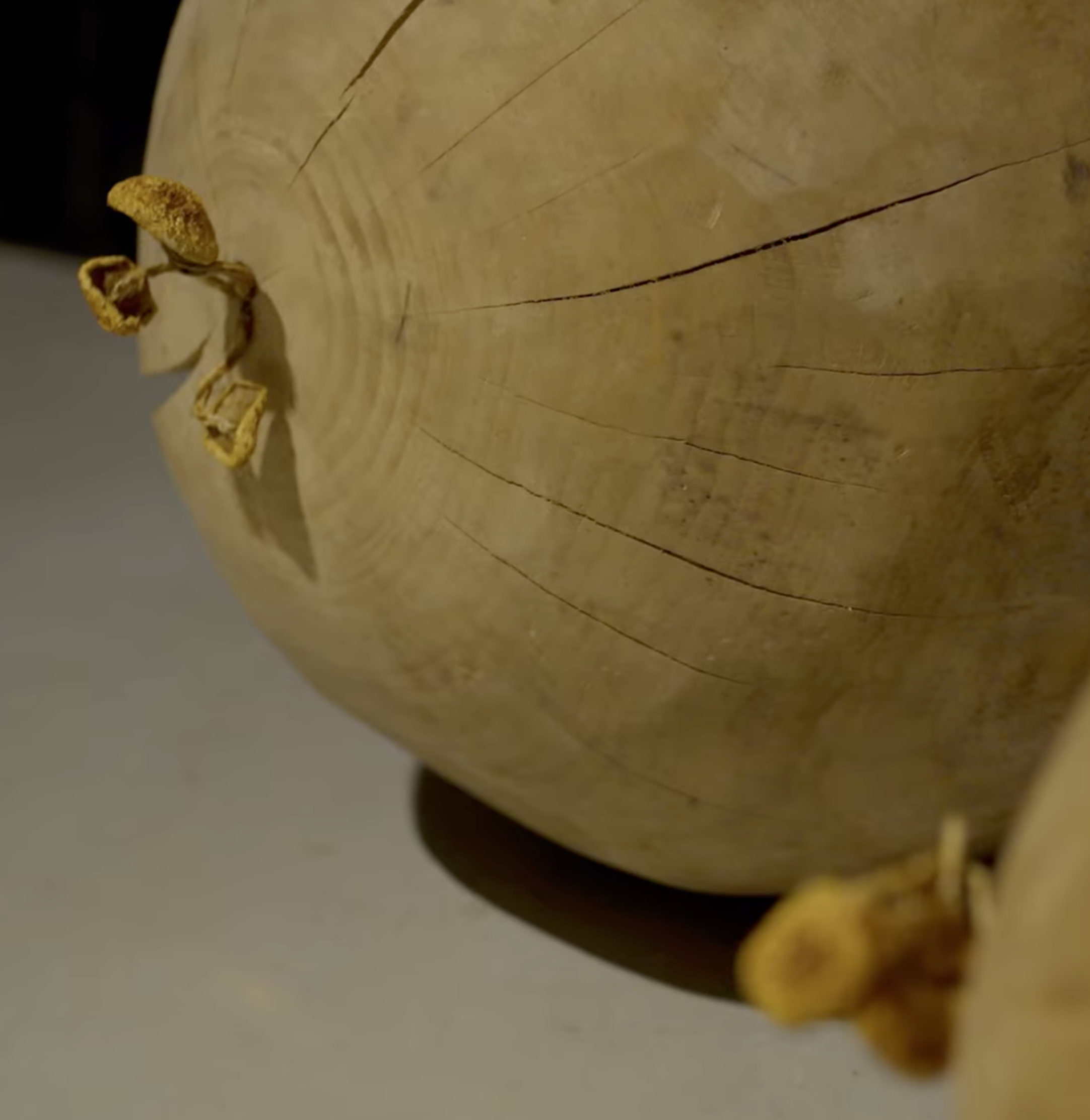
Mushrooms spontaneously grew from the eggs, which Bourgeois left in place.
A trend is emerging. Like many artists ( Barbara Hepworth, Giacometti, Henry Moore, Georg Baselitz, Zadkine, Brancusi, etc.) who first worked in wood, this installation by Bourgeois already preludes later works. It seems as if working with wood creates a seed for later work in other materials. The proof of this could be found in her spiders that became world famous ten years later, the gigantic Maman installations from 1999-2003. Don’t round eggs (of marble) also hang under those? Bourgeois once said: “The spider protects her eggs, just as my mother once protected me.”
That statement is telling. Louise Bourgeois (1911–2010) grew up in Choisy-le-Roi near Paris, in her parents’ studio, restorers of tapestries. From an early age she learned the rhythm of thread, repair, care and craftsmanship. Later she left for the US, where she worked in a studio in Brooklyn, New York.
Mother as model for spiders
Bourgeois’s mother, a woman who repaired textiles, became the later model for her famous spiders: protective, tenacious, healing. But long before the spiders would become her icons, Bourgeois developed her own plastic vocabulary rooted in introspection, physicality and peeling away memories.
In the literature there is no direct, explicitly confirmed link by Bourgeois between the wooden eggs and those of her giant spiders. But in terms of form, symbolically and psychologically, there is indeed a relationship. You could even say that Gathering Wool is a key work in which the later “spider-egg” iconography is already present. For Bourgeois, the sphere is a primal form: between cell, egg and cocoon.

The head of one of Bourgeois’s Maman installations: giant spiders carrying marble ‘eggs’ beneath them.
‘Gathering Wool’ was presented in 2025 by the leading international gallery Hauser & Wirth in New York. On YouTube (at 1 minute 19) the curator presents the work. Other branches of Hauser & Wirth are in Zurich, London, Somerset, Los Angeles, Hong Kong, Gstaad, St. Moritz, Monaco, Menorca, Paris and Basel. It is one of the most successful art galleries in the world, which through collaboration and co-financing of exhibitions in museums quickly makes its own stable of artists – such as Paul McCarthy – ‘museum-worthy’.
Jan Bom, November 26, 2025