Paul McCarthy turns Snow White into a porn star, by having her suck off the pointed hat of one of the seven dwarfs. The wooden sculpture is part of his White Snow project, a series of gigantic sculptures carved from black walnut wood.
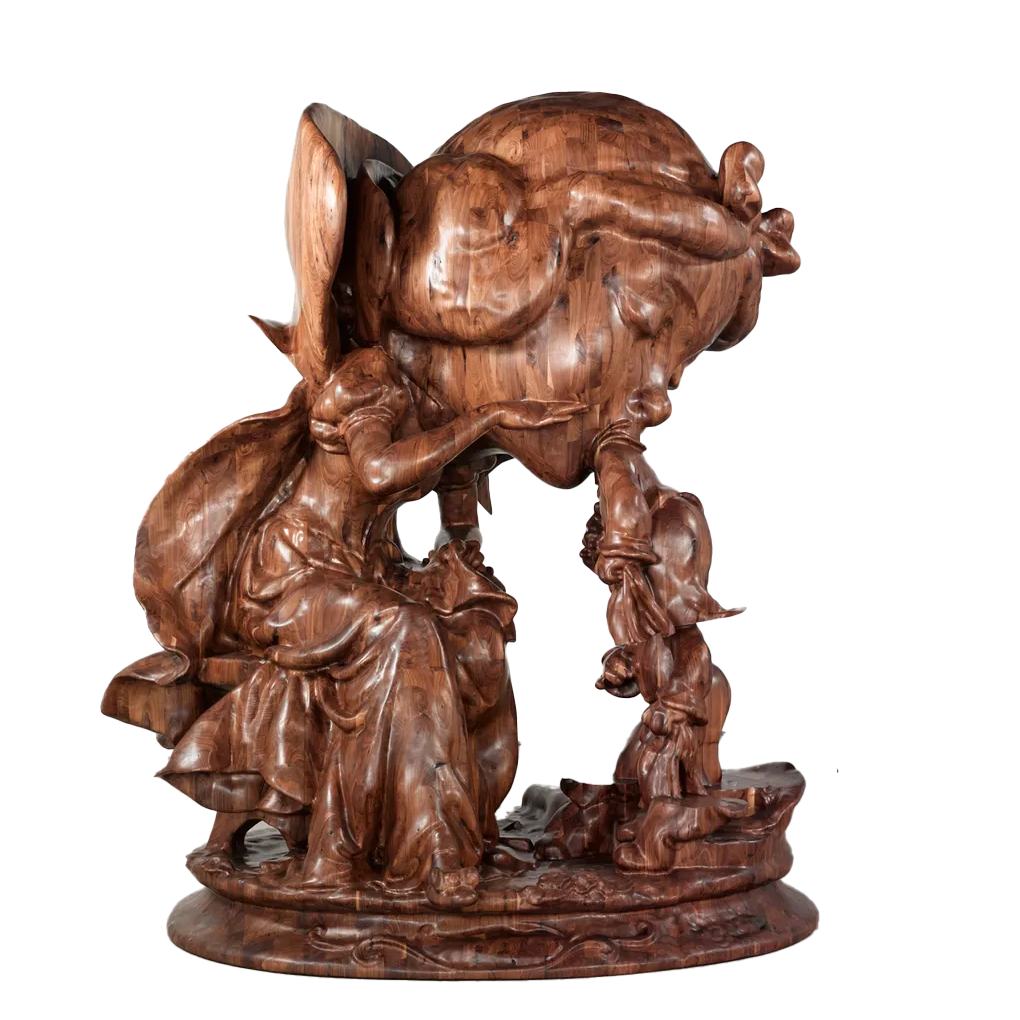
The pointed hat — in its childish connotation an innocent accessory — is transformed by McCarthy into an explicit phallic symbol. The dwarf becomes an object of lust and Snow White an actress from a very obscure porn film. The more than 4 meter high sculpture is therefore often called the White Snow Dwarf Suction.
The work is exemplary for the work of this subversive American sculptor: deconstructing cultural objects so that suppressed charges of violence, sexuality and power become visible. Throughout his entire artistic career McCarthy exposes the hypocrisy of cultural symbols.
The Mask of the American Consciousness
Paul McCarthy (1945, Salt Lake City, Utah) is considered one of the most provocative and influential contemporary artists from the United States. His oeuvre spans more than five decades. He made performances, installations, video, drawings and sculptures. McCarthy is especially known for his raw and often shocking criticism of American mass culture, hypocrisy in the family, sexuality, consumerism and the suppressed shadow sides of the American ideal.
Yet his work is never gratuitous: behind the grotesque caricatures and violent humor lies a penetrating analysis of the condition humaine. What he likes to do most is tear off the ‘civilized’ mask of Western culture.
Nostalgia as Nightmare
Within McCarthy’s extensive oeuvre, the series of wooden sculptures based on Disney’s Snow White and the Seven Dwarfs forms a special benchmark. These works, produced between 2009 and 2013, were computer-controlled (CNC) carved from laminated black walnut wood. Precisely this wood species is traditionally associated with luxury and wealth.
The figures from Snow White — the dwarfs, the prince on the horse and even the forests and scenes from the story — are in these works distorted, displaced, rotated, sometimes sawn open or ‘doubled’. Through the use of walnut, the sculptures get an aura of timelessness and monumentality. But this concept is also immediately undermined by the grotesque, unstable forms.
Dark echo from childhood
Some sculptures look at first glance like traditional statues — with deep, glossy veins and perfectly polished surfaces. On closer inspection, however, they are ominous, contorted and aggressive. The organic wood grain enhances the physical impact of the sculptures: what was once innocent and recognizable is now a dark echo of American childhood.
McCarthy made the sculptures in close collaboration with digital craftsmen. He manipulated the original digital models with 3D software and then carved them into walnut with CNC milling machines.
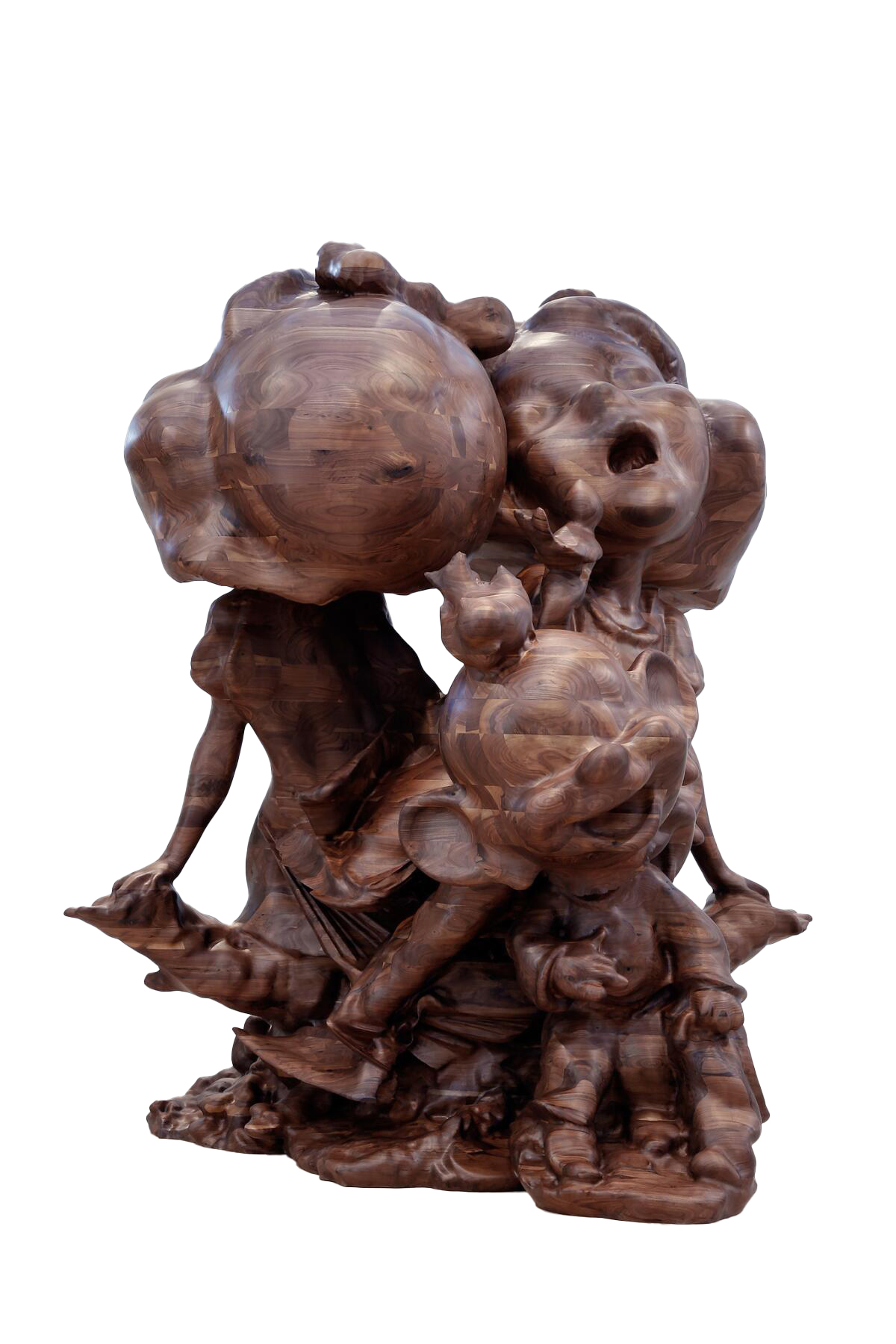
Because walnut trees never grow as thick and tall as McCarthy’s sculptures, the wood is laminated: glued together. This also produces alienating effects.
McCarthy deliberately plays here with the gap between human hand and machine, between romantic wood carving and post-industrial sculpture production. The series balances between craft and algorithm. It is thus a commentary on the way culture allows itself to be marketed, duplicated, scaled up and distorted.
Disney as Target
That McCarthy chose Snow White as a motif is not coincidental. Walt Disney’s early animation from 1937 is seen as the archetype of the American cartoon. Innocence, purity and moral clarity are central to it. For McCarthy, this facade of innocence is merely a cover. In his vision, Disney represents precisely a system of cultural brainwashing. Violence, sexuality and colonialism are sublimated into supposedly child-friendly fantasies.
McCarthy’s White Snow sculptures are therefore not a parody, but provocative dissections of a romantic fairy tale. He fillets the ideology behind the narrative. He shows what happens when you scrape away the sugar coating. What emerges are sexually charged power games, patriarchal mythology, fetishization of female innocence, and a thoroughly racist view of the world.
By carving these motifs in precious wood, the work gets an additional charge. It is also a critique of the tradition of Western sculpture, in which the use of wood has always been intertwined with religious, moral and national symbolism.
Precious black walnut wood
The choice of black walnut wood is crucial for this series. Walnut is historically connected with power structures — from Victorian furniture to colonial interiors. It symbolizes precious heritage. By realizing the sculptures in walnut, McCarthy undermines the everyday nature of the Disney material (animation, celluloid and nowadays digital pixels). He elevates the sculptures to a perverse monument for the culture industry.
Another notorious work by McCarthy is Tree (2014), a 24 meter high inflatable sculpture of a Christmas tree that was installed on the Place Vendôme in Paris. The artwork immediately caused a wave of outrage in the French media and on social media. The sculpture was widely described as a ‘butt plug’, used for anal penetration. McCarthy admitted that the shape of his sculpture was deliberately ambiguous — referring both to a pine tree and to a sex toy. But it wasn’t just about provocation for him. He also wanted to address the moral hysteria that arises when symbols from different contexts coincide. That succeeded very quickly. Within a few days the work was already vandalized. The deflated green balloon was quickly removed and not reinflated.
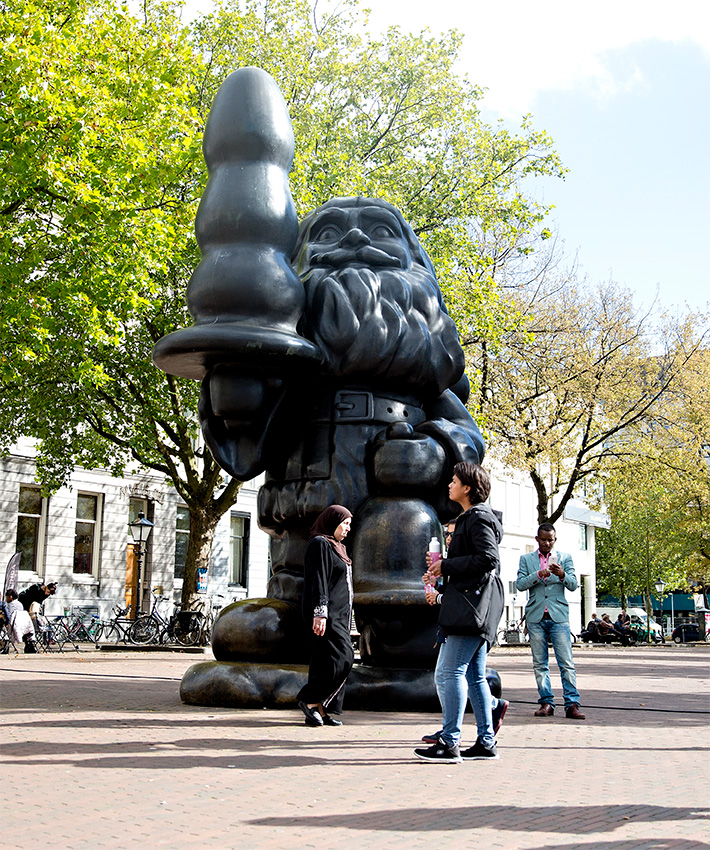
A smaller, permanent variant of the work — Santa Claus (2001), popularly called ‘Gnome Butt Plug’ — has been standing permanently on the Eendrachtsplein in Rotterdam since 2008 after several relocations. In the port city too, the bronze sculpture met with quite a bit of criticism. Businesses didn’t even want it opposite their establishment. It has since become an iconic (and ironically embraced) city sculpture.
Influence and Morality
McCarthy’s Snow White works have been exhibited in international institutions such as those of the extremely successful Swiss gallery owner Hauser & Wirth, the Park Avenue Armory in New York, and the Monnaie de Paris.
The reception in the press is often ambivalent: admiration for the technical and material mastery, combined with outrage or confusion about the content. That is precisely McCarthy’s strength: he forces the viewer to examine their own moral positions.
His wood carvings therefore form a rare intersection between classical sculpture, contemporary technology and conceptual criticism. They prove that sculpture, even in an age of screens and simulations, can still be a powerful means to expose ideologies.
About the making process of this series a now rare and therefore very expensive book has been published. Paul McCarthy: White Snow (2016), published by Hauser & Wirth Publishers. It is an extensive monograph about the Snow White series, including behind-the-scenes documentation of the making process and essays about the relationship between Disney, wood carving and subversion.
Text Jan Bom, May 5, 2025