In a tree trunk, many younger versions of the same tree are hidden. Giuseppe Penone makes these visible again.
Wood carving artists take into account the natural shapes in a piece of wood. Knots, they should not be in places where an eye or nose needs to go. These irregularities can even serve as a starting point for the final sculpture: direct carving, an originally ethnic vision of wood carving that the French artist Paul Gauguin was the first to adopt when he made wooden sculptures and woodcuts in Tahiti.
What is our origin?
The Italian artist Giuseppe Penone (1947) goes much further. He was the first to systematically carve out the annual rings from tree trunks, to investigate like an archaeologist what the whimsical life form of that same tree had been many years earlier. Something of the primal force of life becomes visible through this. Penone touches on deep questions such as: what is our origin? What does nature keep hidden from us?

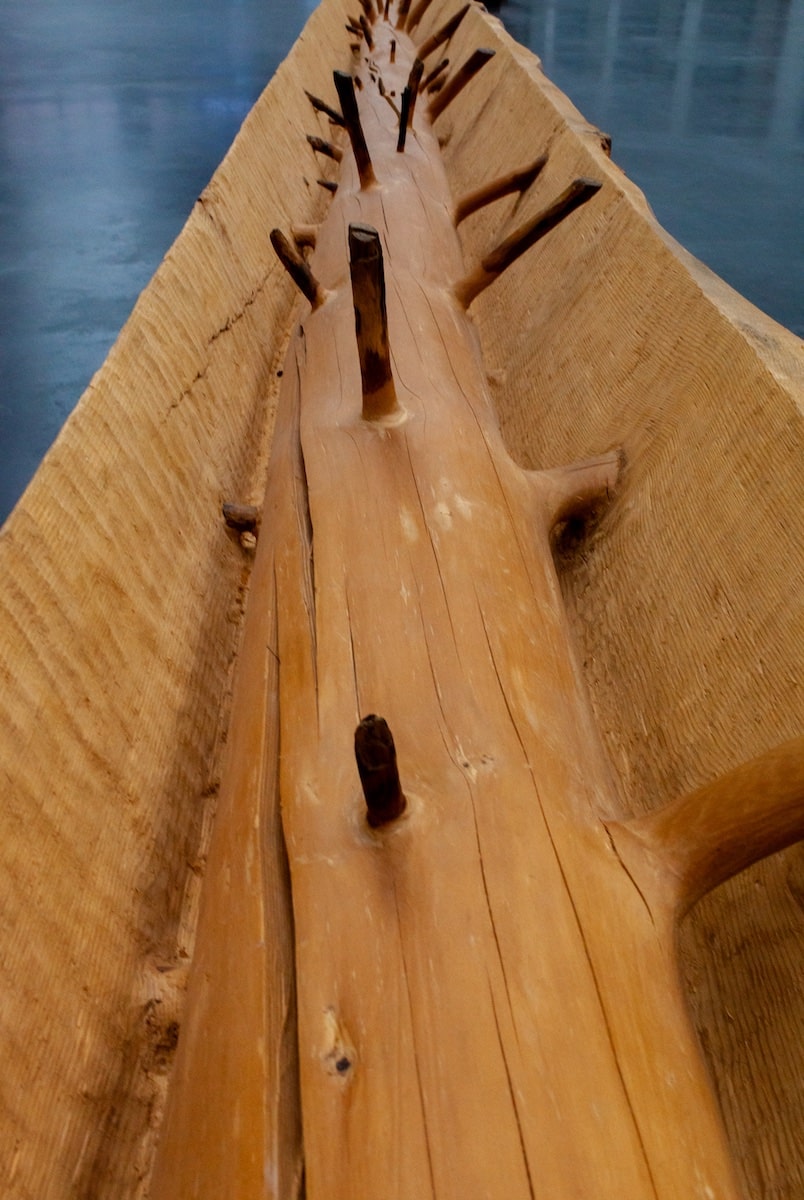
His tools remained the same as those of other woodworkers; axes, chisels and gouges. In the photo you can see how he, deep in a tree trunk, carves out the annual rings from a trunk, until he hits the year he had chosen in advance, at the ring at the end of the trunk. He even incorporated this choice into a title of one of his earliest works from 1969, ‘Il suo essere nel ventiduesimo anno di età in un’ora fantastica’, or: ‘His Being in the Twenty-Second Year of His Age in a Fantastic Hour’. What remains is a young trunk with branches sticking out that were first hidden. Those are the dark knots that wood carvers dislike so much.
“Poor materials”
Penone was fortunate to be able to join as the youngest member an art movement that conquered museums worldwide: Arte Povera. This group of artists from Italy and Greece used simple, ‘poor’ materials. They tried to break through the oppositions between nature, man and culture.
Penone chose the tree trunk as a cheap medium. He even says that trees for him: ‘are not just a subject, but much more; they form the substance of my work’.
After his intensive processing, the tree trunks upgraded to art ended up in famous museums such as the Tate Modern in London, the Centre Pompidou in Paris and the MoMA in New York.
“Closer to nature than ever”
The importance of his work also penetrated the Netherlands. The Stedelijk Museum already exhibited a version of his trees, or ‘Alberos’, in 1980. Other Dutch museums also purchased works. In the garden of the Kröller-Müller Museum, a bronze tree, a beech, has stood since 1988. In the sculpture garden Clingenbosch in Wassenaar, the bronze sculpture Biforcazione can be found since 1991. Since 2001, a tree by Penone that seems to float just above the ground stands at the Westersingel in Rotterdam. Museum De Pont in Tilburg showed in 2010, among other things, his opened-up larch ‘Albero fiume’ (photo above this article). In his latest work, in a lagoon near Venice, a tree carries a heavy stone in its branches.
Interest in the ‘upcycling’ of tree trunks by Penone only seems to be growing, now that the question of how we should protect biodiversity is becoming increasingly urgent. The private museum Voorlinden organized from October 8, 2022 to January 29, 2023 a ‘grand retrospective exhibition’ of his works.

Director Suzanne Swarts gave a beautiful description of his work: ‘Giuseppe’s oeuvre is true poetry. He shows you a beauty that surrounds us daily, but that we often don’t perceive. He makes us aware of our sense of touch, breathing and sight, which teaches us to look at the world around us differently. Surrounded by his work, you imagine yourself closer to nature than ever’.
And how does Art Bible Janson’s place Penone’s work in time? Not at all. He doesn’t appear in it at all. What’s more: the entire Arte Povera art movement remains unmentioned.