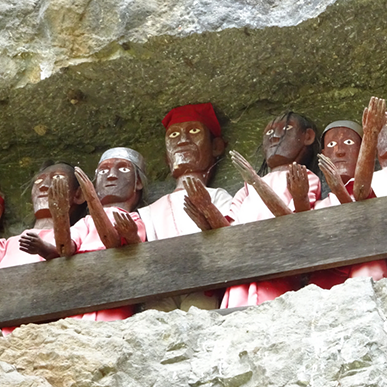
The memento mori of Aron Demetz are not classical artworks with skulls, wilted flowers or hourglasses. His wooden sculptures make death itself visible. The heads and bodies of his sculptures show traces of transience and decay. Demetz shows the inevitable end, without passing moral judgment.
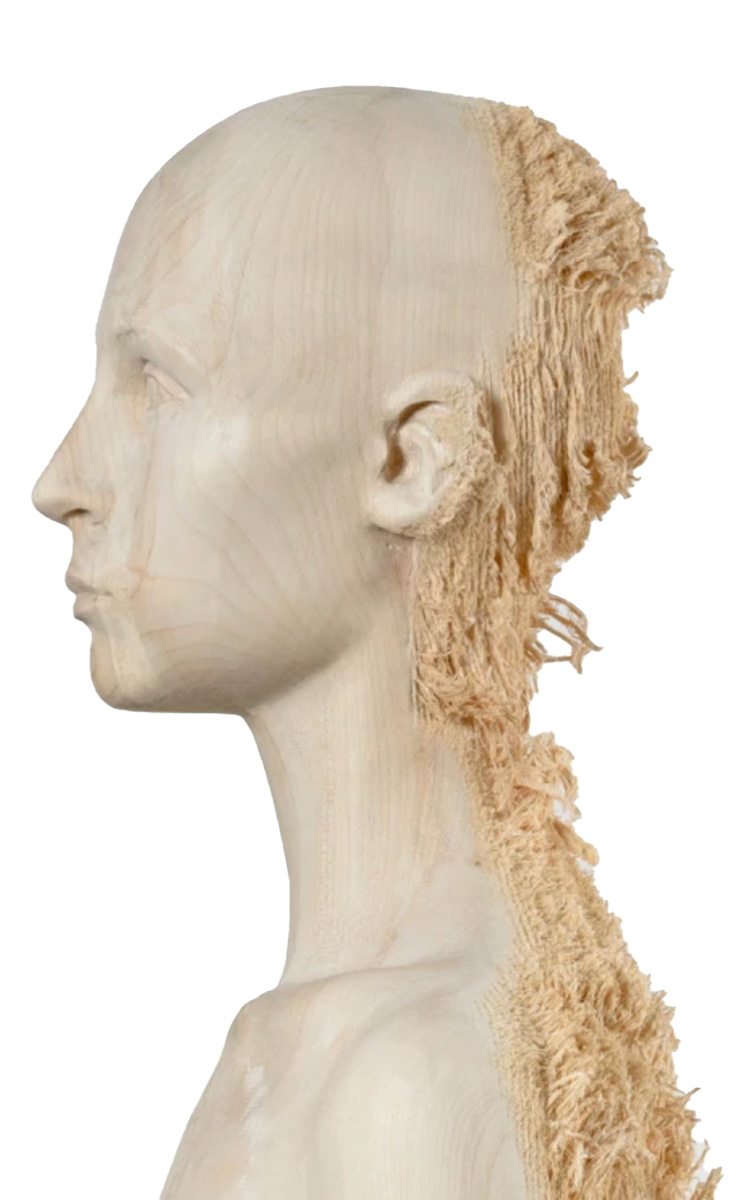
The memento mori of Aron Demetz sometimes take the form of a half ‘eaten away’ body, as with this sculpture Sud.
The figures of Aron Demetz (1972) are often life-sized, sometimes partially burned or partially broken off. Wood cracks, fissures and discolorations remain visible. They are deployed as carriers of meaning. The material itself carries time: it lives, dries, cracks, ages.
Through his treatment of the wood, the mortality of the body becomes directly visible. Art critics emphasize that his work is not heroic, nor does it glorify the role of the victim. Demetz’s figures are wounded, but dignified; damaged, but still present.
I doubt whether I really find this work beautiful. Would I want to place such a head that seems to have been in the grave for a few years in my study? I don’t think so. Are these sculptures commercially attractive? For fans of zombie films perhaps, because with Demetz the Apocalypse is already tangibly present. What has eaten away at the back and back of the head of that woman (from the still unsold sculpture Sud from 2012)? These sculptures certainly don’t sell fast. On the website of Gazelli Art House several sculptures from Demetz’s ‘zombie series’ are still being offered with price on request. There’s no quick turnover here.
A skull with rotten teeth
On the other hand, his courage to dust off the old theme of memento mori is to be praised, after its popularity in the sixteenth century. An artist like Pieter Claesz presented in the Golden Age a painting like Vanitas, with a skull lying with rotten teeth on a book.
But Claesz wanted to encourage his audience to a good and religious life by depicting extinguished candles. This motive to threaten is completely absent with Demetz. He does not preach a religious morality. His sculptures are not meant to warn of hell and damnation.
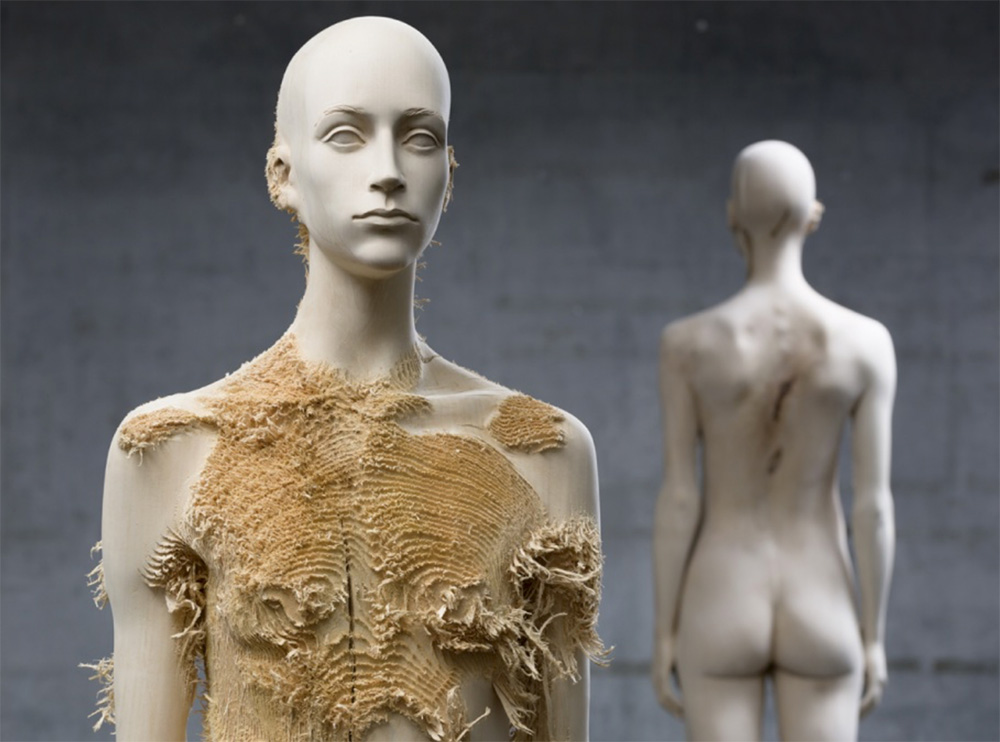
In the series Advanced Minorities, Demetz combines an almost smooth mannequin-like woman of linden wood with signs of decay.
Also for this reason art critics characterize Demetz rather neutrally as a pivotal figure between traditional wood carving art and contemporary sculpture. He experiments with fire, resins, pigments and even sandblasting wood. This creates a tension between control and chance, between nature and culture, between tradition and modern technique.
A sculpture from his series ‘Counting the Winters’ I would very much like to own, especially because I myself have been experimenting with the gas burner on cross laminated timber (CLT) for a while. After burning and brushing, the annual rings appear, which produces beautiful structures. Demetz knows how to achieve the same effect with sandblasting, for which he uses sequoia wood. The fragility of life produces pure beauty here, without associations with scary movies.
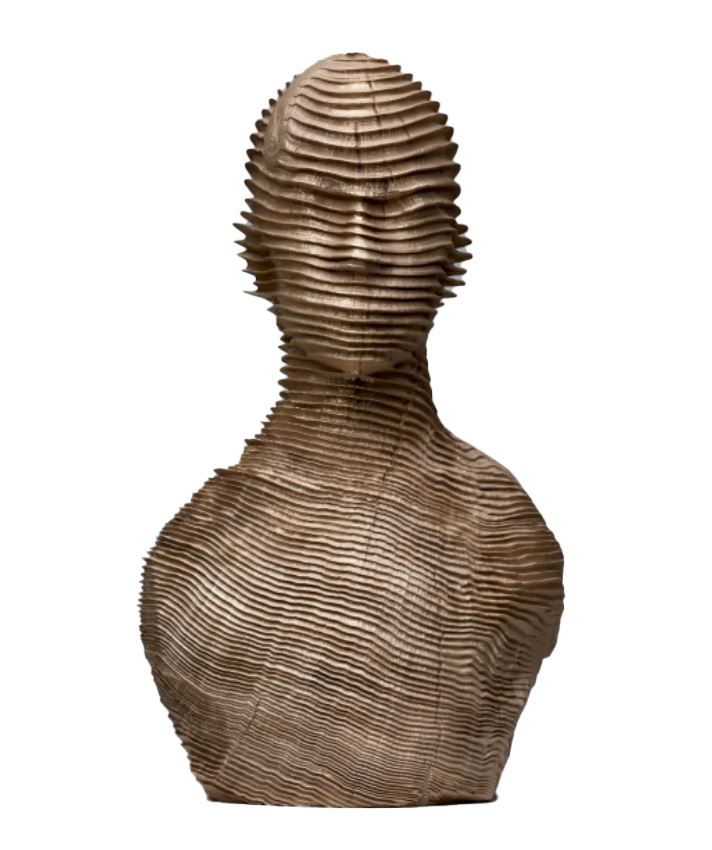
From the series ‘Counting the Winters’, a bronze cast of a burned (or sandblasted) bust.
Demetz grew up in Val Gardena, a valley in the Dolomites famous for its centuries-old wood carving tradition. Here he followed training at the local art and sculpture school in Selva/Sëlva di Val Gardena and the vocational school for wood carvers and painting.
Later he studied sculpture at the Akademie der Bildenden Künste in Nuremberg, where his sculptural language developed further. Already during his training he became fascinated by the tension between craftsmanship, time and the condition humaine, human existence including all shortcomings.
There are many Demetzes
The name Demetz is in Val Gardena synonymous with the wood carving tradition in the valley. Several families with that name, such as the Demetz Art Studio, have been producing wooden religious sculptures for generations. Although Aron Demetz also comes from such a sculptor family, there is no demonstrable direct blood relationship between him and Gehard Demetz, another well-known wood carver with the same surname.
It is fascinating to see how new generations of wood carvers from Val Gardena break free from the traditional wooden Jesus and Mary figurines and develop their own visual language. Aron Demetz already belongs to a younger generation following in the footsteps of internationally renowned predecessors such as Bruno Walpoth, Willy Verginer and Gregor Prugger. They are sometimes approaching 70 years old now. The fifty-something Demetz is still a ‘youngster’ compared to them.
In summary: with Aron Demetz I see his memento mori not as symbols; he shows the mortality of the body itself. His sculptures speak of transience and time, of wounds and recovery. Life is as it is: temporary. Wood, body and time merge in Demetz’s work into sculptures that silently but unmistakably testify to the inevitable end. Nothing more, but nothing less than that either.
Jan Bom, January 20, 2026