Willy Verginer prays on an oil barrel, while a color plane indicates the rising sea level. The oil drums return in numerous other sculptures. A child can no longer play carefree in the water due to all the floating barrels and other debris around them. A young deer stands orphaned on an oil drum. A woodpecker pecks a hole in such a barrel. A man drowns in it.

Willy Verginer prays on an oil barrel, a sculpture with a crystal-clear ecological message.
This sharp criticism typifies Verginer’s work. It is strongly figurative and material-conscious but at the same time holds a mirror up to the world. Verginer says he is happy to have grown up in a clean mountain environment, but shows in his sculptures the threat to that idyll.
Magnificent carving technique
Verginer (1957, Bressanone/Brixen) grew up in the valleys of the Dolomites. His childhood in Val Gardena, a region with a centuries-old wood carving tradition, laid the foundation for a deep affinity with wood. The world of the studio and the natural environment became his first university. Here he learned that wood is not just material, but an excellent medium for telling stories.
He first followed painting education at the art institute in Ortisei, and then developed as a sculptor through autodidactic exploration. He first worked, like contemporaries such as Bruno Walpoth, in various studios in Val Gardena. That period of master-apprentice training formed the foundation of his craftsmanship skills.
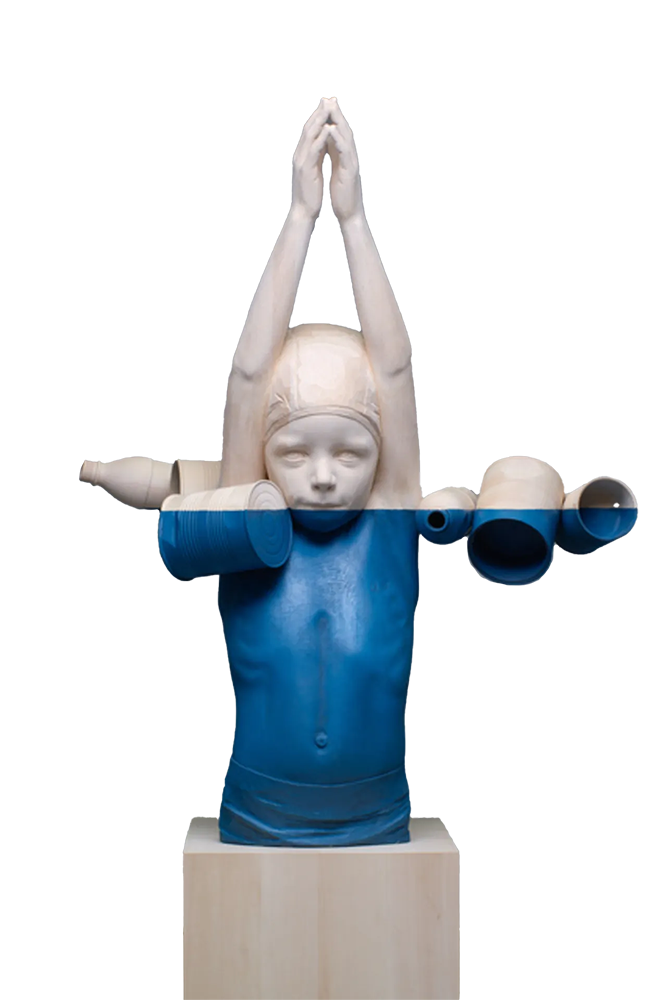
A little boy plays in the water, but is surrounded by floating debris, including miniature oil barrels.
I find the realistic wood carving technique of Verginer magnificent. Enviable, simply. Super-realistic. Sometimes he builds up trousers from rough planes, carved with a large flat gouge. But the face is then perfect in expression, beautifully smooth-sanded with a fine rasp. He also carves beautiful women.
His sculptures have been interrupted by color planes and industrial objects since 2005. This places the classical figurative in a new context. An oil barrel or an enormous color plane can suddenly shift the narrative of the sculpture: nature is threatened, the child excluded. The world becomes unbalanced.
Color planes as separation
Verginer plays with contrasts. By using the color planes, he creates a visual separation between the known and the invisible, between what we directly understand and what we must reflect on. Why is that head suddenly gilded? Why is that body covered with aluminum foil, or painted with deep black acrylic paint? Reality as it is, and reality as we experience it, is disturbed by human intervention. What is the impact of our actions?
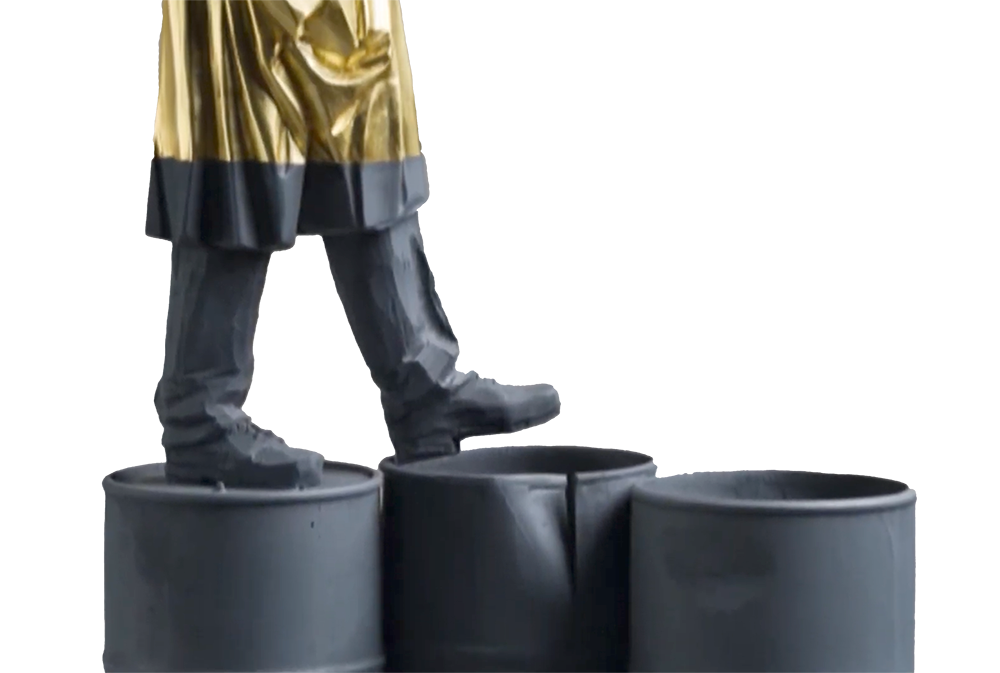
Verginer lets one of his sculptures tumble into an open oil barrel, just one step short: exciting.
This stylistic feature makes Verginer’s work very recognizable. When his sculptures are in a group exhibition, everyone remembers: those half-painted figures, those were Verginer’s sculptures. Visitors who love surrealism also get their share with Verginer. Suddenly they encounter a pink-painted Bambi high in the branches of a tree.
Half visible, half symbolic
His sculptures invite contemplation. The children, the adults, the animals and the objects are, through the color planes, in an in-between space: half visible, half symbolic. The viewer is invited to search for connections, parallels and implications, without the work directly imposing them. How subtly Verginer conveys his ecological message.

Willy Verginer poses next to a sculpture where a woodpecker pecks a hole in an oil drum.
Verginer’s work is internationally known. He has exhibited in Italy and beyond, from museums in Trentino to Apeldoorn. His work is included in corporate collections and sold by his gallery LeRoyer at art fairs such as Art Miami and Art Toronto. He also represented South Tyrol at the 54th Biennale in Venice. All in all he enjoys international fame — at auction a work already fetched more than 45 thousand dollars. His bronze casts on Artsy are somewhat more favorably priced.
Yet his starting point remains local and personal: the wood of the Dolomites and the valleys of Val Gardena form the core of his artistic identity. The craftsmanship foundation is still there, but it is extended, broadened and shifted to a 21st-century context — even if that context is not always cheerful.
Jan Bom, January 18, 2026