The oldest known depiction of a wood carver is Greek. It shows a naked man seated, holding a bust between his knees. The scene is placed on the inside of a drinking cup and dates to around 520–500 BCE.
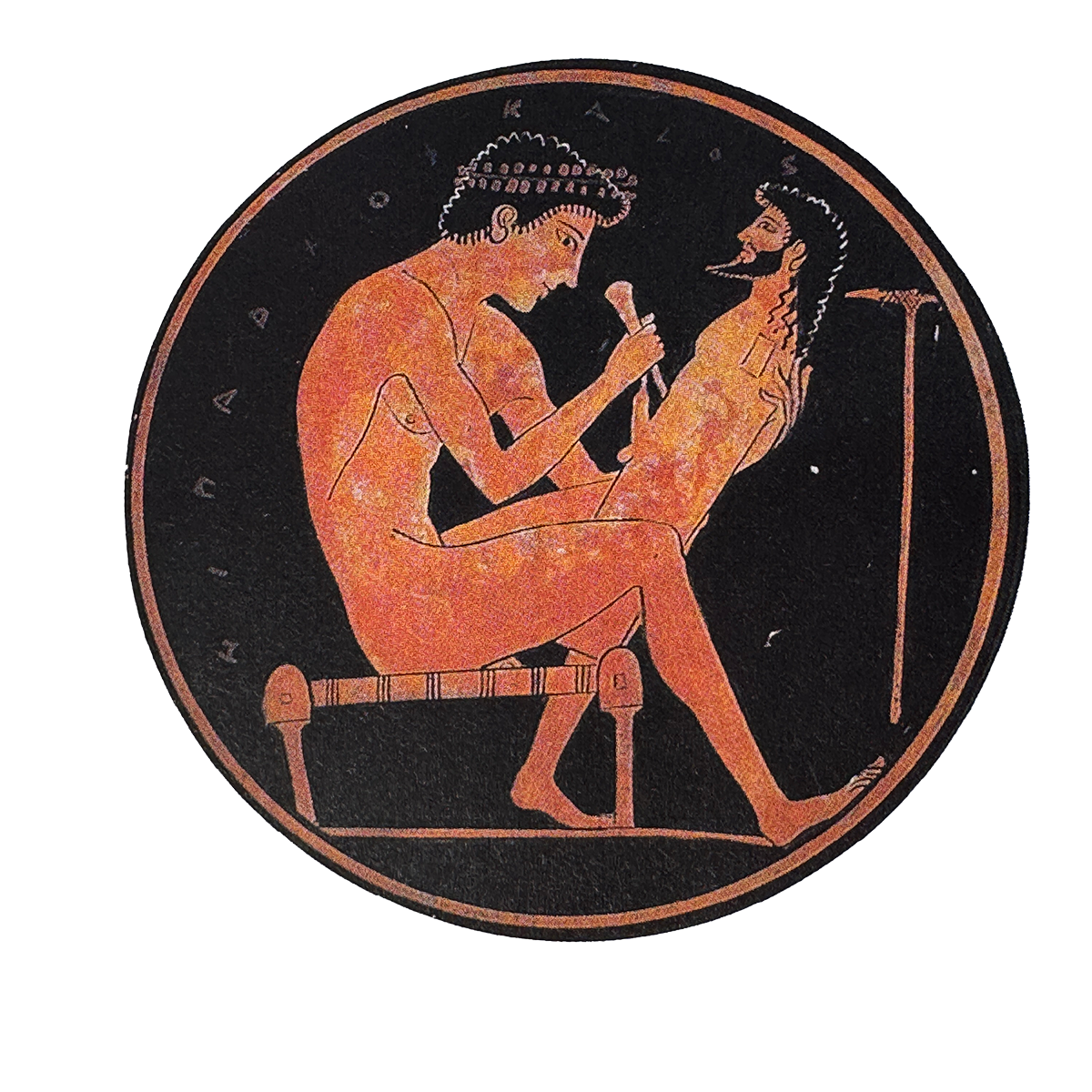
The cup is now in the National Museum of Denmark in Copenhagen.
What makes this object remarkable is that it shows a craftsman at work carving wood. On ancient pottery, artisans are rarely depicted, even on Greek vases. More often we see athletes, mythological figures, or war heroes. Another rare exception is a Greek cup showing a bronze worker at work. That object is roughly as old and is part of the Staatliche Museen zu Berlin collection.
Rare exception
There is little known about artists and craftsmen in antiquity. The Greeks did not yet practice art for art’s sake. Tools have hardly survived, and texts describing working methods have not been preserved. Most sources instead focus on how major public commissions from cities or sanctuaries were assigned. How a woodworker actually made his figures can therefore almost only be inferred from this single cup in Copenhagen. All we know now is: the oldest depicted wood carver was a Greek.
Philippe Bruneau describes the scene in Sculpture (Taschen). It dates from the early period of red-figure ceramics. The carver is working on a bust, also known as a herm. This word comes from ancient Greek (hermēs) and is connected with the god Hermes.
Pillar with erection
In ancient Greece, herms stood along roads, at borders, and at building entrances. They had a protective and demarcating function. Typically they consisted of a rectangular pillar with a head on top. Often the pillar was also depicted with an erect male organ, something that, as can be seen, is also the case on this cup.
The cup also contains an inscription: Hipparchos kalos — Hipparchos is beautiful. This was a commonly used phrase on Greek pottery. The inscription may refer to Hipparchos of Athens, co-ruler of the city, who was murdered in 514 BCE, probably because of his authoritarian behavior. This murder was later seen as the symbolic beginning of Athenian democracy.
Jan Bom, februar 10 2026