Ursula von Rydingsvard wishes goodnight. That is to say: her artwork with the Polish title Do Nocy does so with a smile. It is characteristic of this artist to transform wood into a personality, with human emotions and human forms such as a mouth.
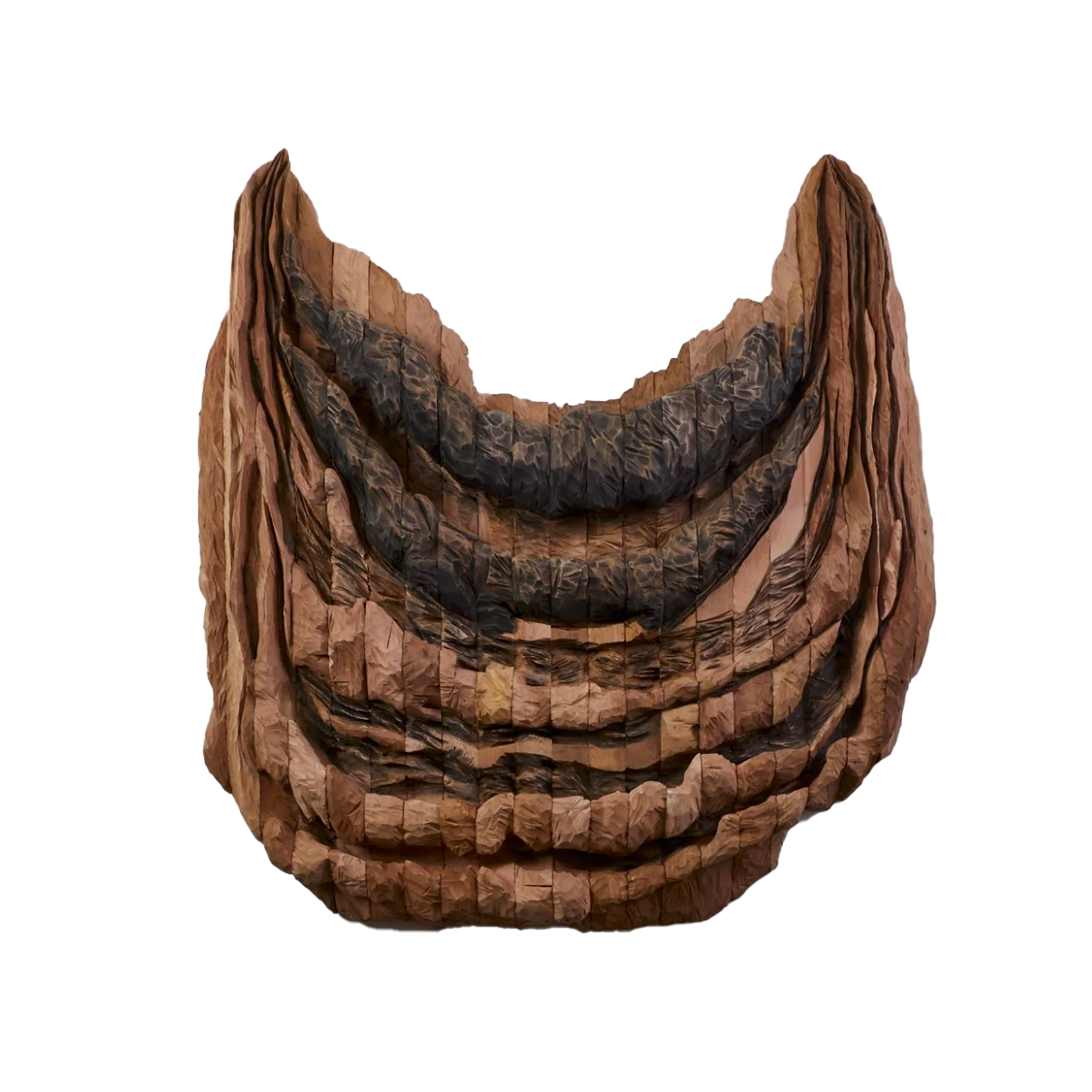
Ursula von Rydingsvard wishes goodnight, through a wall object from 2023, made of many mouths. Do Nocy is the title on the artist’s official website.
Ursula von Rydingsvard (born 1942) is one of the most influential sculptors of her generation. For her, wood is not just material, but a language with its own logic and emotional resonance.
Her work, always constructed from cedar beams, transcends traditional wood sculpture. Von Rydingsvard establishes an intense relationship between natural matter, human experience and organic form — precisely the thematic that I am also interested in with Dendroism. Although I must note that the artist does not look at what drawing is already present in her cedar beams, apart from the sawn shape of the beams themselves. In that sense I still consider her a traditional sculptor.
Memories of barracks
Von Rydingsvard was born in 1942 in Deensen, Germany, from a Polish mother and Ukrainian father. Her early childhood was marked by World War II: she spent the first years of her life in various refugee camps. She lived with her family in wooden barracks before they left for the United States in 1950.
Those first experiences in environments of rough and functional wood — rugged floorboards, rugged beams and rugged emergency constructions — continued to work unconsciously in her artistic thinking. They gave her a bodily memory of wood: structures that defined human space.
In the United States it was especially her studies at Columbia University, where she earned her MFA (Master of Fine Arts) in 1975, that gave her direction. Initially she first worked with metals like steel — dominant at the time within minimalist sculpture. Soon she found metal too cool, too distant and conceptually limited. Wood offered her something metal could not: it was warm, tactile and contained an implicit history.
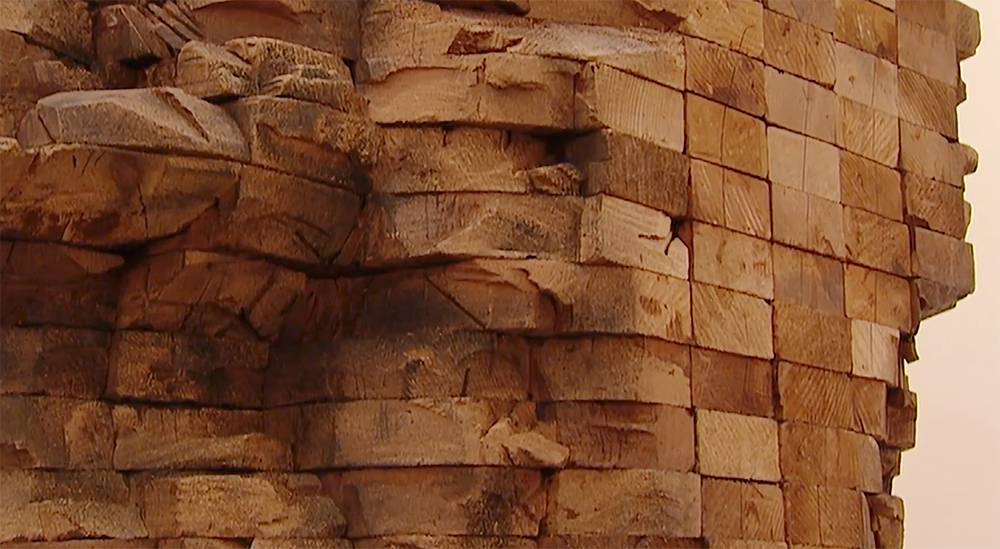
Rough cedar beams determine the ‘skin’ of Von Rydingsvard’s sculptures.
In her enormous studio in Brooklyn, Von Rydingsvard developed an almost ritual approach to woodworking. She often begins with a fixed size of cedar beams. These are readily available industrial building materials in the US. Instead of carving a sculpture on a large scale from a single tree trunk — as traditional wood carvers often do — she stacks, glues and cuts the beams with circular saws and chisels. This creates robust, organic-looking forms. By rubbing in graphite, a very fine black powder, tensions are created through depth and shadow effects.
Von Rydingsvard’s work spans a broad spectrum: from relatively intimate wall sculptures like Do Nocy to monumental outdoor works. An example of the latter is Ogromna (2009), an enormous construction of stacked cedar beams that evokes a feeling of a giant tulip-like bud. The title itself, derived from the Polish word for ‘enormous and powerful’, underscores the emotional mission of her sculptures.
Bodies and caves
Her sculptures also often seem to reference bodies, natural caves or other geological formations such as stalagmites. Some works, like Tak (2015), have a human scale and intimacy, where the structure can suggest a spine, a torso or an inner space.
Von Rydingsvard’s work enjoys broad international recognition. Her sculptures are included in the collections of numerous leading museums, including the Metropolitan Museum of Art, the Museum of Modern Art, the Whitney Museum of American Art and the Storm King Art Center. Her extensive solo exhibitions — including a major European retrospective at the Yorkshire Sculpture Park — demonstrate the consistency and diversity of her practice over decades.
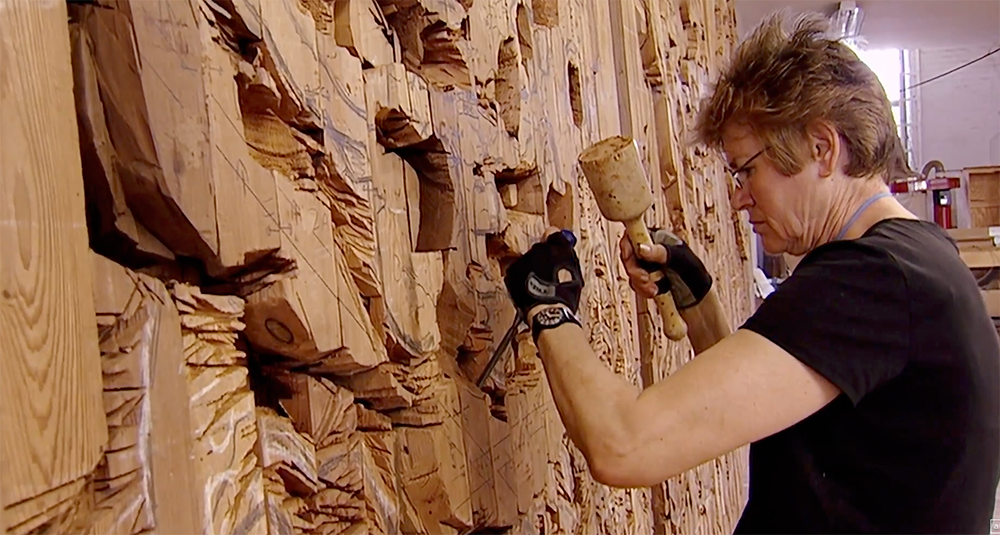
Ursula von Rydingsvard at work, with chisel and mallet.
On YouTube a beautiful documentary can be found in the series ‘Ecology’: Art in the Twenty-First Century (Art21). On her own website Von Rydingsvard also shows her most recent sculptures.
The work of Von Rydingsvard asks for a bodily and emotional response from the viewer, as if the sculpture were a human partner. That’s why I like to say back to her wall sculpture Do Nocy: ‘Sleep well too’.
Jan Bom, January 14, 2026