Donatello depicts a naked Mary Magdalene. She is only covered by the hair she did not cut for thirty years. The poplar wood sculpture broke with all traditions and rules of the church. The Renaissance began. The Italian Donatello (Born as: Donato di Niccolò di Betto Bardi) lived from approximately 1386 to 1466.
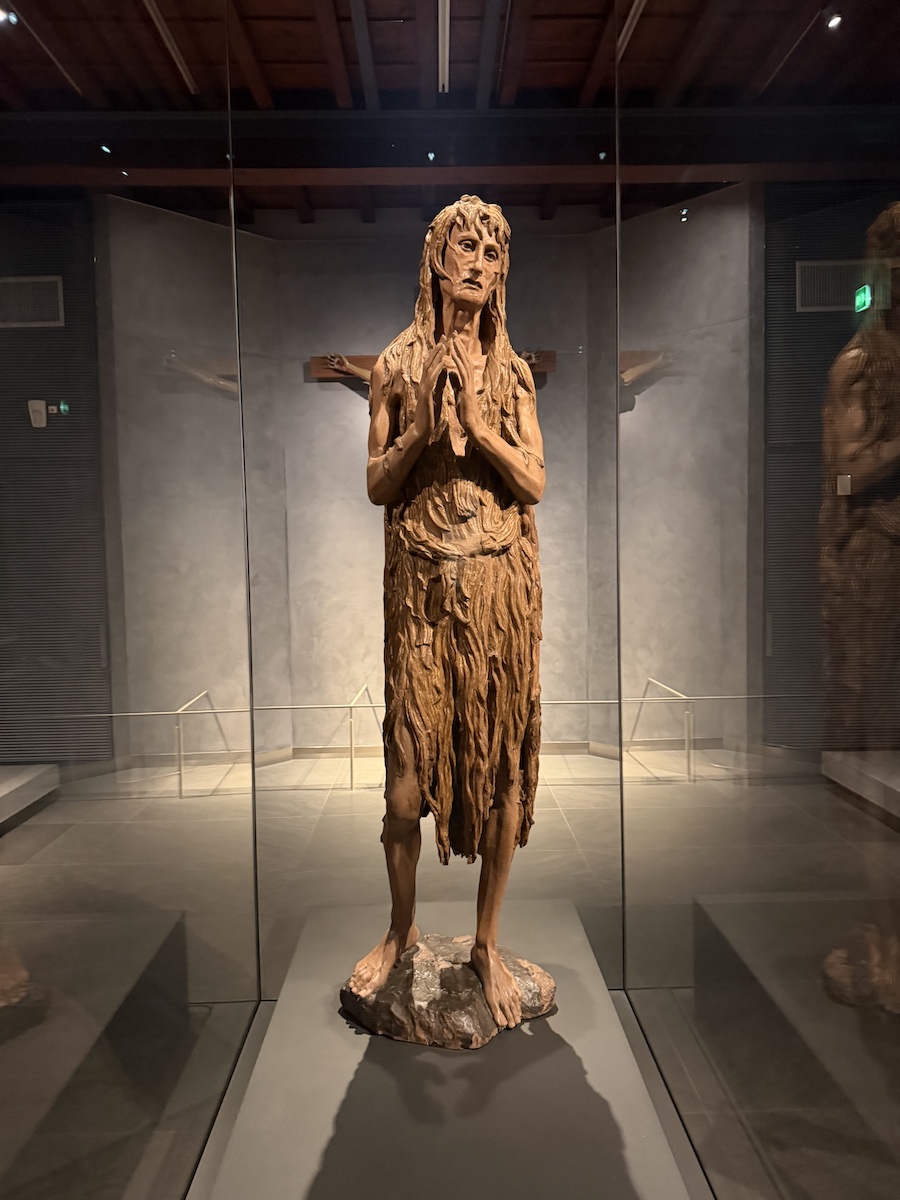
Donatello depicts a naked Mary Magdalene, only covered by her long hair (photo Jan Bom)
Donatello worked in the early years of the Renaissance. He even helped shape this art movement. His poplar wood sculpture of Mary Magdalene is a symbol of this. He radically breaks with how saints were supposed to be depicted. His Mary Magdalene was not a sweet pious admirer of Jesus, but a tormented woman, after a life of penance.
The sculpture stands in the Museo dell’Opera del Duomo in Florence and is one of Donatello’s most moving and innovative works.
Hollow look in the eyes
This Magdalene from 1457 (approximately) is depicted as an emaciated woman, clad in rags or perhaps only covered by her own never-cut hair. Her thinness, the deep grooves in her face and the hollow look in her eyes make her image human and emotionally charged. This is a break with the earlier idealization of Mary Magdalene as a youthful, beauty-radiating penitent.
Donatello chose wood instead of marble or bronze, materials in which he excelled. The choice of wood was not only practical—lighter and easier to work—but also contributed to the expressive power of the work. The polychromy (painting) and gilding gave extra depth to the drama of the sculpture, although much of the original colors have faded.
The failure of the Jansons
In the last edition of the American ‘Art Bible’ Jansons this sculpture is the last shown when it comes to artisanal wood carving – woodblock printing excepted. And yet the absolute peak of wood carving was still to come, around the year 1500. Then master carvers such as the German Riemenschneider and Dutch Master of Elsloo delivered their top works. Not to mention the amazing ‘prayer nuts’ from the workshop of Adam Dirkszn.
And as if a revival of artisanal work in a natural material like wood is not slowly but surely gaining momentum this century, carried by modern artists of name and fame like Ellsworth Kelly, David Nash and not to forget Giuseppe Penone. About this development the American art historians in the Jansons are silent as the grave. Nash and Penone are not even mentioned. Into the waste paper bin then, this outdated standard.
Maarten van Rossem does it better
The Dutch historian Maarten van Rossem gave on his website Maarten a much finer description of Mary Magdalene than the Americans do in the Jansons. He writes it so beautifully that I cannot bring myself to shorten this quote.
Van Rossem: ‘Christ returns after his death and what I find so interesting is that he first appears to Mary Magdalene, a woman no less. According to the stories she was a woman of loose morals before her ‘conversion’ by Christ. Of course she doesn’t believe what she sees and she wants to touch Christ, but he says: ‘noli me tangere’, do not touch me (John 20.17). That is of course a Latin translation, but if you take the Greek, you can understand it a little better, because then you translate it as ‘stop holding on to me’, or: ‘stop clinging to me’.
Into the wilderness
‘After the resurrection of Christ and the meeting in the ‘garden’, Mary Magdalene retreats as penance into the wilderness of southern France (according to Jansons in a desert, jb). She remains there for thirty years, fasting and praying. It is an apocryphal story, for example it is not in the Bible like this. According to tradition, Mary Magdalene was depicted as a beautiful rich young woman in expensive clothes. To be able to recognize saints in images, they were given an attribute. For Mary Magdalene it is the ointment jar.
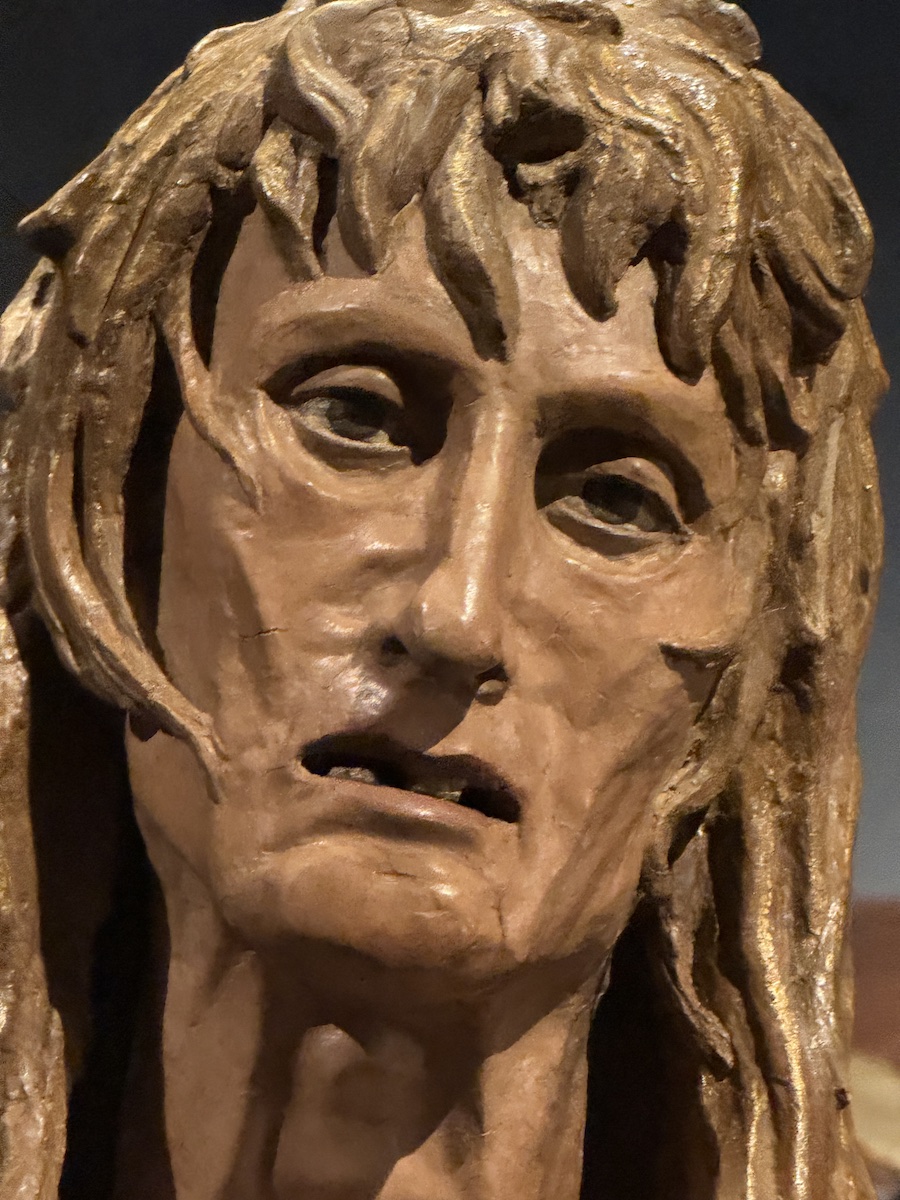
‘Old, hollow-eyed, emaciated, dressed only in her hair’. photo Jan Bom
‘How different and groundbreaking Donatello approaches it! Old, hollow-eyed, emaciated, dressed only in her hair. Without attribute. He must have delved into what someone looked like after all those years of deprivation. That is completely remarkable given the fact that Donatello was a Renaissance artist. During the early Renaissance it was all about beauty, grace, elegance and not at all about decay and deterioration.
Already 71 years old
Donatello was already 71 years old when he made this sculpture. For that time that was ancient. Incredible that he stood chiseling in what is quite a substantial piece of wood. And of course he knew the decay of his own body. You wonder who the client must have been. It is known that the sculpture was intended for the Baptistery in Florence. That was a place where baptisms take place, where transformation occurs. This sculpture of Mary Magdalene is of course a symbol of transformation and penance, and of a deep faith for which you give up everything.’
Text Jan Bom, February 2, 2025