A good likeness portrait, carved in wood. That is what German wood artist Karen Löwenstrom (1978) has specialized in. It is a special genre that Löwenstrom practices: the (group) portrait in wood. On commission. Her sculptures are figures of about 25 centimeters high, carved in fibrous spruce wood. Not the first type of wood you would think of to render a facial expression.
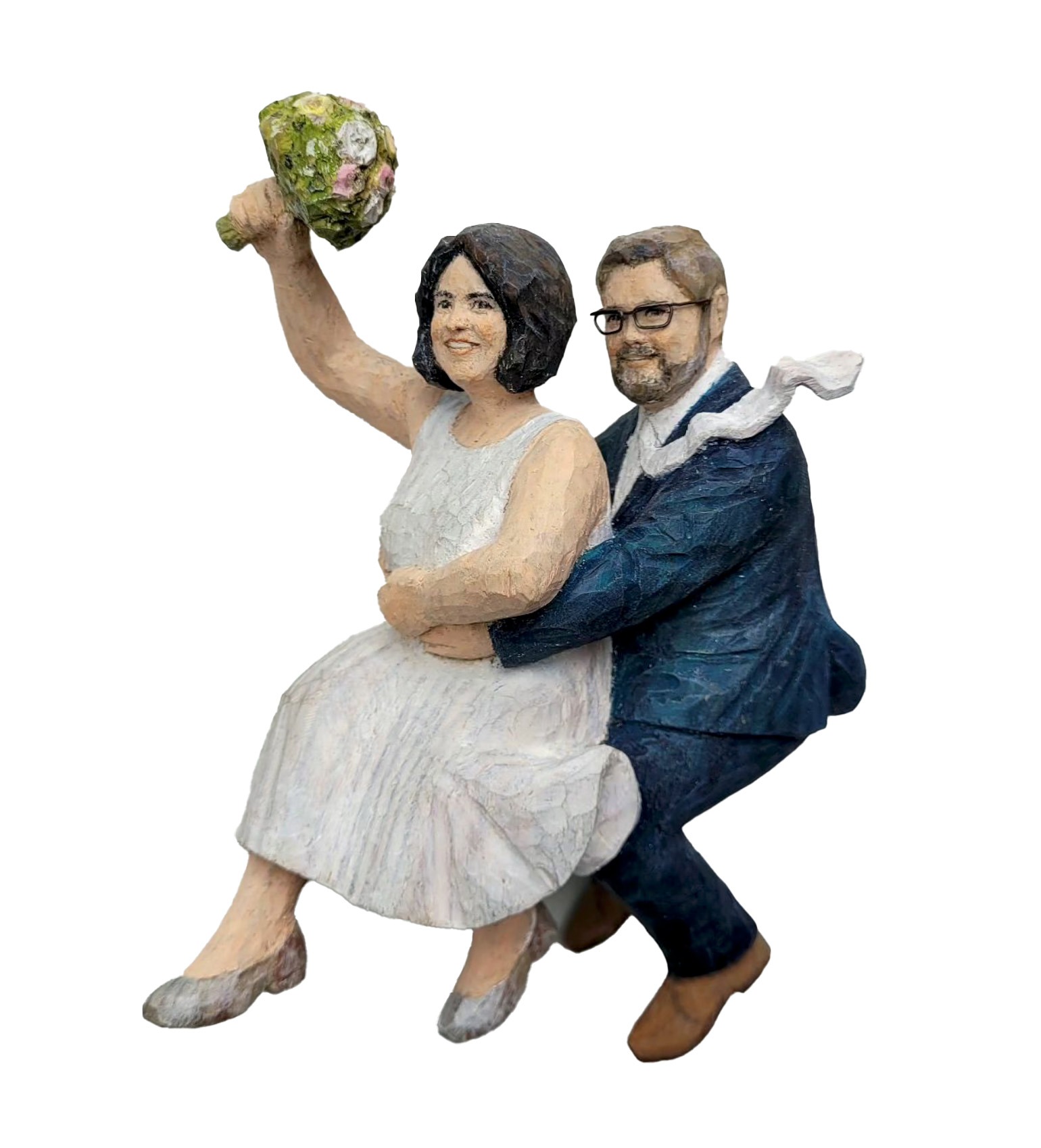
Karen Löwenstrom carves family portraits in wood. Commissioned by the married couple: a double portrait.
Her clients understand that a wooden sculpture is not a photograph. But still they want to recognize themselves in the sculpture. That Löwenstrom can do this is downright impressive. Her portrayed subjects look strikingly lifelike. That is easy to verify. Löwenstrom often shows the real people her sculptures are based on for comparison.
Try doing it yourself. At this scale, a few wood fibers can already make the difference between a smile or downturned corners of the mouth. Between someone looking straight at you, or someone squinting. It is precision work. Löwenstrom’s gouges must be razor sharp.
Happily arm in arm between happy sons
It is a secret pleasure to follow her steady production on Instagram. Monthly, sometimes even weekly, she posts sculptures she makes for new clients. Sometimes it is an older couple, together in a round bathtub. Iron glasses on their noses, sturdy swimsuit on. Laughing. Sometimes a white bride and her groom swim into the wide world on a rough piece of tree bark, symbolizing a fish. The man’s white tie flutters over his shoulder. The bride holds her colorful bouquet up like a trophy. Then again a mother walks happily arm in arm between her equally happy two sons. Regularly the family dog must also be incorporated into a family group. Löwenstrom sometimes gives the animal a long leash. Or a child plays crouched with an adorable puppy.

A ballet dancer in pose, also: cheerful. No injury suffering. No stress.
Löwenstrom is very modest about her artistry. She is already happy ‘if I can bring cheerfulness to people’s faces’, she writes on her website. Just as modest are her demands on her clients. Hours of posing sessions are not necessary for her. A good photo or a series of photos suffices, preferably taken from different angles, to translate the facial characteristics and posture well into 3D.
‘Bundessiegerin im Bereich Holzbildhauerei’
However, don’t make the mistake of thinking that we are dealing with someone who took up wood carving as a hobby, after which everything got completely out of hand due to unexpected talent. Having grown up in the artists’ village of Worpswede near Bremen, she did indeed follow a classical art education at a ‘Fachhochschule für Graphik und Design’. After that she continued her studies by collaborating with professional sculptors and following various other professional courses. She thus ultimately achieved the recognition ‘Bundessiegerin im Bereich Holzbildhauerei’.
In the Netherlands such solid training programs for wood carving cannot be found, unfortunately. Those who want to start with ‘woodcarving’ here end up with ‘master carvers’ like Jan van Harskamp of Houterij De Specht. Who also had to teach himself. Belgium still has a part-time academic training, which is reportedly somewhat academic and traditional. On Saturdays, in Antwerp. Takes five years, with two years of specialization afterwards.

An older couple that ‘will enjoy it’, in a Citroën 2CV.
Karen Löwenstrom thus carves family portraits in wood. I have a few favorites. The older couple coming up through the open roof of a Citroën 2CV, each waving with one arm. Also: modest in size. No more than 37 centimeters long, 15 centimeters wide and 16 centimeters high. Or the sculpture of a female photographer. Löwenstrom made no attempts to give her a slimmer figure.
The size of a Nativity scene
In terms of size these sculptures compete with the dimensions of an original wooden nativity scene, as developed by the German ‘professor’ Karl Kuolt (1879-1937). That was more than a century ago, but his company Anri still exists. In the Italian St. Ulrich (East Tyrol), craftsmen still carve cribs with baby Jesus, mother Mary, the Three Wise Men from the East, the donkey, cows and lambs. Such an original wooden Nativity scene with 12 figures has now become a collector’s item. On Catawiki a collector paid 935 euros for one. Marktplaats is still full of them, especially before Christmas.
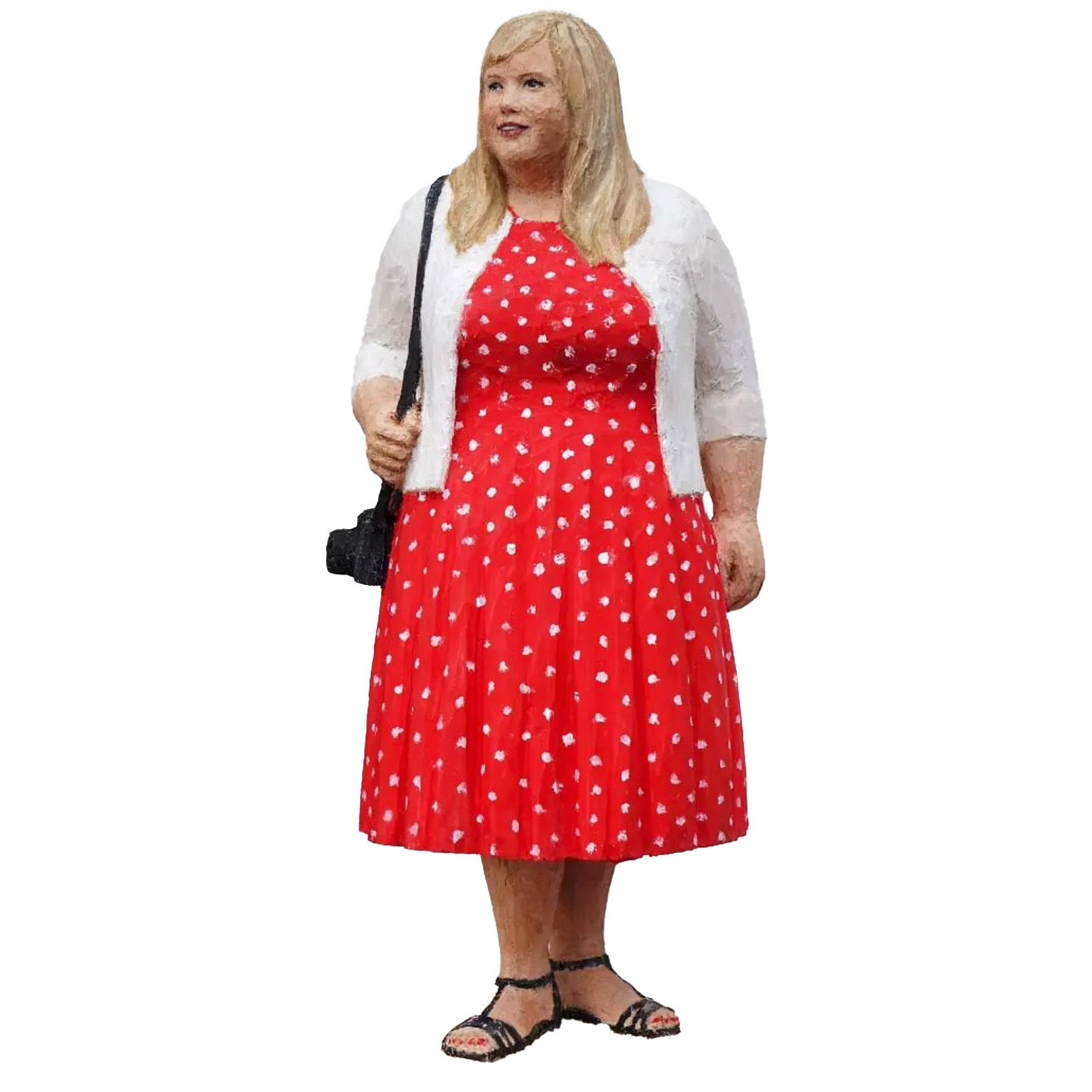
The female photographer, made more cheerful, but not slimmer than she is.
However, Löwenstrom does not use gold leaf like in Nativity scenes. She does paint her sculptures very precisely and colorfully with acrylic paint and gouache. A protective layer of ‘edelwachs’ gives the sculptures a protected top layer; it brings out the cheerful colors of the paint even more.
Too artisanal, too light
Löwenstrom will not make the art history books. For that her work is too artisanal, too lighthearted, too carefree. Curators of modern art museums look down on so much domestic happiness. Families where nothing seems to be wrong at all is not something that metropolitan museums want to associate with. And yet I enjoy it every time Löwenstrom presents a new sculpture. But… Don’t tell anyone.