
I find it fascinating how in TV series history is dramatized to make a story exciting, full of ‘cliffhangers’. The streaming services go quite wild with their series about Vikings. In their primitive villages, Viking women emerge with complicated hairstyles as if they had spent a day at the hairdresser. Danish King Forkbeard even gets three braids in his long black beard. That’s not where he got his nickname from. A Forkbeard is nothing more or less than a split beard.
He did really exist, this ‘King Sweyn Forkbeard’. He lived from 963 to 1013 and was the son of Harald Bluetooth, after whom the wireless connection system is named. Sweyn even rose to king of the Britons, but not for long. He ‘reigned’ no more than five weeks, from December 1013 until his death.
Historians take pleasure on their websites in correcting all the inaccuracies and nonsense in the Viking series, as far as that is possible. I myself have always been annoyed by the use of the name ‘Kattegat’, the narrow sea strait between the European mainland and Scandinavia. The name is clearly of Dutch origin. And that can’t be right. In the time of the Norsemen we weren’t yet sailing to Sweden and Russia to get our wood there.
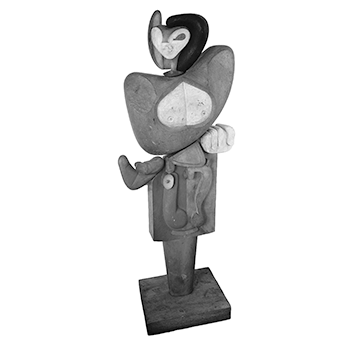
I find this phenomenon of ‘falsified history’ fascinating. Hence this wooden book-with-beard. Forkbeard’s fantasy beard grows in a surreal way from a book, to lead a life of its own.
Footnote: I was given a piece of lime wood with solid knots to work with. That was one of the reasons to make such a large braid with tassel. I was quite satisfied with the find, to give such an impossibly large piece of dark and impossible piece of wood a function. Yet I have been asked several times: ‘Did he hang his beard in the soup?’