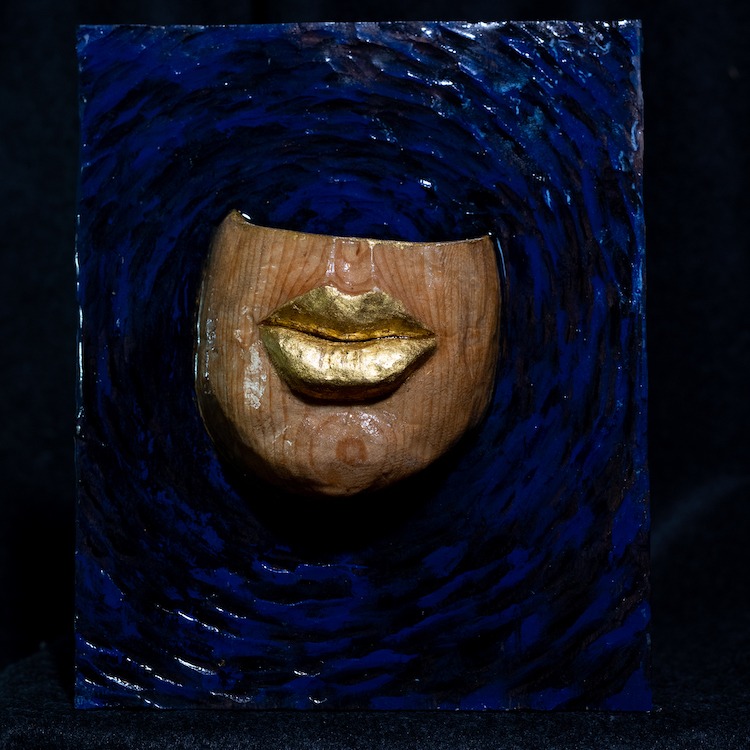
The heat of the tropical night. The ocean black and blue. A mouth tells stories. A memory of Bonaire, the paradise of the Netherlands in the Caribbean.
The history of carving in wood began with a flat surface. Beginning wood carvers also start with a small board and carve a relief into it, just as a coin also has a relief of the portrait of a king, queen, statesman or emperor. The advantage of this method: your drawing on the wood remains. You can keep working along the drawn lines.
That example disappears when working on three-dimensional forms. When making a head, you carve that drawing completely away. You can keep adding drawings to the wood, but much more important is learning to hold that final image in your imagination. And that’s not so easy. Unlike clay, where you build up a head in more and more layers, cutting away wood can easily ruin a nose because you started on the nostrils too early. It takes courage to dare to carve wood.
Full lips
I still lacked that courage when I learned to carve a mouth. The lips remained much fuller than I had planned, in the beginning it even looked as if they had been injected with botox. What follows is a process of razor-thin cutting, sanding, scraping, until I was suddenly whispered to by a tropical woman and I stopped. First I imagined she spoke Brazilian Portuguese, with those soft sweet sh-tones. Later I moved my mouth to Bonaire, where in this beautiful Dutch municipality I found ‘my’ mouth again in the faces of female compatriots.
The island of Bonaire is partly very low-lying. Where the slave huts now stand and the salt pans lie, the rising sea level will flood the island by mid-century. With unchanged climate policy, residential areas and even the airport will later be underwater. In my sculpture, the tropical mouth has become the center of a blue-black whirlpool. We talk and talk, but wait too long with decisive measures.
Under a layer of epoxy
With this sculpture my first experiments with epoxy also began. This synthetic material brings up colors and gives a sculpture a strong high gloss. Epoxy can also protect wood against the centuries to come, unlike oil or beeswax. Look at the magnificent wooden artworks in museums, eaten away by woodworm and wood beetles. According to me, wood protected under a layer of epoxy can even produce sculptures that can stand outside without rotting.