Gauguin went to Tahiti in search of the noble savage. He eventually carved the wooden sculptures that the French colonizer had destroyed. Towards the end of his life he could finally make a good living from it.
For wood carving enthusiasts, the absence of works in wood by French artist Paul Gauguin (1848 – 1903) in the ‘art bible’ Janson’s is an omission. Even the woodcuts and sculptures the artist made on Tahiti and the Marquesas Islands are missing.
‘Direct carving’ means that a sculpture is not copied (to scale) from a design in clay.
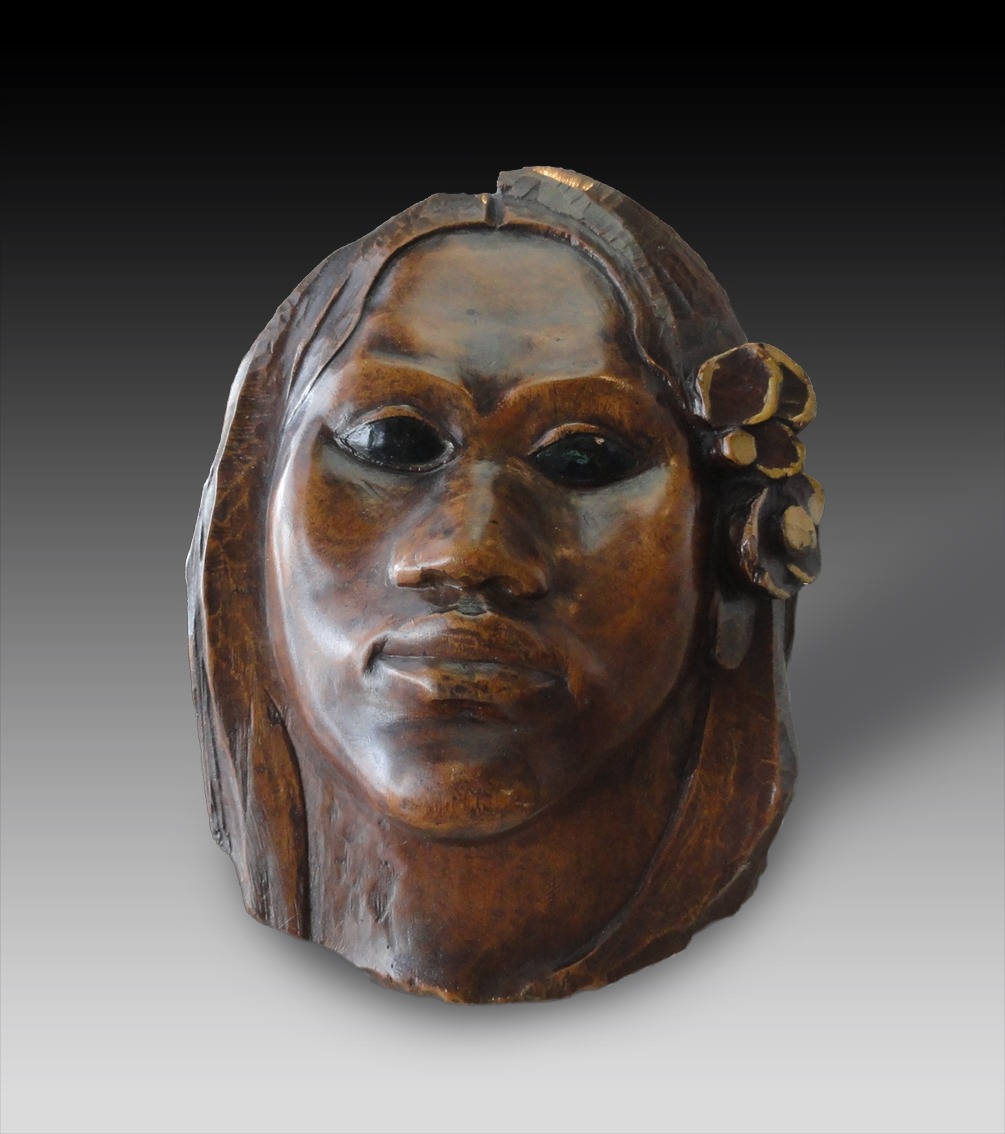
Gauguin gave this female head many names. He called it Tehura, but also Head of Tahitian Woman and also Teha’amana. He carved it around 1892 from Pua wood. He partially gilded the flower in the hair with gold leaf.
Vincent van Gogh and Paul Gauguin were friends, who even painted together for a few months in southern France. Among the things they had in common was a love for Japanese prints, which were collected as wrapping paper by artists in Paris. They were prints from woodcuts. Van Gogh even repainted one, a garden with blooming trees: ‘The Plum Garden‘, a woodprint by Ando Hiroshige from 1857. It would permanently influence his style. The Japanese woodcutters made the distinction between foreground and background disappear, as if there was no near and far. But Gauguin also adopted this Japanese way of depicting.
Direct carving, without a model in clay
He went even further and made woodcuts himself in the South Pacific, in which his painting style is very recognizable. Art experts state that Gauguin adopted the indigenous style of woodworking, in which the grain and irregularities in a tree trunk were co-determining for the final image. Previously, Western sculptors first made a study of their sculpture in plaster or clay, after which students copied it one to one (or enlarged it) on stone or marble with special tools. About this characteristic of modern wood carving, also called ‘direct carving‘, not a word can be found in the art bible Janson’s.
Gods forbidden by the church
Janson’s does describe a lot about the many art movements in which Gauguin is classified: fauvism, post-impressionism, symbolism, primitivism. And also quite a bit about his spiritual search for the ‘noble savage’, who lived in harmony with nature. That no longer existed, partly due to the French colonizer. Even the indigenous art hardly existed anymore, destroyed by the French colonizer. That’s why the disappointed Gauguin decided to reinvent it. He even made figurines of the gods of the islanders that had been forbidden by the Roman Catholic Church. And he also gave these gods a place in his paintings, which eventually began to sell well in Paris.
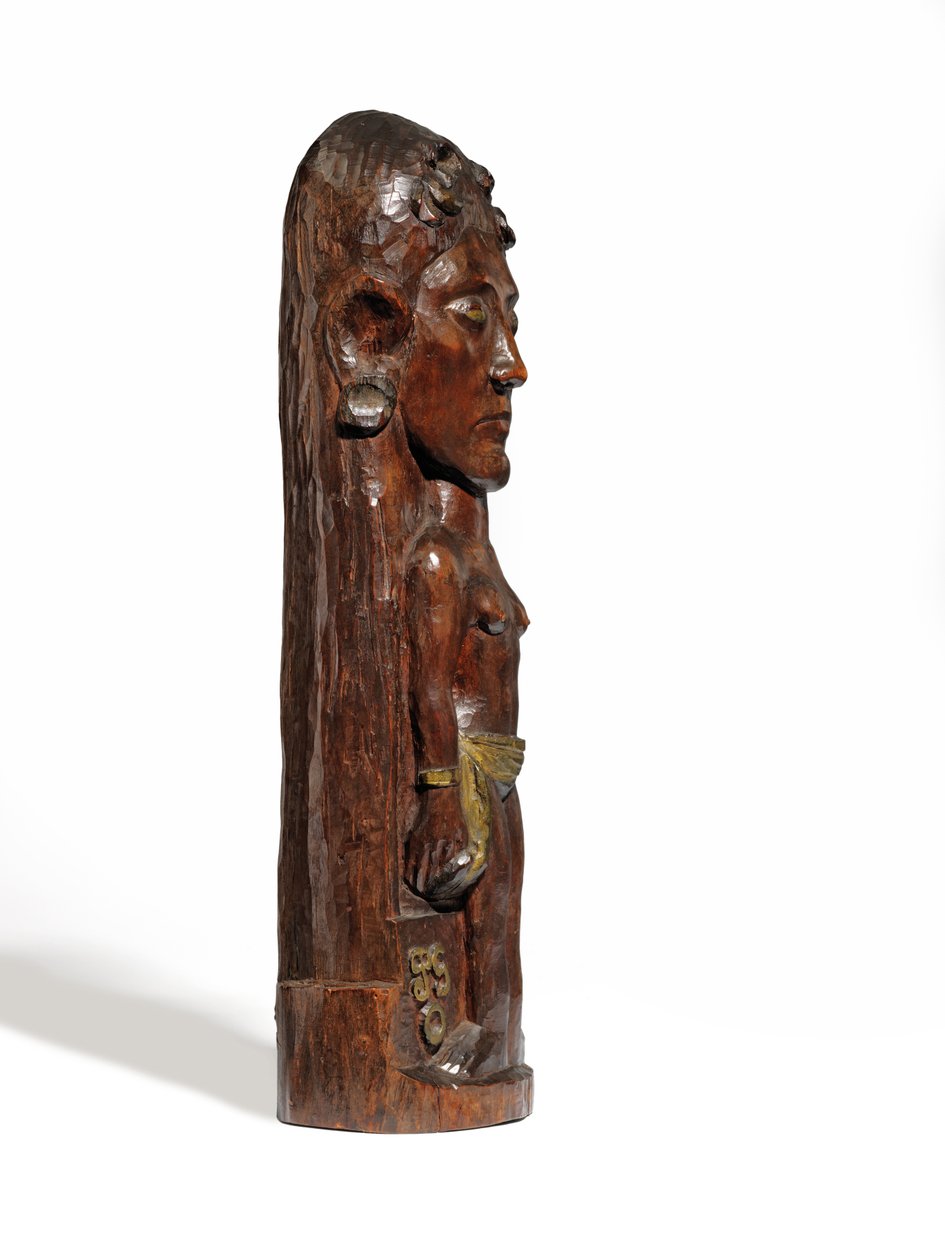
‘Thérèse’ from 1902-1903 Gauguin also carved when he was working in the South Pacific.
It is precisely this sculpture by Gauguin, ‘Thérèse’ from 1902-1903, that is on record as the wooden sculpture with a record yield at an auction by Christie’s: 30.9 million dollars in 2015. The artist also carved this female figure in Polynesia. He worked on it with, among other things, gold leaf and copper nails.
Wooden sculptures by Gauguin such as ‘Tehura’ can be found in the Musée d’Orsay in Paris. The ARTnews website describes Gauguin’s development in an article, which also mentions ‘Tehura’.
In 2024 an admirable biography about Gauguin, Wild Thing, by Sue Prideaux was published. I wrote a review about the book, emphasizing his wood carving, also during his years in Denmark, in Brittany (where he carved his own clogs) and of course the islands in the South Pacific, where a wooden sculpture was placed on his grave.
Jan Bom, May 2022 (update May 2025).