From the poetess Sappho who lived on Lesbos, one poem has survived. It is about her female beloved who nevertheless chose a man. We are writing 570 years before Christ.
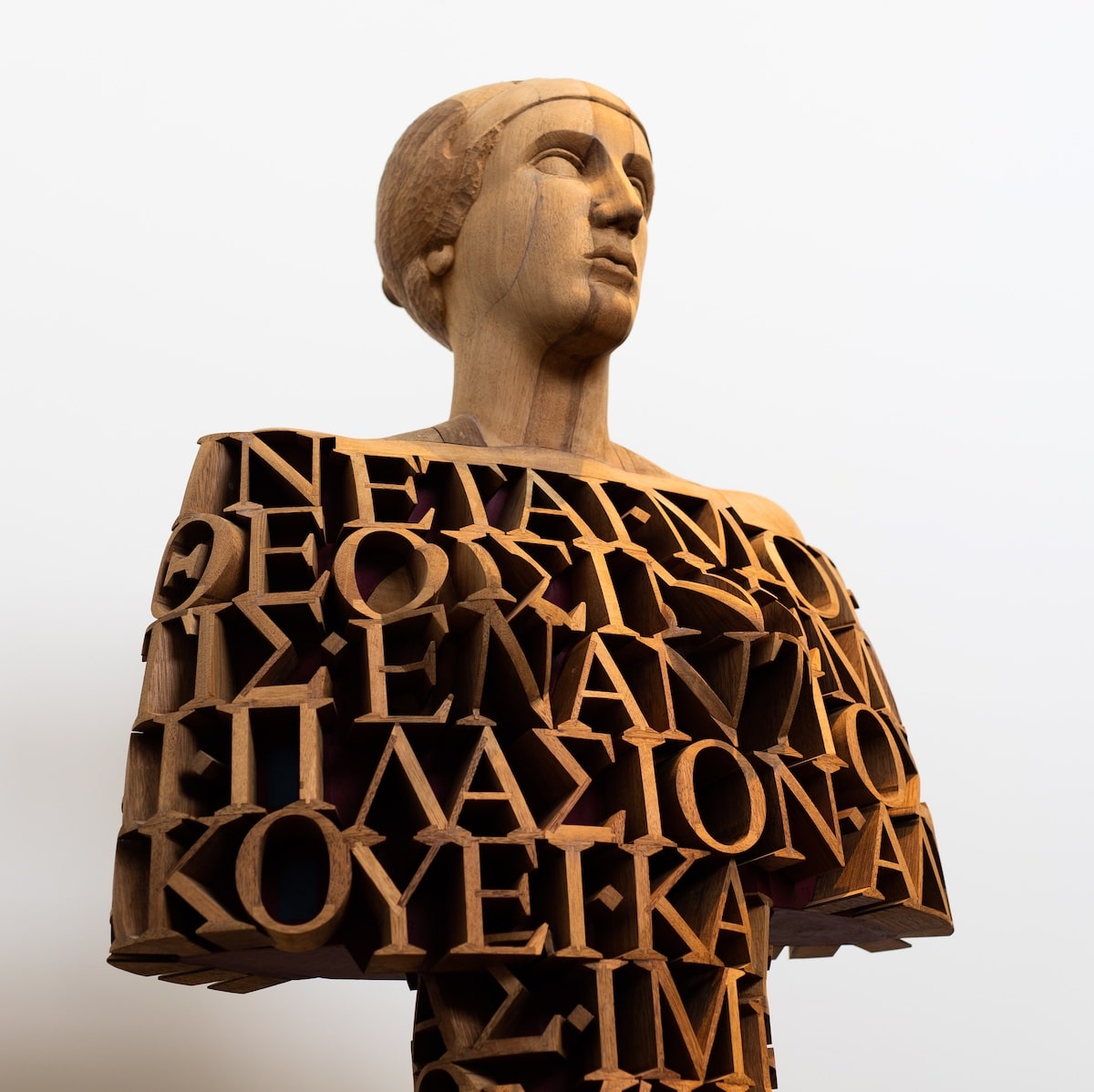
The poem inspired the Dutch sculptor Gerhard Lentink (1956) to create a monumental sculpture, in which he built the dress of the poetess from her desperate lines of poetry. She thus assumes, as in a metamorphosis, the form of her own poem.
Lentink chose a fragment about the physical nature of love. He wrote about this: “It moved me that the physical sensations that arise with intense infatuation turn out to be timeless. A gap of 26 centuries is effortlessly bridged.”
“Speaking is no longer possible for me”
Happy as the gods seems to me the man who sits right across from you and listens to your beautiful voice
and sweet laughter, so that suddenly my heart pounds in my chest. As soon as I look at you
my voice falters
my tongue is broken,
a light fire runs through my skin, I see nothing anymore, my ears are ringing,
sweat streams from me,
a trembling seizes me,
I feel colder than grass, it seems as if I am dying,
but everything is bearable if…’
‘An expression of yearning desire’
Lentink had already built a kind of roof structure from letters before, ‘Walter’s house’, also based on a poem. This time he took a limestone figurine from around 640 BC as his starting point. It is called La Dame d’Auxerre, even though it originally comes from Crete and is in the Louvre in Paris.
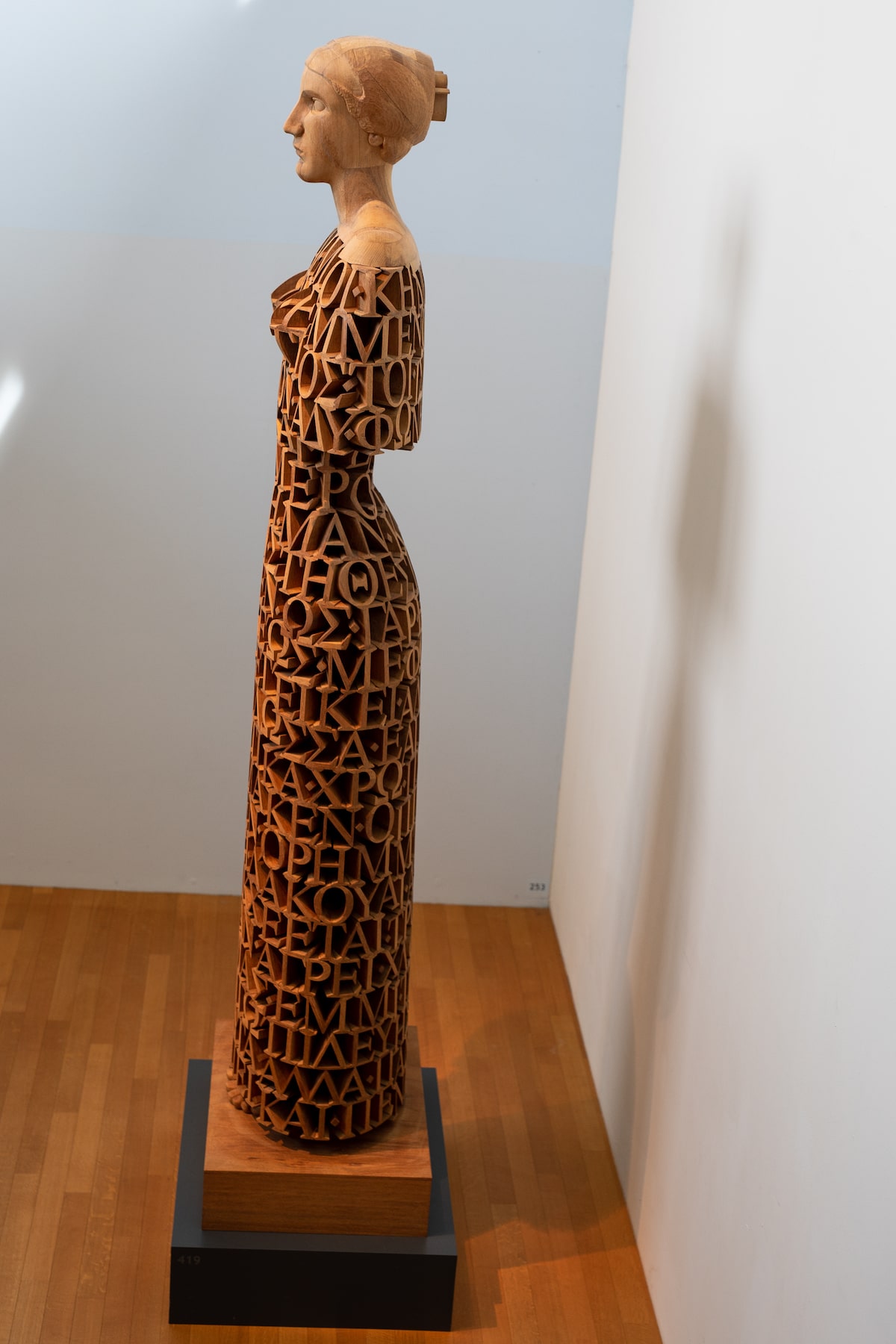
Lentink about this source of inspiration: “The goddess wears a long, waist-cinched pleated garment down to her bare feet. Around her shoulders she wears a long collar, a pelerine. In the unfortunately damaged face, the famous archaic smile adorns it.”
That’s why he chose another portrait of Sappho in marble for the face, which is in the Archaeological Museum of Istanbul. “In this time there is already room to give the face an expression of yearning desire.” This idea can still be clearly seen especially in Lentink’s design.
“2600 separate parts”
The sculptor then began a gigantic puzzle, which started with cutting out 390 letter characters, built from about 2600 separate parts. Lentink worked on it for months. He sawed the parts from the tropical wood species merbau, one by one. He sealed them at the back with a piece of plywood, painted in the color oxblood red.
Then he worked all the individual letters of the poem elliptically downward from the neck along a central axis, down to the bare feet. The poem thus reads from top to bottom, for those who understand Greek.
Although he chose the original Greek script, the letters were not. ‘Times New Roman’ is a typeface that newspapers used to use, including the British Times. As a font it has so-called ‘serifs’; strokes at the bottom and top of the letters. They make the text of a newspaper more readable, but Lentink needed the serifs to be able to stack the letters on top of each other. He left out the arms, but for the curve of the breasts and narrowing of Sappho’s waist, he adjusted the shapes of letters individually.
“A monument of female creative power”
The work is now ten years old. It was precisely in this year 2012, when he was still working on the sculpture, that Lentink received a visit from art collector Leo Dijkman and his wife Sylvia de Munck. They walked into his studio in Dordrecht and stayed talking for six hours. After which they bought a work, another one a week later, and when Sappho was finished, finally this special torso as well. It can now be found in Sculpture Gallery Het Depot in Wageningen. It is a paradise for art lovers who appreciate wooden sculptures, from classical torsos to form experiments in which the human body takes center stage. Sometimes in such private museums, far outside the mores and powers of the established art world, the most innovative visions can be found.
Sappho became what Lentink wanted: an icon of female creative power. The artist sees Sappho as the female counterpart of Homer, the male poet who also came from Greece. The soft confrontation versus the hubris. The longing for love versus the yearning for distant lands beyond the horizon. The sculpture is a monument of femininity.