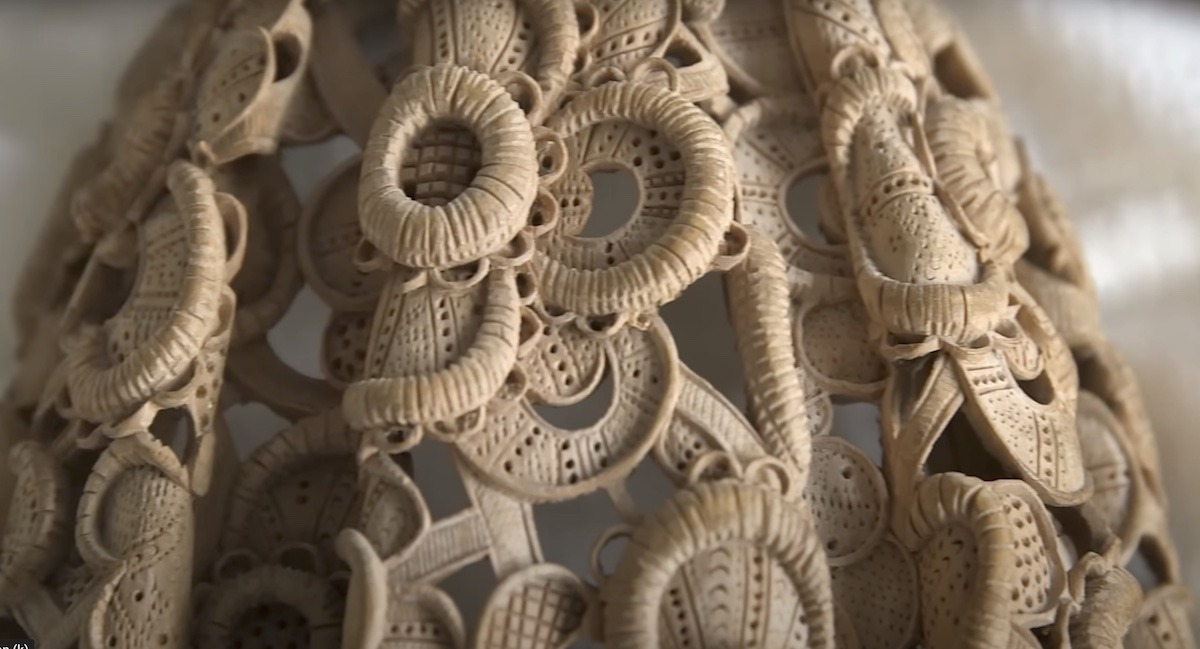

Waving wood. Look at the strings on that violin. They are carved from wood. That curved sheet music paper. That stem of those tulips. According to legend, Grinling Gibbons (1648 – 1721) had a vase with wooden flowers hanging in front of the door of his studio in London, which waved back and forth whenever a carriage passed by on the street.
Too busy, too many details
This artist was not the first to start carving in lime wood (Riemenschneider did so a century earlier) but he could do it so well that his art remains unmatched in detail to this day. Born in Rotterdam, he established a new world standard in fine wood carving in England.
In this era where the sleekness of Ikea’s Scandinavian design is leading, Gibbons’ work looks very busy. Today you would most like to separate all the elements from such a still life again. How beautiful would it be to just hang such a beautifully carved feather on the wall, or to place his wooden music book on the piano.
Appointed as a ‘Master Carver’
The abundance of forms had to do with the era in which Gibbons worked, the late Baroque. Hunting scenes were very popular. But who today still wants to show off such a realistically carved dead duck or pheasant, with its head hanging limply down?
But Gibbons was very successful with it and received beautiful commissions as ‘Master Carver’ – a title of honor from King William III. His showpieces can still be admired, such as the organ case, choir stalls and the bishop’s throne in St. Paul’s Cathedral in London. For wealthy Britons he decorated period rooms with abundantly decorated frames and still lifes with hunting trophies. And also to present samples of perfection like a ‘carved’ neckerchief that looks like it’s made of Brussels lace. Or a bow, with unparalleled subtlety of detail. You can’t get more delicate than this.
The fine cell structure of lime wood
Many hobby wood carvers today don’t realize that Gibbons was the first in England to choose lime wood as material. Before that, oak was the standard, especially among the British. That wood type is not only harder, but much coarser in grain and has knots much more often. Lime wood (Tilia), which is confusingly called ‘limewood’ by the British and Americans (the tree has nothing to do with citrus), has a very fine and regular cell structure. A nice piece of lime wood is as soft as a bar of soap, as long as the chisels and burins are razor-sharp and polished.
Much of what we now know about our compatriot, we owe to the American David Esterly (1944-2019). He dedicated his entire working life to Gibbons’ magic, after he accidentally walked into St. Paul’s Cathedral as a young student because his girlfriend suggested it. Esterly taught himself wood carving and became so skilled at it that he was asked to restore a Gibbons artwork that had gone up in flames at Hampton Court. It took him a year of hacking, chiseling, carving, sanding and planing.
Admirer, biographer and slave
Esterly, the former literature student, became Gibbons’ biographer and wrote the beautiful book ‘Grinling Gibbons and the Art of Carving’. For today’s wood carver, the last chapter is particularly interesting. In it he shares his personal observations about wood carving with his readers. That you can’t do it sitting down, but that your whole body carves along. So you stand. About the many types and sizes of chisels needed to carve natural shapes from wood. About the reed-like plant ‘Dutch Rush’ that Gibbons used to give the surface of his apricots and peaches a soft skin.
And Esterly also provides beautiful anecdotes. The British of that time wanted Gibbons’ decorations so badly that they placed orders with him without first checking whether they could afford to pay him. Once wiser, and still a thrifty Dutchman, the artist delivered his works only half completed. He could carve splendid pods with perfectly round peas inside. But those pods were still closed. ‘When the bill is paid I’ll come by to carve them open’, Gibbons is said to have said.
Recent successors
On YouTube videos can be found in which Esterly talks about his love for Gibbons’ work and carving in lime wood. But also how the wood carver first thinks he is the master of the wood, but in the end is dictated by the wood what still needs to be done. ‘You’ve gone from master to slave’, Esterly cheerfully states.
After many centuries Gibbons still has successors, including the still young Belgian Julien Feller. He works at least as finely, spending a year (3,500 hours) on a piece of Brussels lace made of boxwood, which also waves as if hanging on a clothesline in the wind. Gold leaf accents complete his detailed artworks. Feller is academically trained. His refinement has now gone so far that he is proud to be able to work at ‘the size of a grain of rice’. He therefore sometimes works with a stereo microscope, an instrument that did not yet exist in Gibbons’ days; the first microscope had only just been invented then.
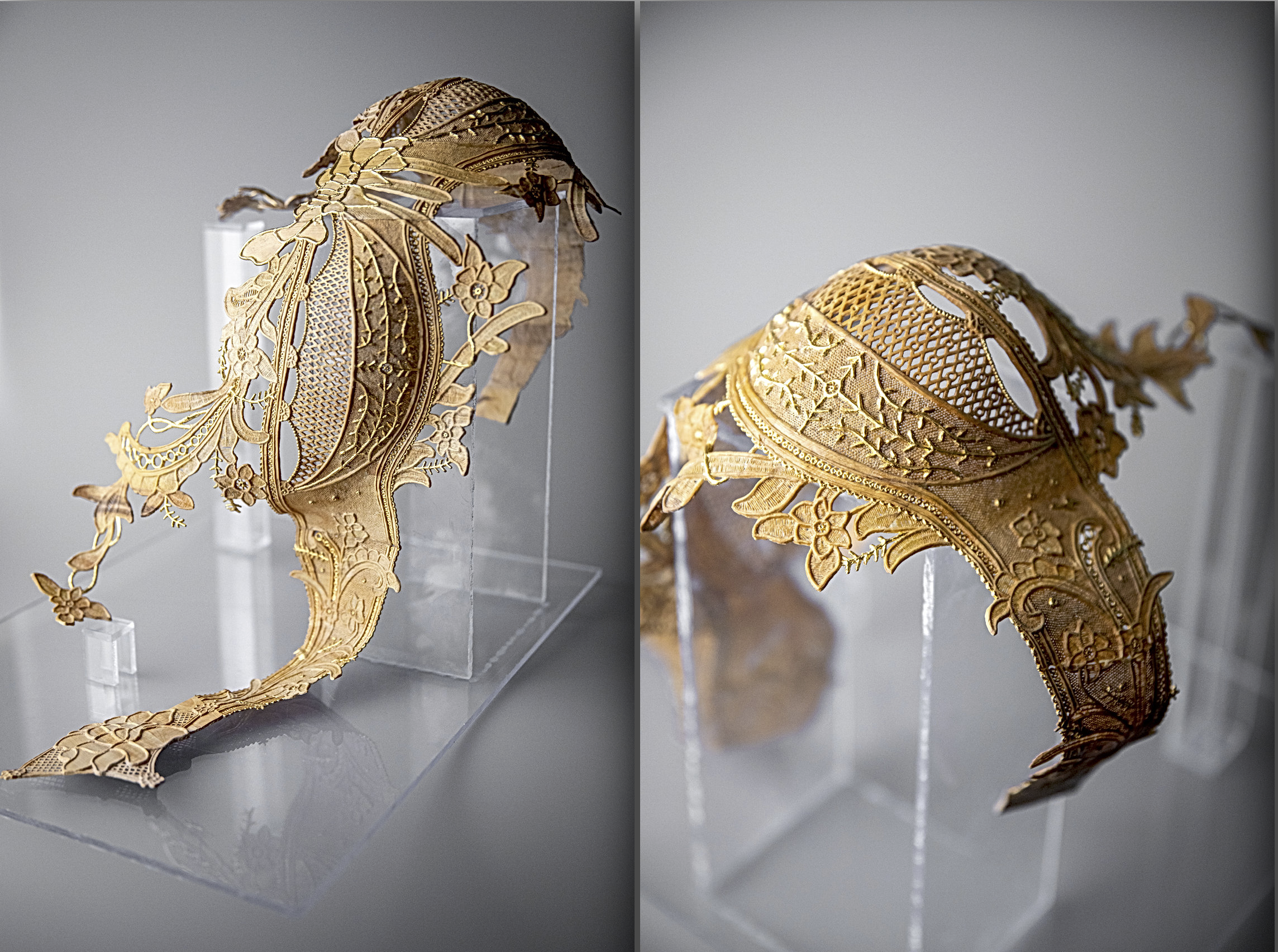
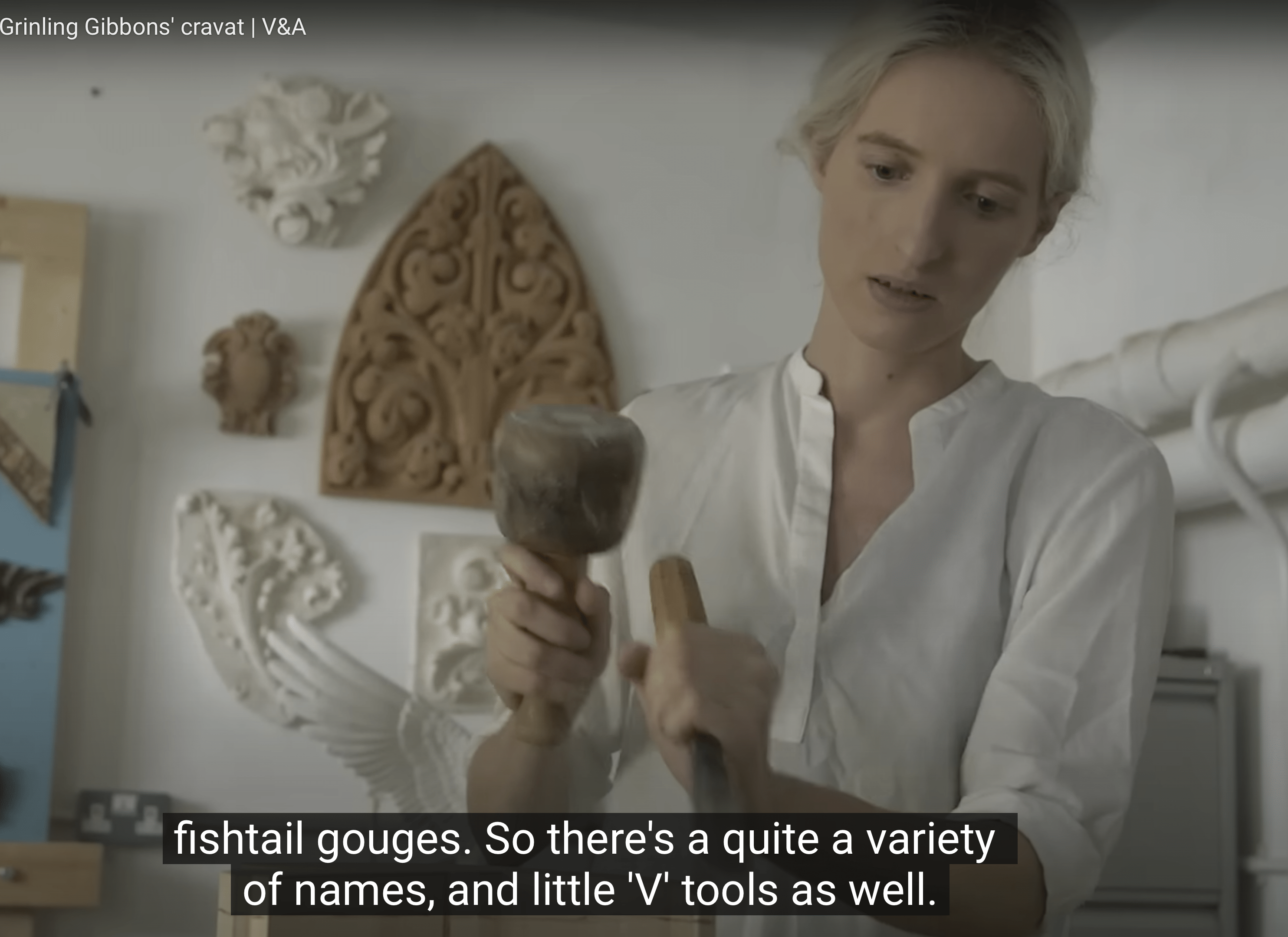
British wood carver Clunie Fretton is another ‘follower’ of Gibbons. She made a copy of the master carver’s famous lace cravat and documented the entire process in a web movie ‘How it was made’. It becomes clear how precise the rough preparations for such wood carving are, using a replica for measuring out the shapes of the cravat. Excellent lesson for beginners. A good beginning is half the work. With this aside: Fretton used an enormous arsenal of different gouges and burins. With a fun fact: these tools have hardly changed since Gibbons’ time. What is newer is the use of sandpaper to make the skin of the wood perfectly smooth. Gibbons had to perfect his smooth fruits with a rough kind of reed, which he had imported from the Netherlands.