Totem poles are alive and kicking, with the latest example carved in 2026. How can that be? Aren’t totem poles supposed to belong to a distant past, somewhere along the Pacific West Coast of Canada and the United States? Nothing could be further from the truth.
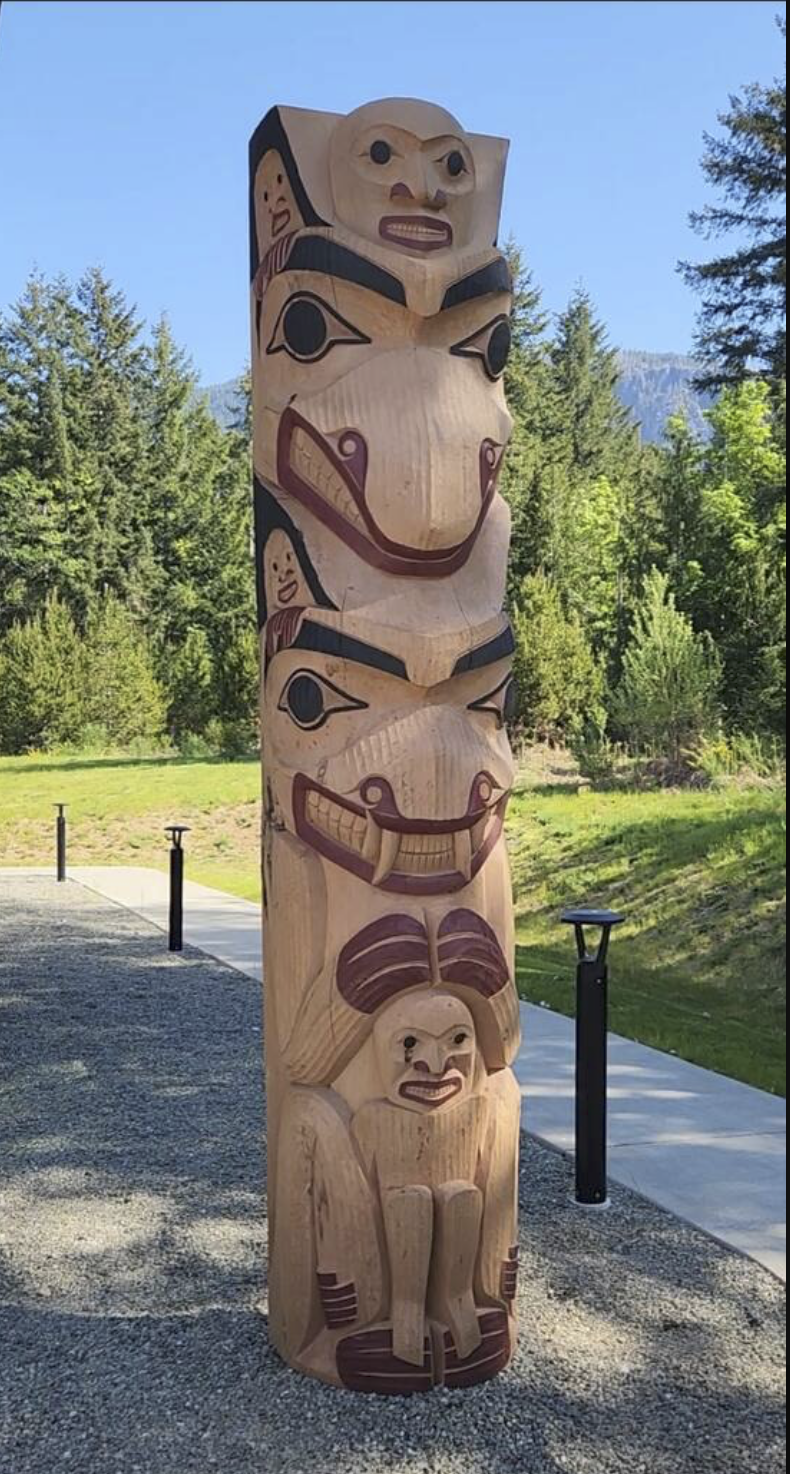
Totem Poles are alive and kicking, like this one, carved in the year 2026 by Sanford Williams.
On May 13, 2026, a new totem pole in Nootka Sound, on the west coast of Vancouver Island in British Columbia, Canada, was ceremonially ‘awakened’. The work is called The Protector. It was created by Sanford Williams, a master carver of the Mowachaht/Muchalaht First Nation. He carved the totem pole from a cedar trunk. The pole stands beside the Royal Canadian Mounted Police station in Nootka Sound.
The Protector is not a reconstruction of a historical pole. It is an entirely new work of art telling a contemporary story. The pole features a wolf, a bear and five human figures. The five figures represent the communities and waterways served by the local police detachment: Gold River, Yuquot, Tahsis, Tsaxana and the surrounding waters. The wolf and bear represent, among other things, cooperation, loyalty, courage and protection.
That is what makes this pole so interesting. Not simply because it is new, but because it shows that the tradition is still very much alive and kicking.
New Stories in Old Wood
Sanford Williams is not the only contemporary carver creating new monumental poles.
On January 15, 2025, a new pole by artist and carver Dylan Thomas was raised in North Cowichan/Duncan on Vancouver Island. Thomas, a member of the Lyackson First Nation, designed the pole for the headquarters of the Royal Canadian Mounted Police. The ‘Mounties’ thus appear to be a grateful customer for the very latest generation of totem poles.
Because here, too, the work is not a copy. Thomas tells a story in his carving about a human being who encounters the Sxwuxwá’us, the Thunderbird, and receives its supernatural powers. During the transformation, the human being also takes on characteristics of the Thunderbird. Between the bird’s claws appears the Si’ńlhqi, the two-headed serpent.
The pole thus stands firmly in the contemporary world, while speaking a visual language that reaches back through generations.
And in Haines, Alaska, three new monumental poles were also being worked on in 2025. Master carver Sgwaayaans TJ Young worked there with his apprentices James Hart and Rob Martin on three replicas of older totem poles. That project is interesting for another reason: the tradition is not only being continued, but literally being passed on from master to apprentice.
These examples undermine the persistent image of the totem pole as ‘old Indian art in a museum’.
Not Universal ‘Native American’ Art
Incidentally, the term ‘totem pole’ is no more OK than ‘Indian art’.
Totem poles are by no means a universal phenomenon among all Indigenous peoples of North America. The tradition is particularly associated with the First Nations of the Pacific Northwest and Indigenous peoples in the northwestern United States and Alaska.
These include, among others, the Haida, Tlingit, Tsimshian, Gitxsan, Nisga’a, Haisla and Kwakwaka’wakw. They are different peoples, with different languages, traditions, histories and visual languages.
Nor is there one universal meaning to a totem pole.
The poles may refer to ancestry, families, clans, ancestors, historical events or rights. They can function as house posts, mark an entrance, commemorate a deceased person or record an important event. They are therefore not wooden idols. The animals and mythical figures are connected to specific stories and family or clan identities. A raven does not automatically mean the same thing everywhere. A bear does not simply stand for ‘strength’. The meaning emerges within the cultural context of a particular people.
That makes understanding a totem pole fascinating.
A bird carries a human face
When you look at a monumental pole, you often see animals that seem almost to merge into one another. A bird carries a human face. A whale contains another creature. A bear simultaneously becomes another animal.
This is not an attempt to depict nature realistically. It is a highly developed visual language, with characteristic contour lines, oval forms, strongly stylised eyes, and enlarged beaks, claws and teeth.
The wood also determines the eventual form.
A totem pole is, of course, made from a tree trunk. The artist is therefore not working with a rectangular block of wood from which a figure can be carved freely. The round trunk, its thickness, length and natural shape all help determine the final image.
One commonly used wood is Western red cedar, the giant cedar that grows abundantly along the Pacific Coast. The wood is relatively soft, lightweight and durable, and is ideally suited to being worked with traditional adzes and knives.
The Great Revival
The fact that this art form is still alive today is by no means something that could be taken for granted.
The history of the First Nations in Canada includes a long period of colonial oppression. One notorious example is the potlatch ban, which made ceremonies of Indigenous communities illegal between 1884 and 1951.
That is precisely why the story of Mungo Martin (1881–1962) is so important. A member of the Kwakwaka’wakw communities, this carver went to Victoria in 1952 to restore historical poles in the collection of the Royal BC Museum. But he stayed. He made new poles, worked with family members and trained new carvers.
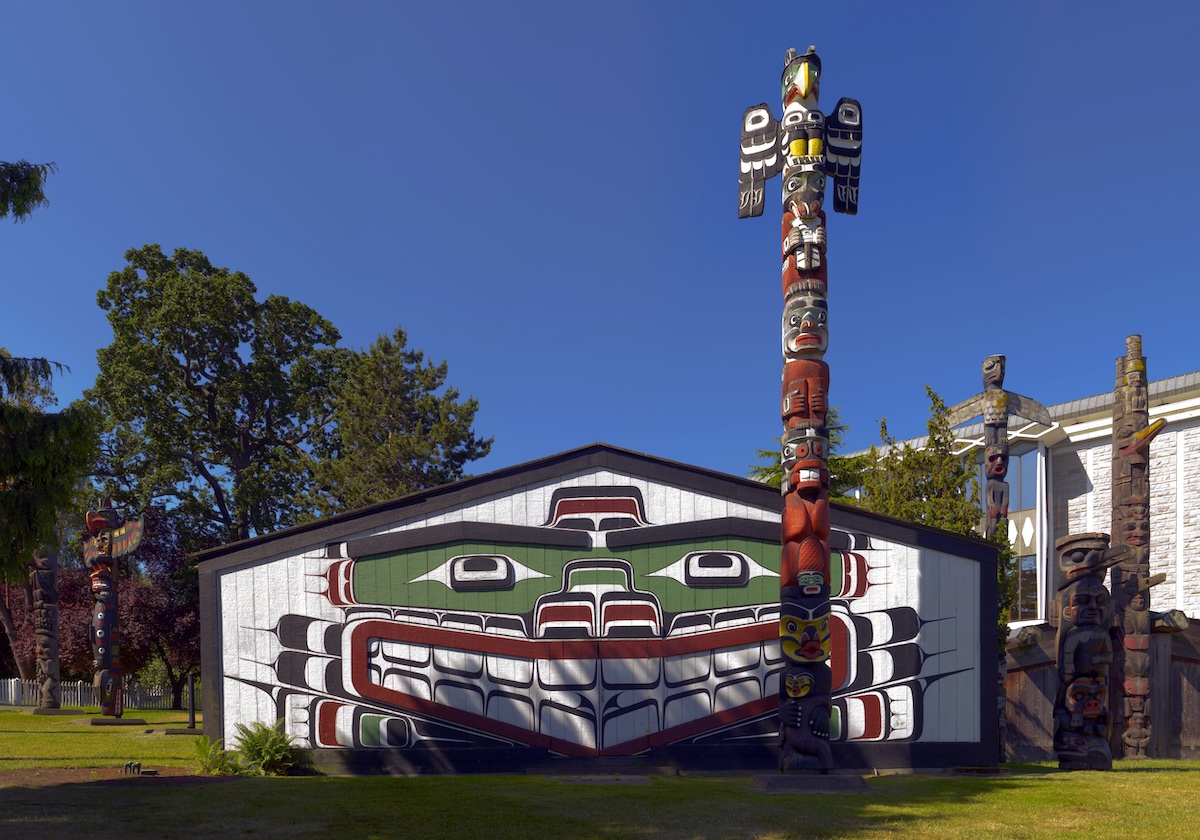
Totem poles are alive and kicking, as can be seen in Thunderbird Park in Victoria, Canada.
In 1953, Martin built the Kwakwaka’wakw house that now stands in Thunderbird Park. For its opening, he and his family created a monumental pole. The ceremony surrounding the opening was remarkable: it was the first legal public potlatch after the ban had been lifted.
The pole was not simply a monument to Martin himself. The figures represented different Kwakwaka’wakw groups and their ancestral stories.
Mungo Martin thus became a crucial link between the older generation of carvers and the artists who followed him.
After his death, his son-in-law Henry Hunt became head carver in the Thunderbird Park programme. Others followed, including Tony Hunt and Richard Hunt. According to the Royal BC Museum, members of the extended Hunt family have continued the tradition from generation to generation.
The history of the modern totem pole is therefore also a history of cultural revival.
From Replica to New Art
In the twentieth century, replicas of historical poles were also made. This happened, among other places, at Thunderbird Park, where Mungo Martin and Henry Hunt reproduced existing poles on the basis of original examples and historical photographs. Some of these were later returned to the communities from which the original poles had come.
But alongside these replicas, there was once again room for original, contemporary designs.
The Carvers Honouring Pole by Johnathan Henderson and Sean Whonnock in Thunderbird Park is an example. The pole was made in 1999 from a cedar trunk that was approximately 533 years old. The two carvers incorporated their own family history into it.
This pole marks a watershed. The makers did not simply look back; they added a new chapter to the development of the totem pole.
And that is exactly what Sanford Williams is doing again in 2026, the year in which I am writing this.
Where Can You See Totem Poles?
Several major museums outside the original cultural region have built up important historical collections of totem poles.
+ The Royal BC Museum in Victoria is the most obvious place to start. On the museum grounds is Thunderbird Park, where monumental poles and the restored Wawadiťła house built by Mungo Martin can be seen.
+ The Museum of Anthropology at the University of British Columbia has an extensive collection of Northwest Coast art. Its online collection includes historical poles and models from, among others, the Haida, Kwakwaka’wakw, Nisga’a, Coast Salish and other communities.
+ The Canadian Museum of History in Gatineau, across the river from Ottawa, also has an important collection of monumental art by First Nations of the Northwest Coast. Its Grand Hall contains large wooden works that make the impressive scale of this art an experience in itself.
+ In New York, the Northwest Coast Hall at the American Museum of Natural History is also worth visiting. Its renewed presentation places strong emphasis on the diversity of Indigenous cultures of the Northwest Coast.
A Dutch Totem Pole
And then, one unusual footnote: new totem poles are also being carved outside Canada, independently of the West Coast tradition.
Members of the Dutch association Guts en Klopper each created their own personal sculpture from a separate section of cedar trunk. Some became schools of fish, some a sculpture incorporating a tree, and some a fox. I myself made a group of revellers marching in a conga line, including a mermaid.
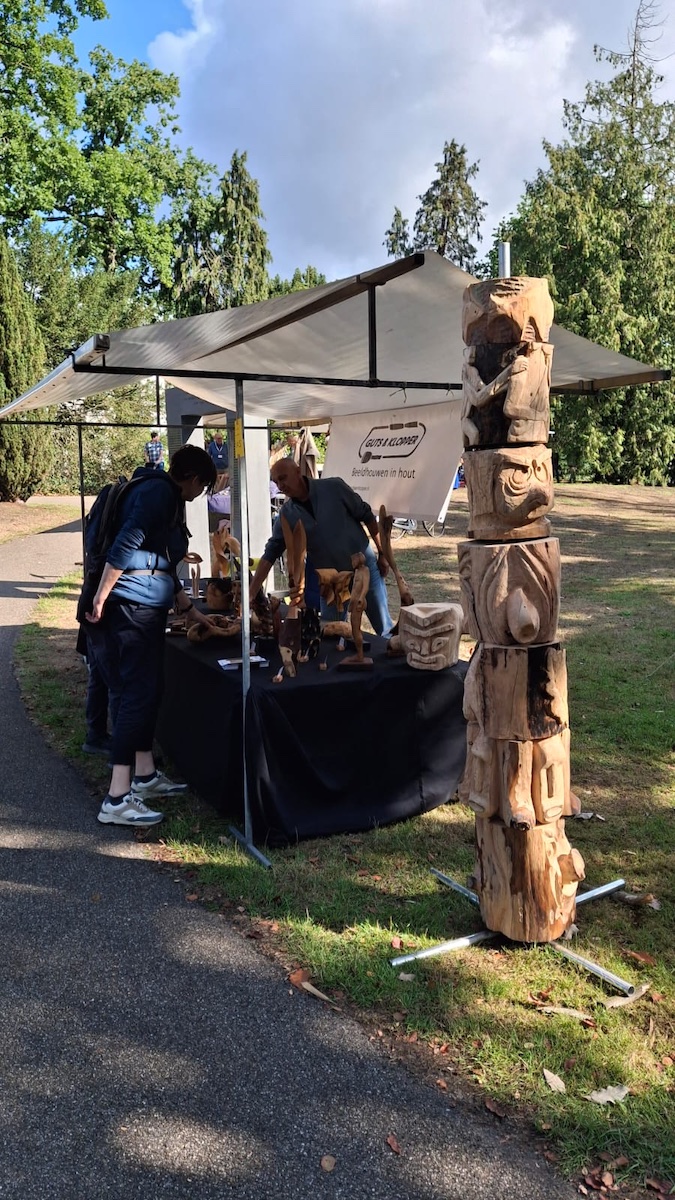
Even in the Netherlands a new totem pole saw the light, made by members of the carving club Guts en Klopper (image Tom Ligthart).
An iron rod running through a hole in the centre of the trunks connects the individual sculptures into a pole about two metres high. This Dutch totem pole was presented for the first time at the Walkart Markt in Zeist on Saturday, August 22, 2026.
Jan Bom, August 30, 2026