When Irena Posner matches wood with marble, something remarkable happens. Wood is warm, organic and relatively light. Stone, by contrast, is cold, hard and heavy. And yet the marriage is a loving one.
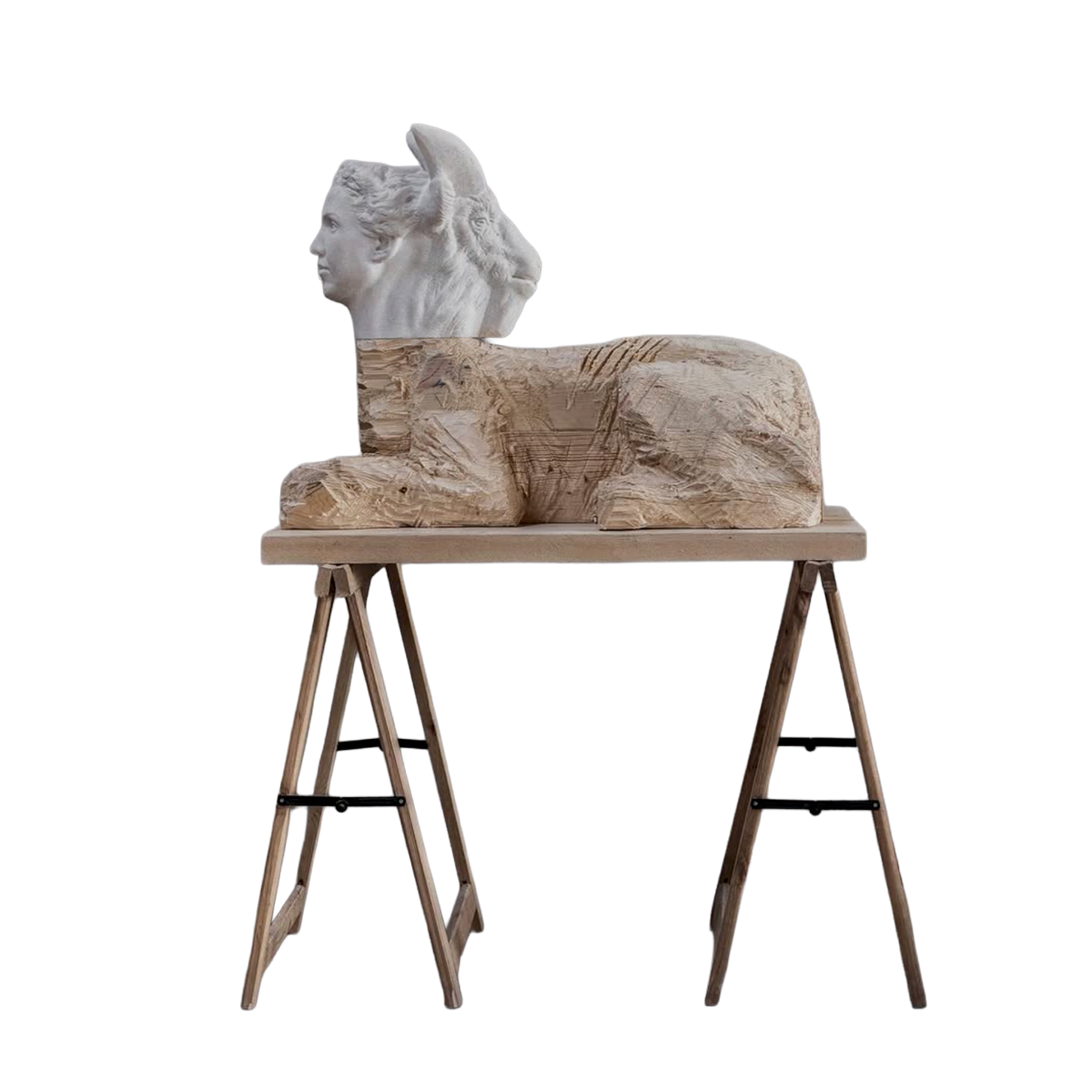
When Irena Posner matches wood with marble, a remarkable tension emerges.
The British artist Irena Posner (1988) demonstrates this beautifully in her 2025 sculpture Common Factor. She combines Portuguese marble with pine wood. The marble is beautiful and smooth. The wood is very rough, with chainsaw marks still visible. Precisely the opposite of what we might expect from these materials. Stone is supposed to be rough. Wood, on the other hand, beautifully smooth and polished.
The sphinx-like plinth is certainly not that, even though Posner says on Instagram that working on it felt like working “in butter”. Quite different from the endless scraping away of layers of marble with a pneumatic hammer.
Provocation and humour
Irena Posner thus presents a provocative combination of materials. And provocation is something this British artist does rather well. She has previously carved two copulating dogs (Dobermanns) in marble. Or an enormous marble leg, under the title Cross Your Toes.
Provocation and humour in one. I have a soft spot for artists like that. Very few dare to use humour. In the Netherlands, there are Wim T. Schippers and Teun Hocks; in Belgium, Kamagurka.
Part self-portrait, part ram’s head
In Posner’s work, body, animal, nature and material constantly merge into one another. In fact, Common Factor is partly a self-portrait and partly the head of a ram. A Janus head, with Posner sometimes placing her own likeness on the plinth looking backwards. Her animal half then looks towards the future. In other arrangements of the sculpture, however, her likeness looks forwards again.
Philosopher and artist
This profound thinking about her sculptures has a background. Posner first studied philosophy at University College London. Only afterwards did she earn a master’s degree in sculpture at the Royal College of Art in London.
She now divides her time between London and Carrara, the Italian city that has been a home to artists working in marble for centuries. Michelangelo obtained the enormous block of marble for his David there, a piece that nobody else wanted.
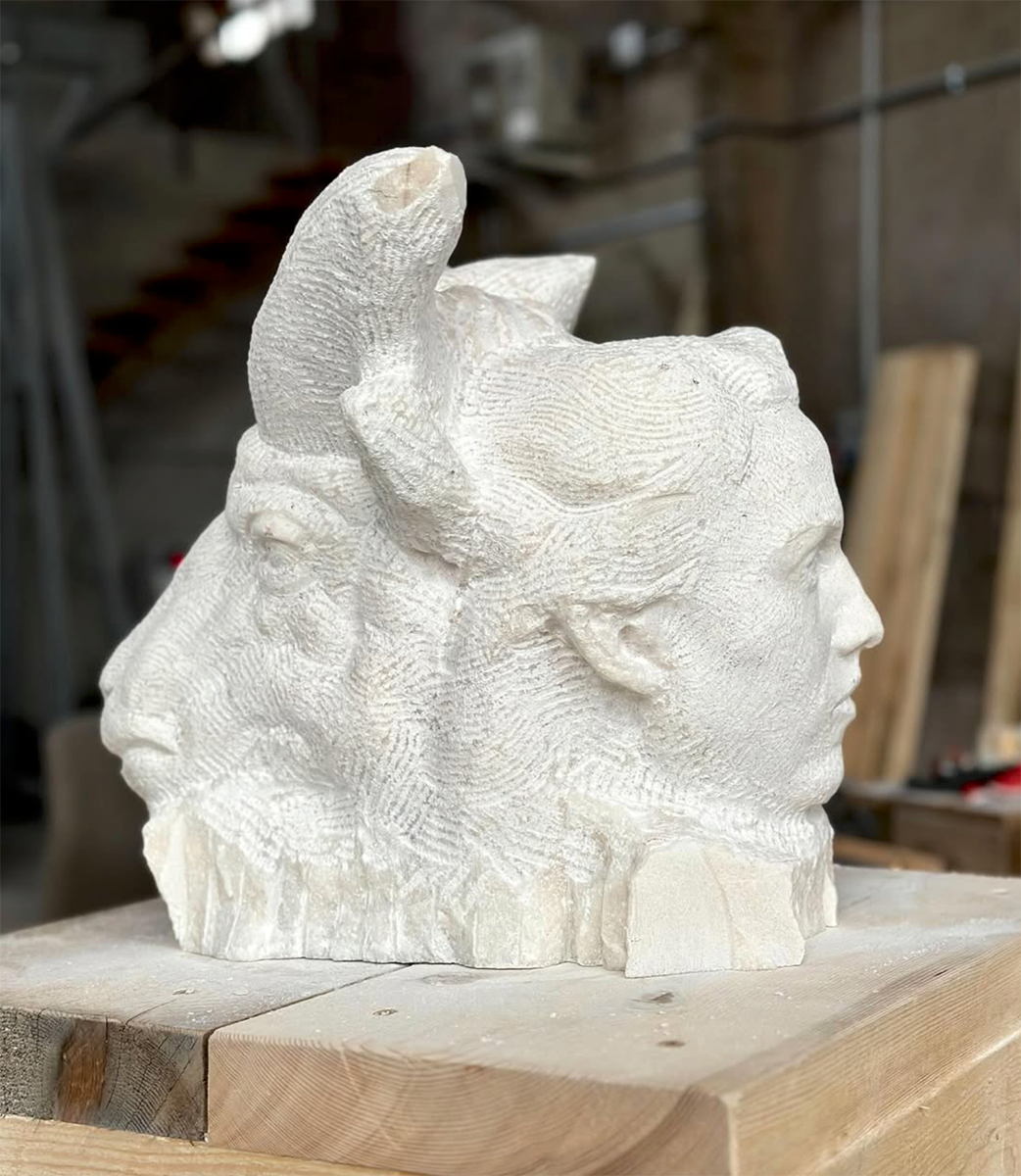
Posner on the Janus head: “For me, animals represent the dysfunctional nature of ourselves.”
Posner began as a painter, but eventually found her form in sculpture. She is particularly drawn to the directness of working in stone. She regularly uses pieces of stone that have been rejected by quarries because of cracks or discolouration.
With Common Factor, Posner chooses not to combine marble with the more obvious material of bronze. Instead, she places an age-old material associated with classical sculpture opposite wood: an encounter between two worlds. But Posner is not the only artist to see something remarkable in this combination.
César Orrico
Spanish sculptor César Orrico takes the idea a step further. In 2025, he created Giro I and Giro II, two sculptures with the same form, but in which wood and marble seem to have exchanged places.
The works are made of cherry wood and marble. In one sculpture, a particular section is made of stone; in the other, precisely that same section is made of wood.
This is more than a clever formal experiment. It makes clear how much influence material has on the way we look.
A body made of marble appears heavy and immutable. The same body made of wood seems warmer and more dynamic. The form remains almost identical, but the experience changes.
Orrico is deeply interested in the human body as an artist. His figurative sculptures are based on a thorough knowledge of anatomy, but are increasingly simplified. He combines a classical approach to modelling with a contemporary understanding of form and material.
Jessica Ielpo
For Italian sculptor Jessica Ielpo, the relationship between wood and marble is an even more direct part of her artistic practice.
Ielpo was born in 1990 in Trecchina, in Basilicata. She studied sculpture at the Accademia di Belle Arti in Florence. During a period in Istanbul, she worked with marble and also became more deeply involved in woodworking. This was followed by internships and further training in Pietrasanta near Carrara, where she now lives and works.
In Ielpo’s work, wood can leave an imprint in the stone. Elsewhere, she works the marble so that it resembles burned wood. Wood and marble as mirror images of each other.
A good example is Burned from 2013. A form in white marble resembles a charred tree trunk and rests on two pieces of natural wood. The cracks and rough areas of the marble recall wood damaged by fire.
Ielpo uses this confusion deliberately. For her, the transformation of material is also about the human body: damage, decay and transformation. The fire that damages wood becomes a metaphor for the changes a body can undergo.
Two materials, two timescales
Three artists, each in their own way, exploring why wood and stone make such an interesting combination.
Wood comes from something that once lived. You can still read the growth of a tree in its annual rings, knots and grain. Even after a tree has been felled, its history remains visible. I made a small art book in which I describe how an increasing number of artists make such stories in wood part of their work: Dendroism.
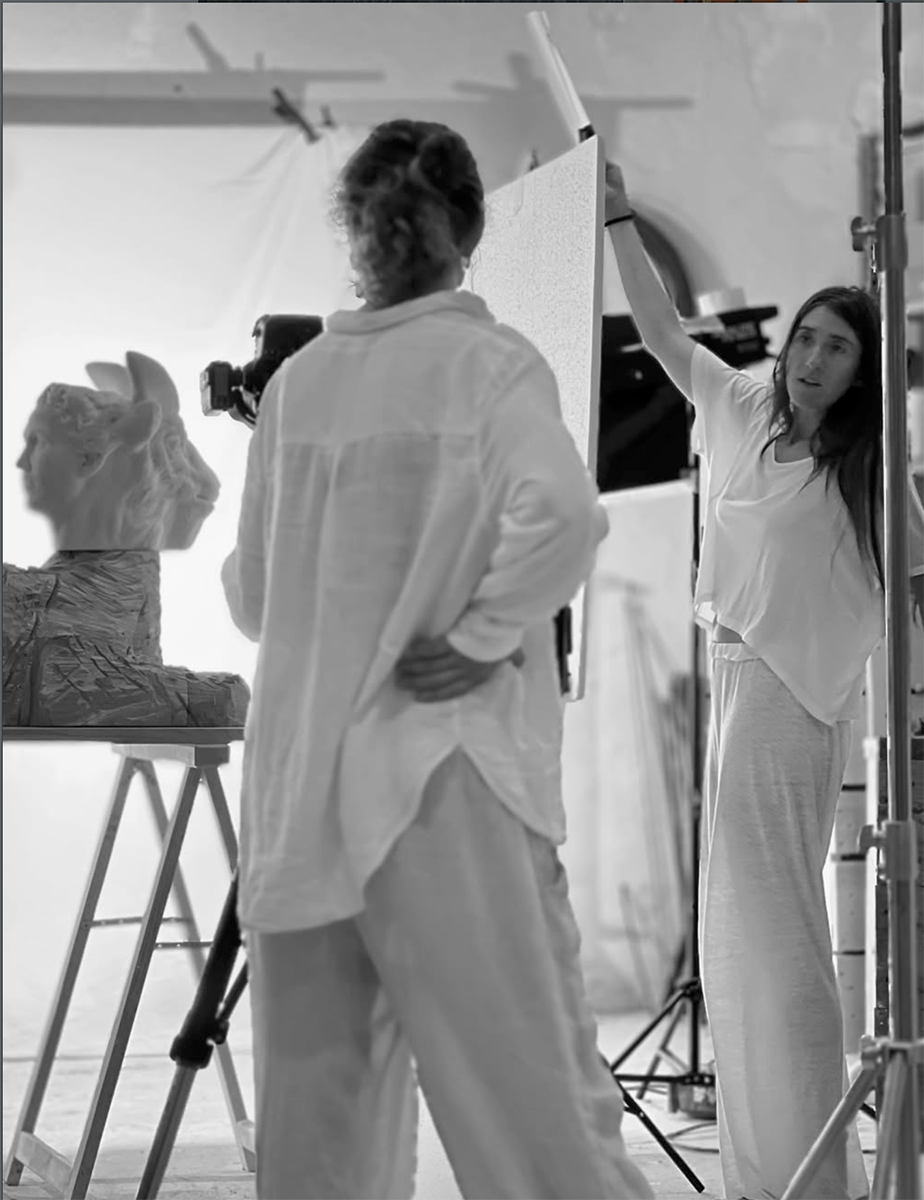
Irena Posner in her studio, this time with the ram’s head looking forwards rather than backwards.
Stone has a very different history. Marble can be millions of years old. The material was formed deep within the earth under enormous pressure and heat. When a sculptor works a piece of marble, they are carving into a history that is vastly older than humanity. Or than trees, which, as organic material, have a much harder time surviving through the ages.
When wood and stone meet in a single sculpture, there is no compromise. Instead, there is tension. And that is precisely where the beauty lies.
Jan Bom, 5 September 2026