Marisol carved presidents in wood. Her portraits of Lyndon B. Johnson and John F. Kennedy attracted thousands of visitors to exhibitions in the 1960s. Her woodcarving earned her the title of the ‘Queen of Pop Art’. But when Marisol became interested in ecology, the art world dropped her from the list of names that included Andy Warhol, Roy Lichtenstein, Claes Oldenburg and Robert Rauschenberg. All men. What a mistake.
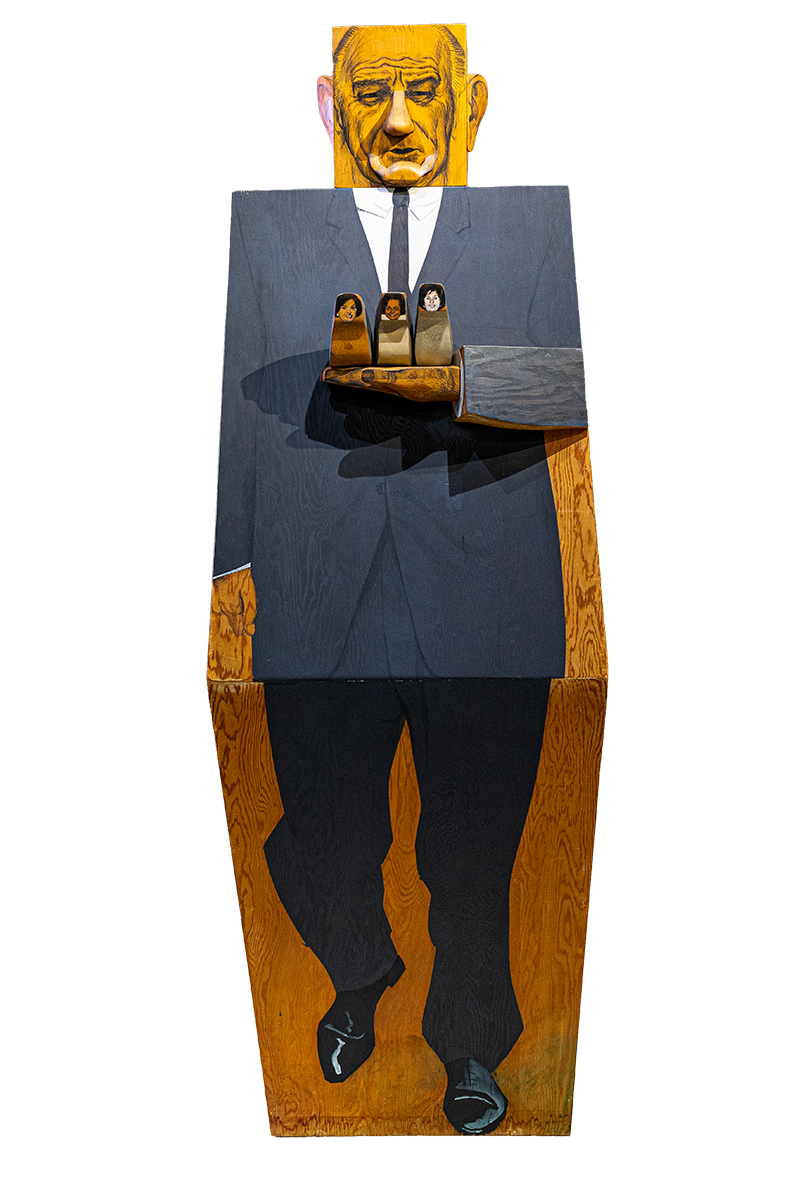
Marisol carved presidents in wood, including Lyndon B. Johnson.
Artists today are producing one sculpture after another of President Donald Trump, portraying him in the most ridiculous poses imaginable. Floating like a giant balloon. Dancing with convicted paedophile Jeffrey Epstein.
Some of these sculptures are anonymous, while others are made by established artists, such as Danish sculptor Jens Galschiøt. He created a satirical, gilded statue of a naked Trump, entitled The Orange Plague. In October 2026, it stood outside the European Parliament in Strasbourg for three days.
The Venezuelan-American artist Marisol Escobar (1930–2016) had preceded them all. In 1967, she created LBJ, a cynical portrait of US President Lyndon B. Johnson. The president is depicted as a large, almost coffin-shaped wooden figure. His face wears a grimace, and Marisol added a pair of conspicuously protruding ears to his head.
In his hand, the president holds small drawn portraits of his wife and their two daughters. Marisol attached the women’s faces to bird-like shapes representing wrens. This presumably refers to the First Lady’s nickname, ‘Lady Bird’.
Killed in Vietnam
The contrast between the faces is striking. The women are smiling broadly. President Johnson has a sulky expression. His immaculate, gleaming patent leather shoes are downright ridiculous. His expression clearly reflects his controversial role in the Vietnam War, in which more than 50,000 American soldiers lost their lives.
Creating this sculpture was a remarkably courageous act on Marisol’s part. At the time, protesters in the Netherlands were not even allowed to shout ‘Johnson murderer’ in the street. To avoid prosecution for insulting a friendly head of state, they therefore shouted ‘Johnson Molenaar’ instead. (‘Molenaar’ means miller in Dutch.)
Marisol’s sculpture is therefore more than a portrait: it is also a political comment. She used wood to give power a literal shape: a president as an enormous, unyielding block. A massive tree that you would rather not drive your car into.
Wooden celebrities
Marisol Escobar (1930–2016) was a remarkable presence in the New York art world of the 1960s. With her dark hair, striking looks and mysterious personality, she attracted at least as much attention as her artworks.
She was photographed by famous photographers, appeared in international magazines and became friends with Andy Warhol. He even called her ‘the first girl artist with glamour’. He filmed her kissing an actor on the lips for several minutes in a film entitled The Kiss.
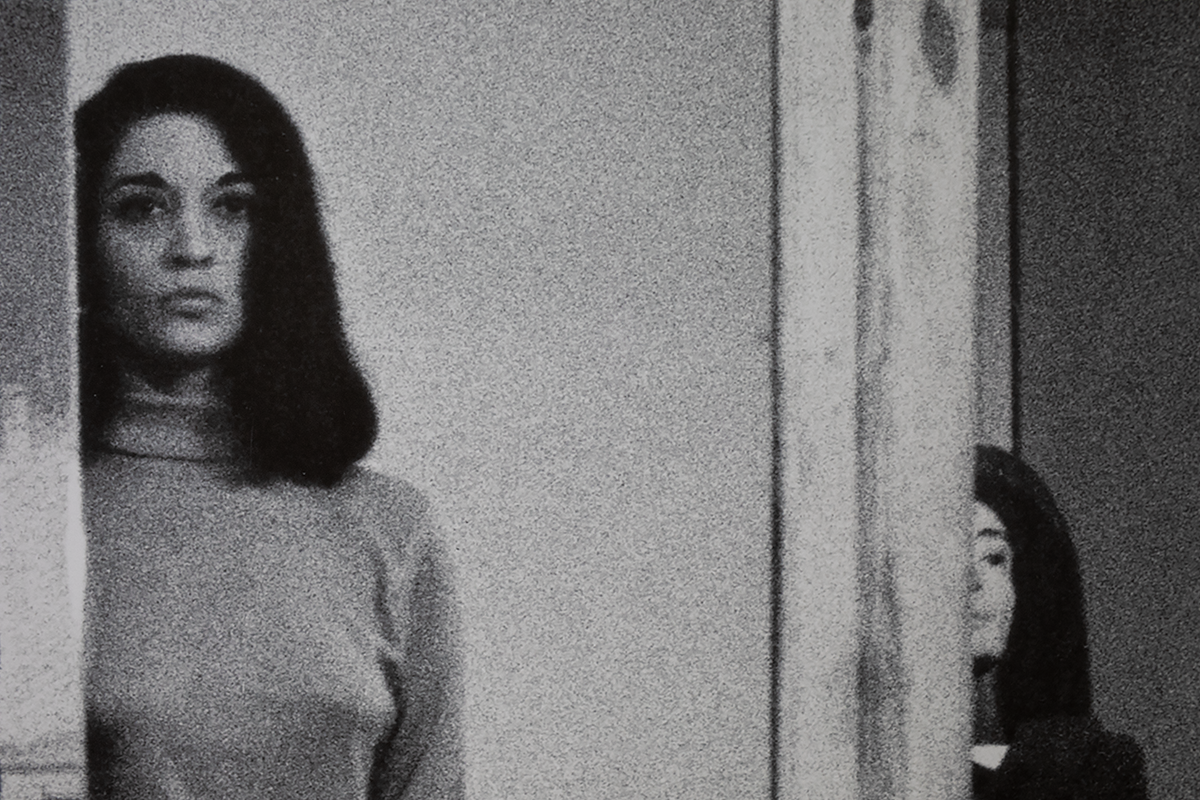
Marisol, silent, beautiful and mysterious: detail from a photograph taken in her studio.
Marisol and Warhol were sometimes referred to as the ‘king and queen of Pop Art’, the movement whose artists made consumer products and consumer society their central themes. Pop artists drew inspiration from advertising, mass media, film stars and comic books. In doing so, they captured the rise of popular culture.
But Marisol was much more than that. She was an unconventional sculptor who developed an entirely new visual language using wood, paint, plaster and found objects. Her wooden figures were often life-sized and colourful. They were funny, too. They resembled enormous toy dolls or primitive shop-window mannequins. Yet behind their sometimes endearing faces lay the sharp eye of an outsider observing American society.
She stopped speaking
María Sol Escobar was born in Paris on 22 May 1930, the daughter of wealthy Venezuelan parents who had made their fortune in oil. She grew up between Caracas, Europe and the United States. After studying in Paris and Los Angeles, she settled in New York in 1951, where she attended classes at the Art Students League.
A dramatic event in her childhood would leave a lasting mark on her character. When Marisol was eleven, her mother, who had given her the affectionate nickname ‘Marisol’, took her own life. After that, Marisol decided not to speak for an entire year. Her silence remained part of her mysterious public persona. At openings of her own exhibitions, she sometimes did not utter a single word. She preferred to let her art tell the story. No self-promotion, no explanations. When a journalist asked her a question, she sometimes gave a rather meaningless answer. Perhaps she also disliked the sound of her own voice, which had a somewhat childish quality.
The Kennedys in wood
One of her remarkable early works (1960–1961) is a portrait of John F. Kennedy and his family. This, too, is an assemblage of rectangular wooden volumes, with the heads mounted as separate elements. For many Americans, this young family embodied a new generation. They radiated optimism and high hopes for the future.
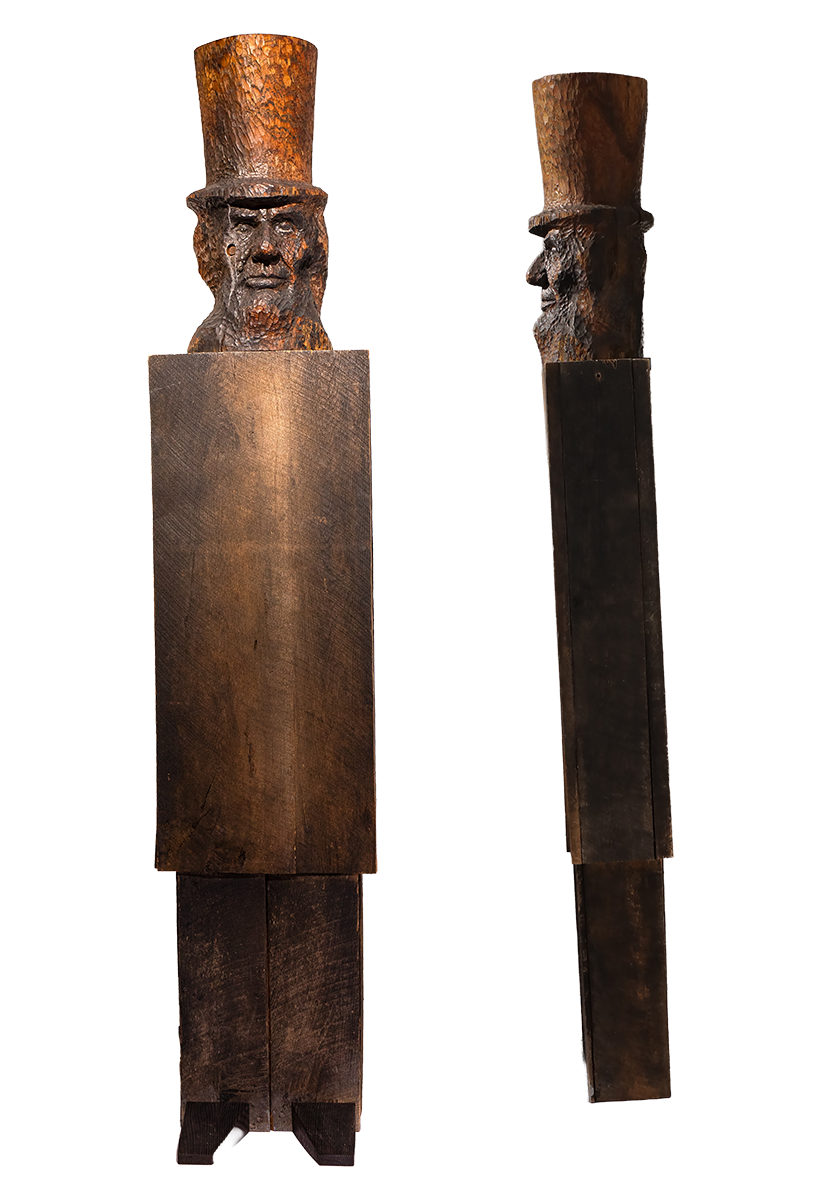
President Lincoln, rigid and upright, an icon in wood dating from 1984, presented at the Depot of Museum Boijmans Van Beuningen.
But more than this sense of hope, Marisol was interested in the way Americans idolised their celebrities and political leaders. The boundary between public persona and private life was what fascinated her. Her wooden figures reveal how people present themselves, but also how they are viewed by others. One example is the early president Abraham Lincoln, with his characteristic top hat.
A tragic sequel to her portrait of the Kennedy family is her sculpture of their young son, John Jr. He salutes as a funeral procession of toy cars carries his murdered father to his final resting place.
From Warhol to Tutu
Even her own friends in the art world were not spared her carving tools. In 1962–1963, Marisol created a sculptural portrait of her early artistic companion Andy Warhol, entitled Andy. It is a four-sided portrait, with every side of the head fully worked out. Viewers can walk around the sculpture and complete the missing information for themselves. And perhaps smile at the pair of battered shoes beneath the figure, which had actually belonged to Warhol.
Marisol wanted to capture a personality, including all its contradictions. I think she was too complex for Pop Art, which often produced rather flat images: a can of soup, an enormous shovel, an enlarged image of a fighter jet from a comic book, the American flag.
She preferred to create sculptures of artists she admired, including Pablo Picasso with his piercing eyes, Magritte wearing his bowler hat, and the Dutch-American artist Willem de Kooning. I spent a long time looking at her sculpture of the American painter Georgia O’Keeffe, accompanied by two dogs standing in front of her like palace guards. Marisol visited O’Keeffe when she was already elderly, and this is clearly reflected in the impressive sculpture she carved. The face is no longer drawn or painted, but carved in wood. And remarkably lifelike. Distinctive and full of character. A remarkable achievement.
The South African bishop Desmond Tutu also became the subject of her sculptural portraits, with an enormous purple body.
Vanished and forgotten
After the turbulent 1960s, Marisol withdrew from the United States for a while. She was horrified by the political assassinations of the Kennedys and Martin Luther King, as well as the attack on Warhol in 1968. She travelled, including to Asia and Tahiti, where she learned to scuba dive.
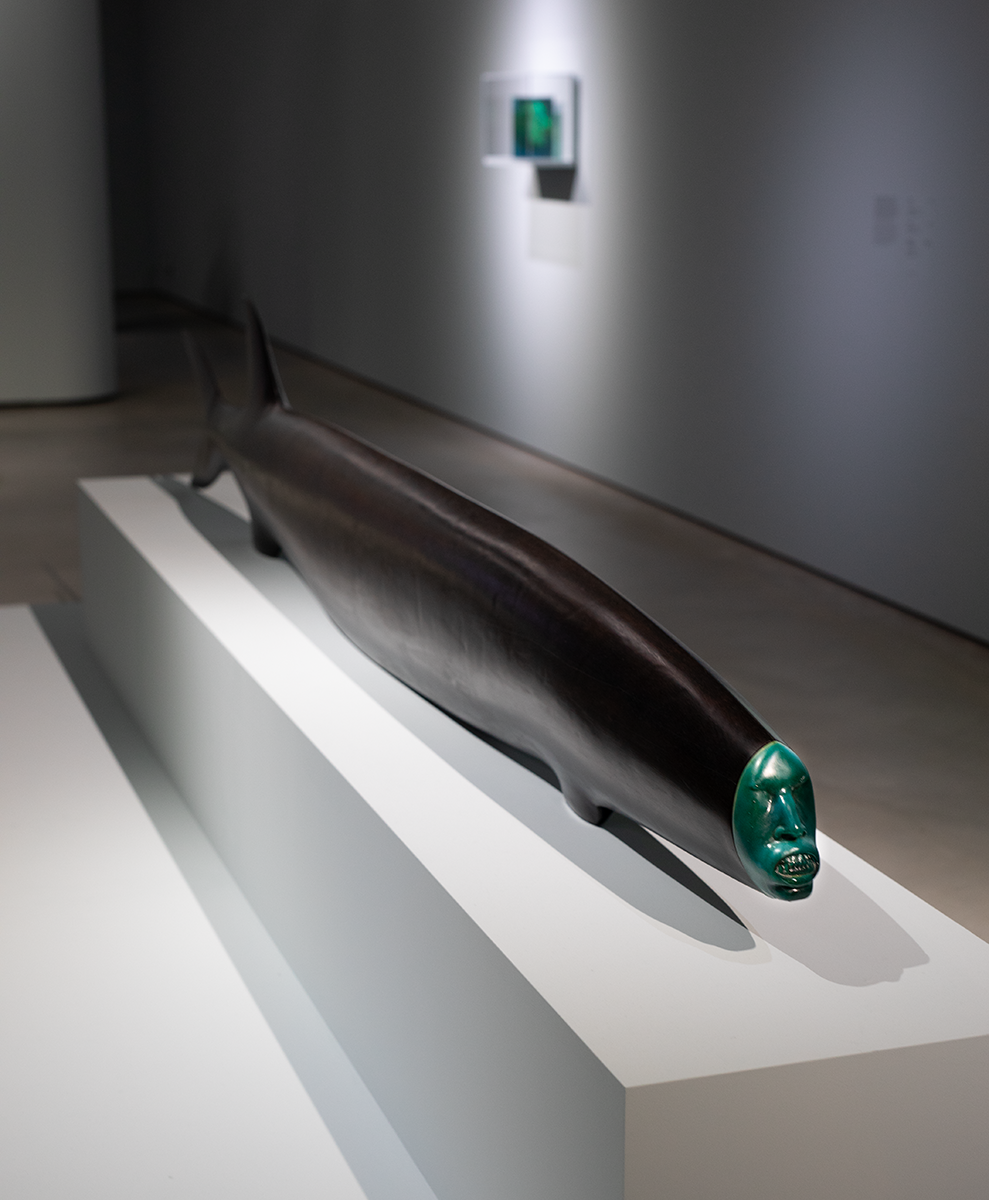
Marisol’s Barracuda (1971), a beautifully finished sculpture measuring 3.5 metres, featuring a cast of her own head as the fish’s head.
This led to a series of enormous wooden sculptures of sharks, barracudas and other fish. She attached casts of her own head to the bodies of the fish. Though the heads were modified, of course. Their expressions were often morbid, threatening or warning. Beautifully smooth, sanded tropical hardwood, but work that American art critics failed to understand.
The lack of attention given to these unsettling sculptures had to do with the male dominance of the art world. Men wrote the history of Pop Art and preferred to keep the story simple, I think. Moreover, her later work no longer fitted within the boundaries of Pop Art. Its connection with consumerism gave way to an interest in ecology. In this respect, Marisol was far ahead of her contemporaries.
Back in Rotterdam
Now, half a century later, the artist is finally receiving the attention she deserves. A magnificent retrospective opened at the Depot of Museum Boijmans Van Beuningen in Rotterdam on 9 October 2026, featuring more than eighty works on loan from international collections. LBJ has also travelled to the Netherlands, as have her sculptures of President Lincoln and the Kennedy funeral, featuring John Jr.
The exhibition runs until 29 March 2027. For me, it is the finest exhibition in the Netherlands in 2026, more surprising even than the Matisse exhibition at the H’ART Museum in Amsterdam, where his magnificent paper cut-outs were missing. How is it possible that I had never heard of Marisol before?
An important contribution to the exhibition comes from the Buffalo AKG Art Museum in the American city of Buffalo. Following Marisol’s death in 2016, the museum received a substantial bequest of artworks from her personal collection.
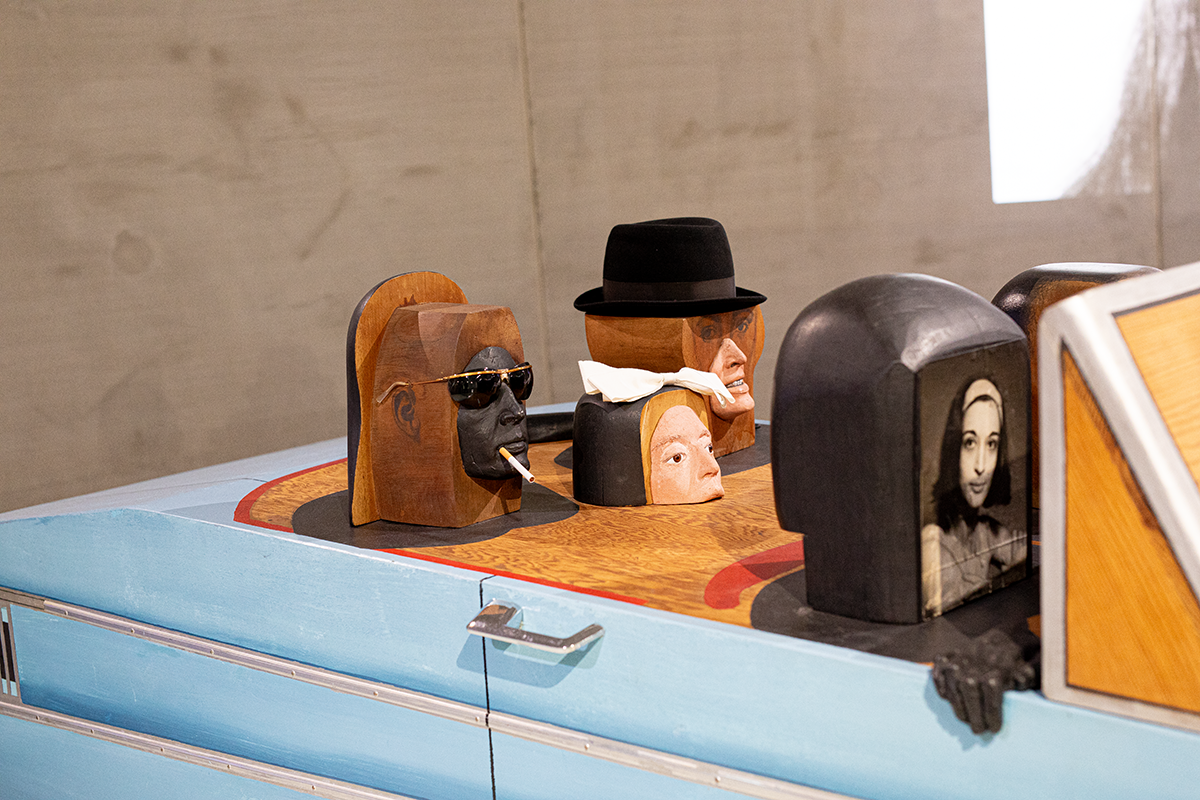
Detail from her early work, The Car, acquired by Museum Boijmans Van Beuningen in Rotterdam.
Rotterdam is also a return to a place that played an important role in her career. In 1968, Boijmans Van Beuningen presented her first solo museum exhibition. Four years later, the museum acquired her sculpture The Car (1964), a half-scale blue Ford Falcon convertible, partly made of wood, with room for five passengers. One of them is Marisol herself. The work is one of her best-known sculptures. And, of course, it is also included in this exhibition, which occupies no fewer than three floors of the Depot.
Marisol was an artist who did not simply use wood as a material, but built an entire world with it, as a comment on the world around her. Groundbreaking and innovative work. Her wooden portraits are funny, moving and critical all at once. They show that a few wooden blocks, a painted face and some found objects can be enough to bring an entire world of ideas to life.
Jan Bom, 24 November 2026