Ai Weiwei built a tree, assembled from trunks, roots and branches from his native China. He deliberately shows how pieces of camphor, cedar and ginkgo wood have been roughly joined together. Art critics each interpret the artwork in their own way. I see it as a remarkable form of Dendroism, because the found and collected pieces of dead wood form the starting point for the story Ai Weiwei wants to tell.
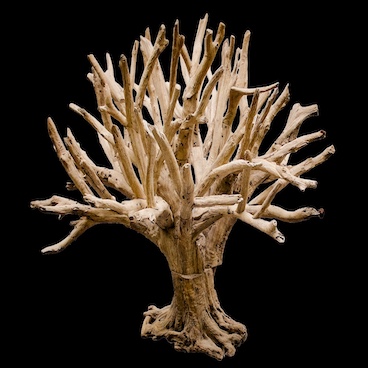
Ai Weiwei built a tree, now part of the collection at Tate Modern in London.
Tree (2010) is a monumental sculpture by Chinese artist Ai Weiwei (1957), measuring 7 metres high and 6.5 metres wide and deep. The work is part of the permanent collection of Tate Modern in London.
The sculpture clearly represents a real tree. Visible saw cuts and joints between the various components reveal that the whole structure has been assembled from separate pieces of wood. This not only exposes the construction, but also highlights the variety of bark textures and wood species.
China’s Lost Nature
But what is the artist trying to communicate through this sculpture? Ai Weiwei’s work often explores complex social and political issues in China. The use of wood in Tree can be interpreted as a reference to the country’s rapid urbanisation and economic expansion, which have contributed to widespread environmental destruction. In this sense, the tree could be seen as a memorial to the natural world China has lost through its rapid economic growth.
Yet there are other possible interpretations. The visible joints between the separate sections of trunk have prompted different readings among art critics. These connections, including the clearly visible traditional Chinese woodworking joints, are not technical imperfections. They are an essential part of the artwork. The joints conspicuously bring together elements that were never originally one.
Art historian Lotte Philipsen wrote an insightful analysis of Tree in the catalogue accompanying Ai Weiwei’s exhibition at De Pont Museum in Tilburg.
She approaches the sculpture through the philosophical distinction between matter and form, a concept that goes back to Aristotle. The original trees have died. What remains is wood: matter without its original form and function. Ai Weiwei then brings this material together again to create the shape of a tree. But that does not make it a living tree. The visible seams and joints prevent us from seeing the sculpture as a naturally grown organism.
Philipsen describes an interesting paradox: what appears to be a meaningful, living form is in fact a construction made from dead material. The traditional Chinese woodworking joints add another layer of cultural meaning.
China’s Many Cultures
The Fondation Louis Vuitton offers a different interpretation. According to the museum, the assembled tree refers to China, where cultural diversity and individual identities are under pressure from the growing uniformity of modern urban society.
In this interpretation, the different pieces of wood represent separate identities. When brought together, they form a larger whole, yet the visible joints continue to remind us of the individual origins of each component.
This interpretation connects with a recurring theme in Ai Weiwei’s work: the tension between the individual and the collective, between tradition and modernisation.
The Iron Version
A positive review appeared in the British newspaper The Guardian in 2014. Art critic Laura Cumming wrote about the iron version of the tree, which was exhibited at Yorkshire Sculpture Park.
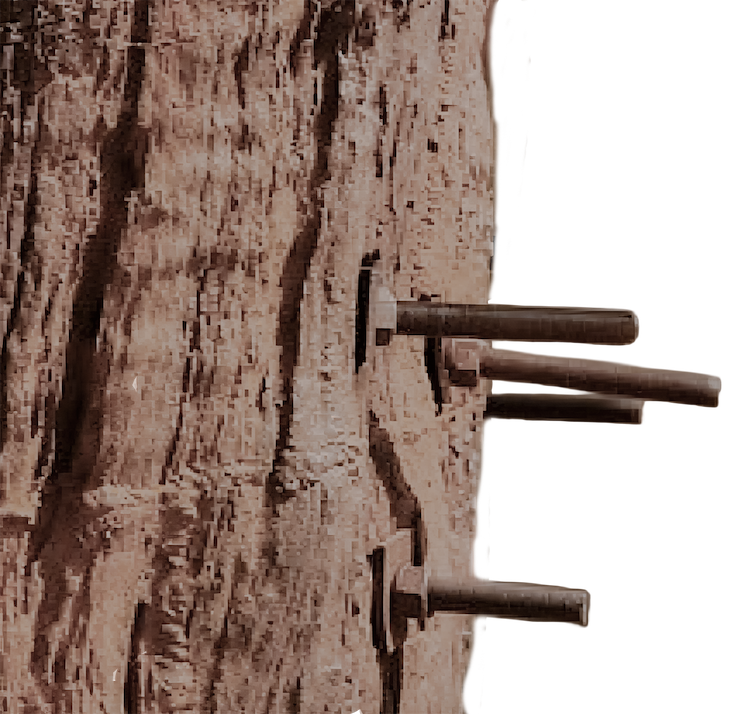
The rust-brown iron version of Tree, with its prominently protruding bolts.
She described how 99 individually cast components come together to form a tree that looks surprisingly alive despite being made of heavy metal. Her interpretation is optimistic: the tree represents the hope for a society in which separate individuals can come together to form a whole.
Cumming describes the sculpture as majestic and exceptionally beautiful. She sees the tree as a symbol that does not conceal its many individual components, but allows them to speak for themselves.
Strangers in a Family Album
Personally, I find Ai Weiwei’s rust-brown iron tree less successful. Made from the same material throughout, it loses the subtle differences in bark texture that make the wooden version so interesting. The enormous protruding bolts and screws do little to compensate for that loss.
What else can I add from the perspective of Dendroism? I see how Ai Weiwei takes the stories told by the individual pieces of trunk and combines them into a single narrative. But it is deliberately an unsettling one. The closer you get to the tree, the clearer it becomes that its unity has been imposed, consciously constructed. That unity has become an artificial memory. Weiwei’s tree is like a collection of photographs of very different people who have never met, yet have somehow been pasted together in a single family album.
An artwork, then, that makes you think. That is what great art does.
Jan Bom, 5 November 2026