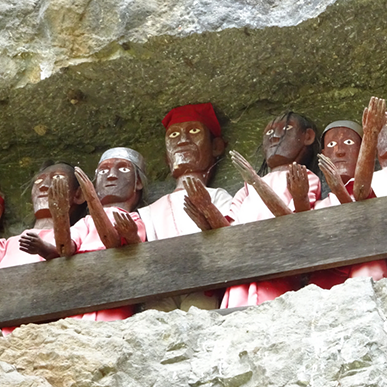
Adriaen van Wesel worked under his own name. Because of this he remained known, while virtually all his colleagues from the late Middle Ages have remained anonymous. They worked as ‘nameless’ sculptors in the workshops of ‘masters’.
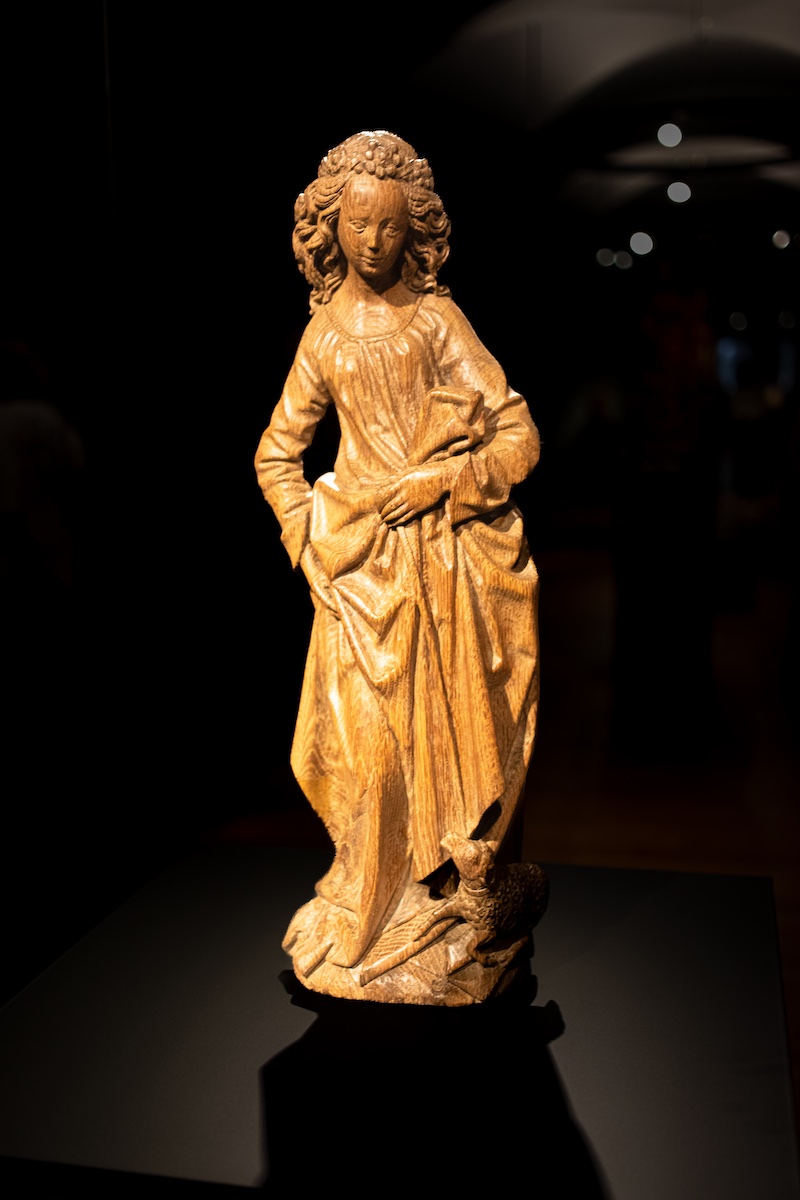
Adriaen van Wesel worked under his own name. Because of this there can be no misunderstanding about the maker of this sculpture of Saint Agnes.
That Adriaen van Wesel has remained known by name, while most of his contemporaries are anonymous, has to do with a number of exceptional circumstances. He was not just a wood carver, but a socially influential citizen in his hometown of Utrecht. He was born there around 1417 and would have died there again shortly after 1490.
Van Wesel was elected chairman of the saddlers’ guild of Utrecht up to nine times, which also included painters and sculptors. He was also on the city council, which is exceptional for an artist of that time. So he not only worked as a craftsman, but was also active in the city administration. Because of this his name regularly appears in official documents, guild books and city archives.
His style was recognizable and influential
Adriaen van Wesel sold his sculptures under his own name, moreover. He received important commissions from prestigious institutions of that time, such as from the Illustrious Brotherhood of Our Blessed Lady in ‘s-Hertogenbosch and churches in Delft, Utrecht, and Zwolle. Those contracts were put in someone’s name, certainly when it came to large commissions. This has contributed to the preservation of his name in the sources.
The fact that several signed or documented sculptures by him have been handed down (such as fragments of the Mary retable in the Rijksmuseum), also helped to keep his name alive. Often it is only the medieval artists of whom both work and archive mentions have been preserved, that we still know by name today.
Finally, Van Wesel had a pronounced, recognizable style. He gave his sculptures wig-like hairstyles and drooping eyelids. Because of this, art historians can distinguish his work from that of others.
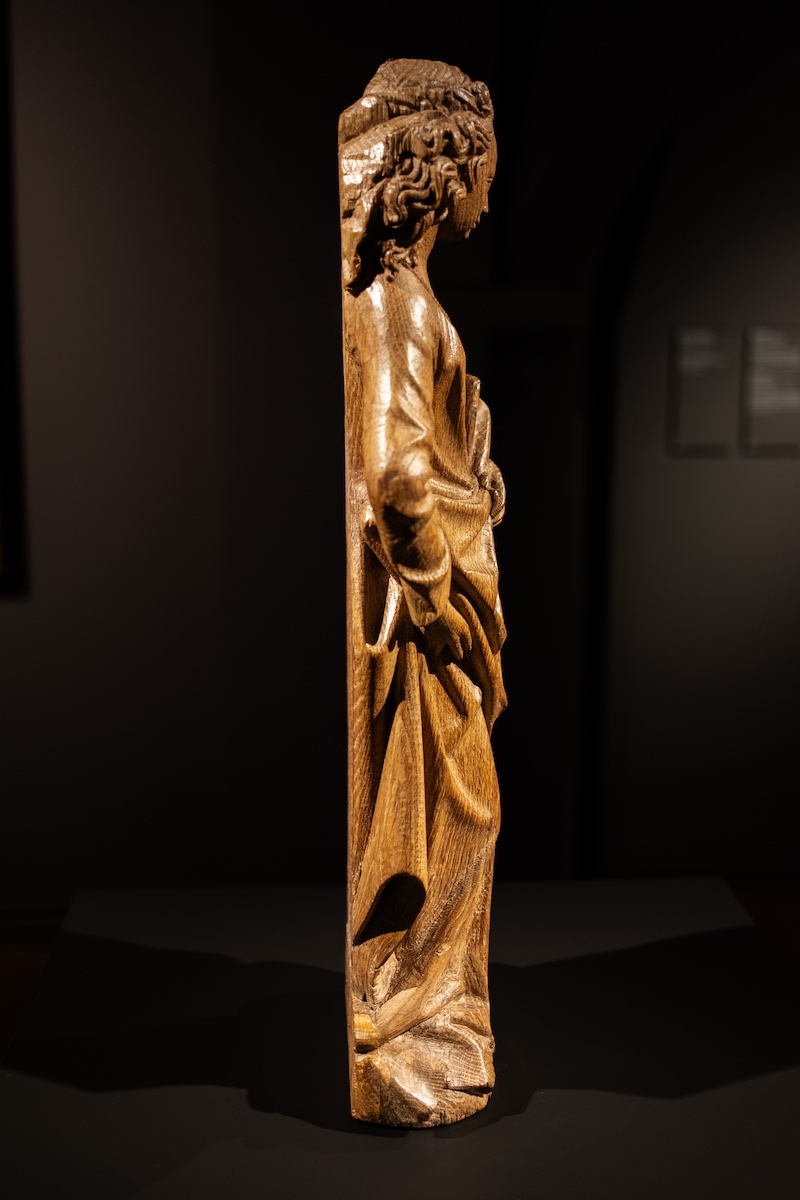
Adriaen van Wesel gave ‘his’ women a hairstyle with beautifully falling hair. Here seen from the side of the sculpture, which is flat at the back.
A good example of this is his oak wood sculpture of Saint Agnes, which stands in room 0.1 of the Rijksmuseum. The saint stands here with bent right leg forward, causing the upper body to subtly lean to the left. With her right hand she holds up a beautifully carved robe at the hip. With her left hand she holds this robe against her. She has a slightly pensive expression. But it is especially the lush hair that stands out, with a band of pearls and rosettes.
Altarpieces about the life of Mary
Van Wesel acquired great fame with his altarpieces, such as that for the Saint John’s Cathedral in ‘s-Hertogenbosch. This altarpiece, consisting of multiple scenes from the life of Mary, was praised for its lively and innovative depiction of figures and events.
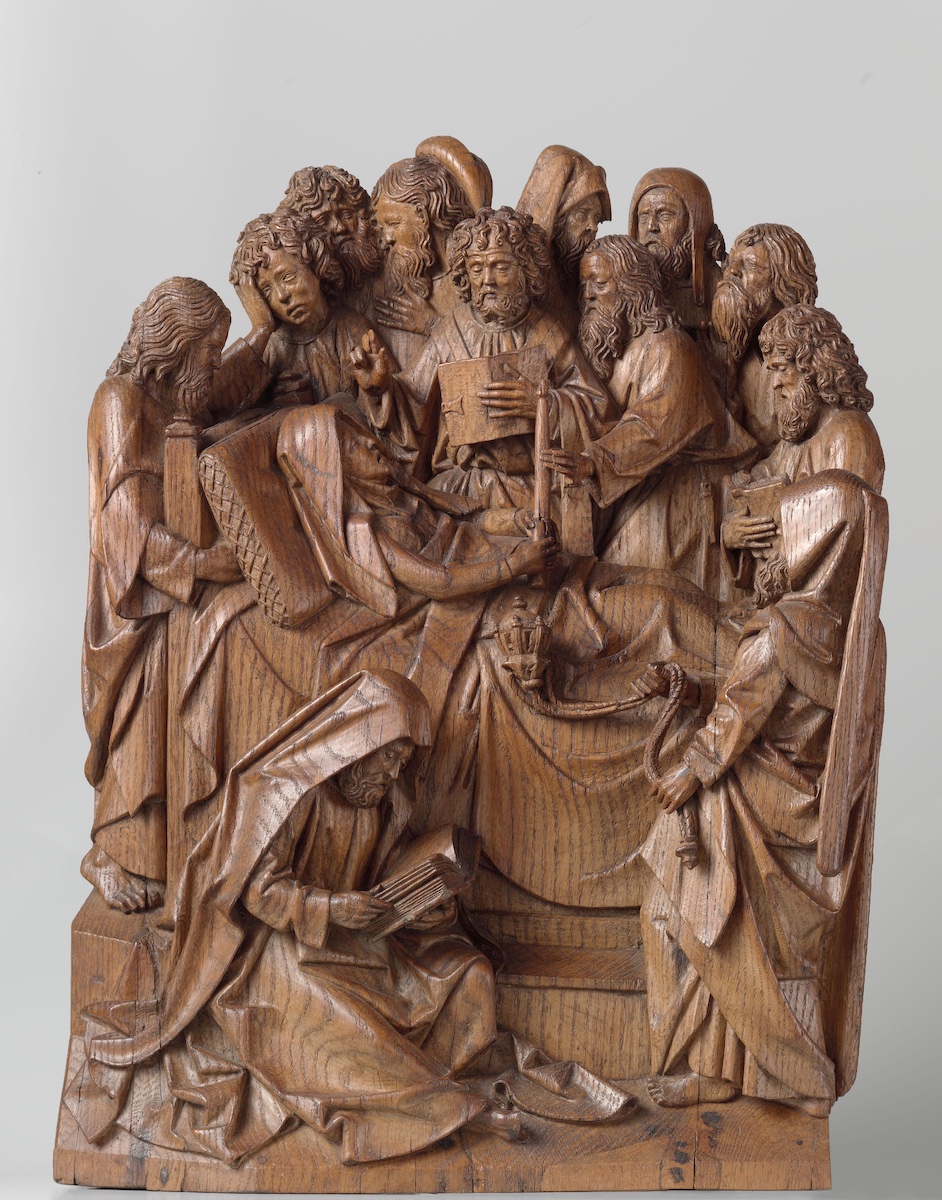
The deathbed of Mary, a substantial fragment from a much larger altarpiece originally from the Saint John’s Cathedral in ‘s-Hertogenbosch. Now on display in the Rijksmuseum.
Although the retable was dismantled over time, various fragments have been preserved. Five of these groups are now in the Rijksmuseum in Amsterdam, including “Mary with the Christ Child”, “The Visitation” and “Mary, Joseph and three angels”. And also “The deathbed of Mary“, where she is surrounded by the twelve apostles.
Two other fragments can be seen in the Museum Het Zwanenbroedershuis in ‘s-Hertogenbosch.
In addition to the Mary retable Van Wesel also made other altarpieces, such as for the Mariakerk in Utrecht (1470), the Nieuwe Kerk in Delft and the Sint-Agnietenberg monastery in Zwolle. Although these works have been lost, some sculptures, such as a “Descent from the Cross” in Berlin and a “Holy Family” in Utrecht, are possibly fragments of these altars.
On the website of Wowwood there are numerous beautiful sculptures by contemporaries who have remained anonymous, because they worked in the workshops of ‘masters’. Examples of this are the ‘Master of Elsloo‘, the ‘Master of Joachim and Anna‘, the ‘Master of Hakendover‘ and the workshop of the maker of the wonders of prayer nuts, Adam Dirksz.
Jan Bom, June 4, 2025