
After first being banished to the waste container, wood is completely back in interior design. This is noticed by artist Christine Langerhorst (1937), who already ran galleries with wooden art objects in Utrecht in the 1960s. Langerhorst makes magnificent books of wood.
She was born in 1937, so 85 years old. But she still uses the band saw, which can be a risky machine. In the hands of Christine Langerhorst, unique pieces of wood become books with deeply cut pages. The pages are so thin that you wonder: how can anyone make this?
No, she doesn’t tremble. She is even somewhat surprised by this question and looks at her hands. They are a bit wrinkled. What do you expect, at that age? But she still goes to the wood workshop in her hometown Utrecht. She works there as if she had just turned 40. “I once spontaneously said that I would live to be 97.”
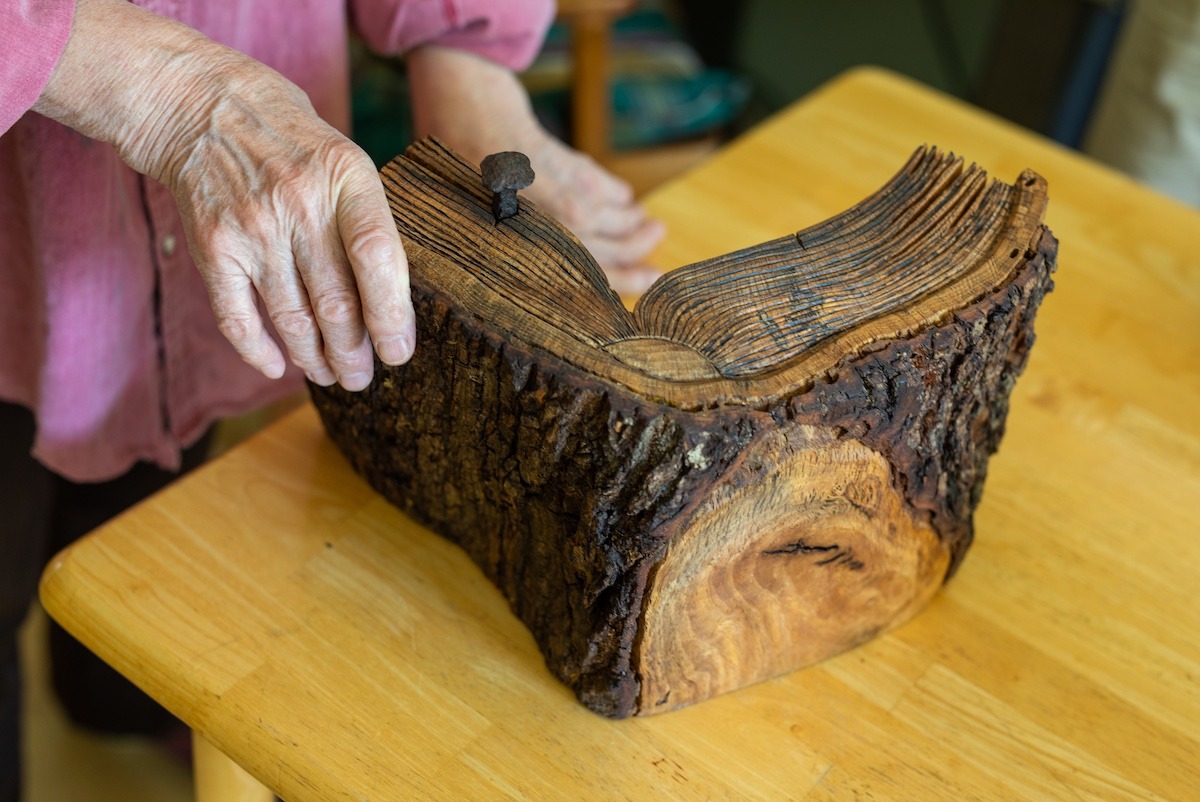
In the front garden of her home stands an enormous tree stump. “That’s from a thousand-year-old oak,” she says. “But it’s not the trunk, you know. It’s a fallen branch. The tree itself still lives.”
Her front room is a small exhibition space with magnificent ‘books’ she cut from pieces of this oak. The bark is still on it, with dark knots and holes inside. Large rusty nails stick out. The work almost refers to the nails on the cross at Golgotha, driven through the hands of Jesus.
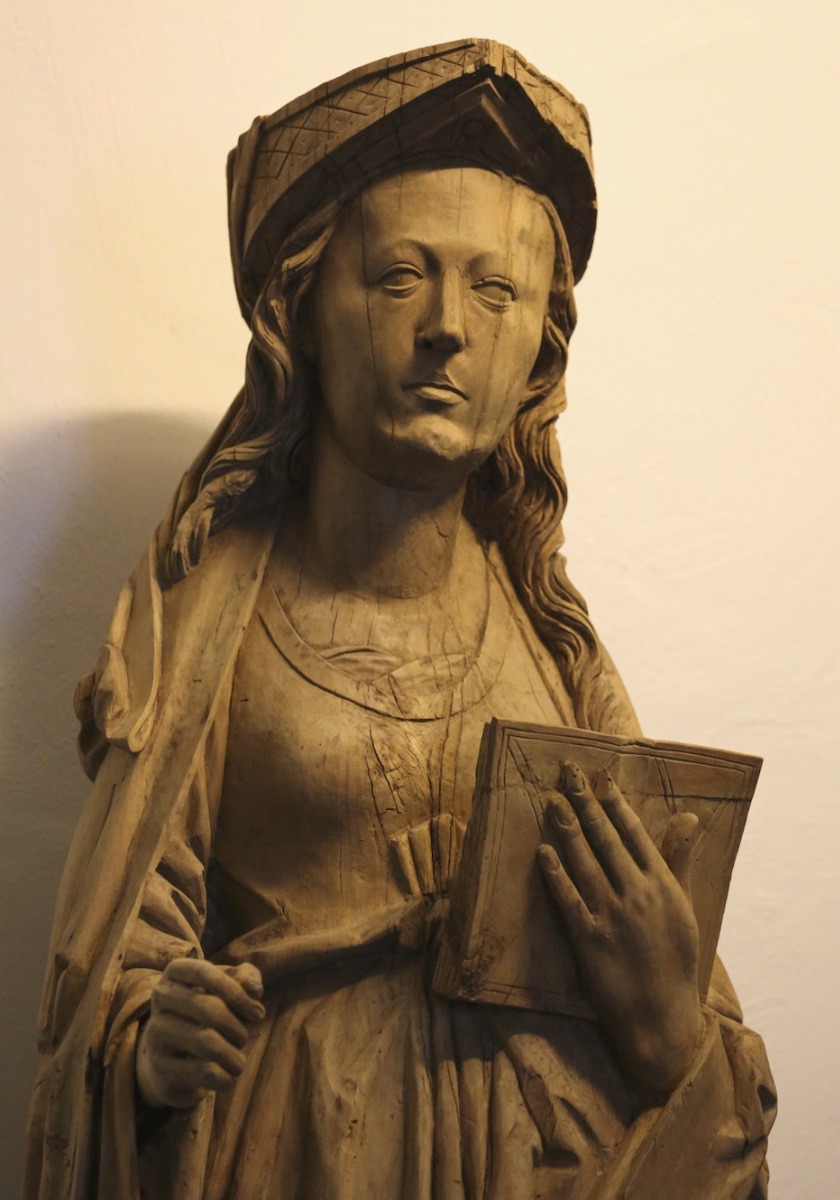
That Biblical association is also evoked by some other works by Langerhorst. Unnoticed we think of a sculpture that the German master carver Tilman Riemenschneider made of Saint Catherine in 1515, as a distinguished woman with a Bible pressed to her heart.
The private exhibition shows more special pieces of wood. We see works made from a velvet tree, two bowls of extremely heavy lignum vitae and a book made from a piece of deep black bog oak from 8 to 10 thousand years old, fished from the Amsterdam-Rhine Canal. It was donated to her by Rijkswaterstaat in 1983. Or that piece of maple more than 200 years old, from the Utrecht Maliebaan, where Emperor Napoleon still paraded with his troops. “That tree was used as a shooting target.” That was very careful with sawing, all that decayed lead in the wood, even though she can still sharpen the teeth of the band saw well herself.
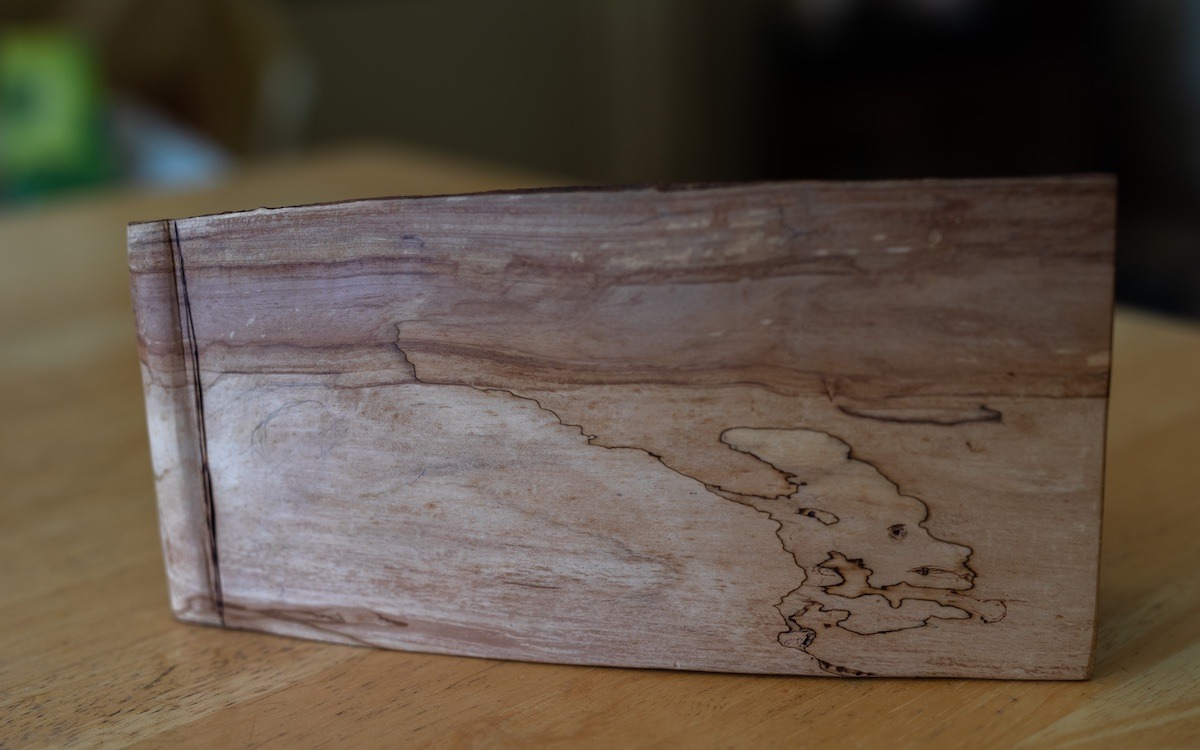
Yet it is especially the ‘drawings’ in the wood that become the starting point for her artworks: “the stories that trees tell us.” She picks up an elongated book, with which she cut about 25-centimeter-long pages with the saw. On its cover is ‘spalting’ visible, an erratic distortion in the beech wood. “Caused by two types of fungi that meet in the wood. Very special. Then something happens and that something can be struggle but also intense love that literally causes burning. If you scratch the black lines loose with your nail or with a knife, that wood is charred! There are also brown lines and spots. Have the fungi made peace there and cozily mingled? Anyway, I saw the head of a dog in it. That’s why this book is called ‘The Flying Dog’.”
A book of dark wood also shows an image in the frayed-looking pages. Do we see what animals they are? “This book is called ‘The Wild Boar Hunt’.” And indeed, suddenly a row of repeating heads of wild boars emerge. They seem to be in battle formation, ready for the counterattack.
Rising butterflies
On the wall of her living room hangs a work that is unsurpassed in subtlety. At first glance it is a large book whose loose pages seem to fly into the air as if by a gust of wind. The pages are mirror images of each other, as old furniture makers processed beautiful pieces of veneer mirrored for their display cabinets. We guess. Might these perhaps be rising angels?
Wrong. Again the artist turns out to be firmly anchored in nature with both feet. Langerhorst: “They are butterflies. They are the wings of butterflies. And look at the drawing of the wood…”
We look and see a light form in the wood, again a distortion by fungi. In each rising page it is slightly larger. “It’s the chrysalis of the butterfly, which gets bigger as the butterflies fly higher: the chrysalis transforms into a butterfly.”
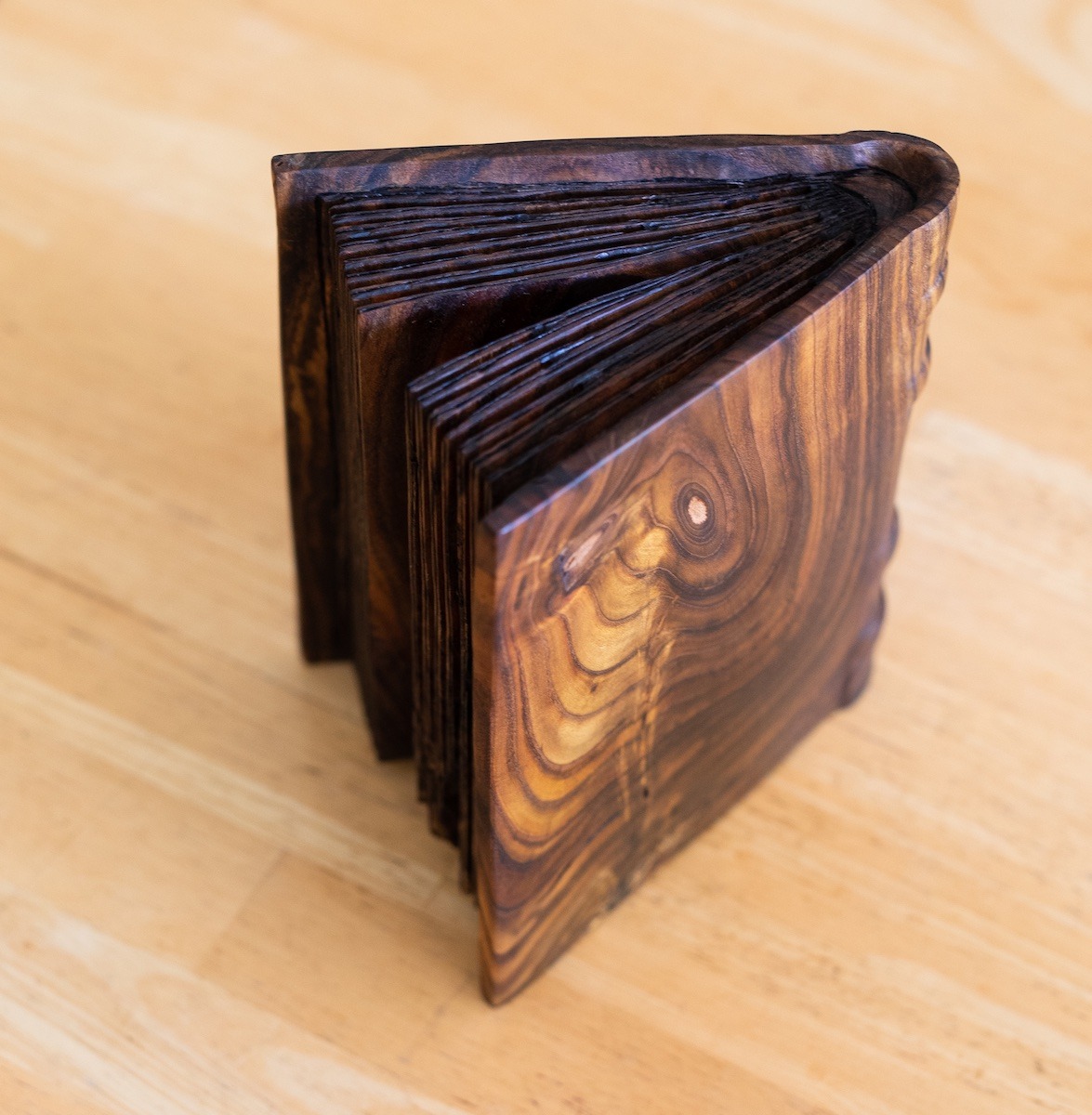
She still does everything herself. She has even developed her own natural methods for preserving her work. She mixes raw linseed oil with turpentine; one a product of flax, the other the resin of a conifer. Her warning: “Don’t use boiled linseed oil. It dries much too fast. Raw oil takes its time and produces a better result. And turpentine, not white spirit, to penetrate deep into the wood. White spirit is very different stuff. Made from petroleum.”
Wrong products don’t come into her house, which smells of beautiful French beeswax. Continuing her story: “And then I have an old preserving kettle with linseed oil in which I immerse the whole sculpture. Then I put it on a draining rack to dry. After two days I wipe the surface.”
“Crazy world”
Langerhorst is very well informed about current developments. When it comes to burning trees to generate ‘green’ energy: “I think this world has gone crazy.”
We come to talk about which artworks can be reproduced with Artificial Intelligence (AI) and which cannot. “Mine cannot,” she states firmly. Today you can already digitize sculptures and mechanically reproduce them. Langerhorst: “But searching for stories in the wood and working further with them, that can never be done by AI. You also have to feel wood. I think that because of the threats of new technology, people are getting more and more feeling for wood.”

For such unique book forms the prices of Langerhorst’s work are very modest. She no longer does active acquisition. At the annual wood market in her neighborhood Oog in Al she does sell smaller books for amounts of 70 euros. The larger works are actually still dirt cheap, with price tags of 700 euros. For truly unique pieces she asks 2,800 euros. “People have no idea how many hours of work go into it. Sawing out all those pages. And then you’re not done yet, because the saw leaves rough fibers. You have to sand those away with sandpaper too. Then polish the cover, with increasingly fine sandpaper.”
With a ‘burning pen’ she perfects the illusion of the book by adding extra deep brown lines to the already thin wooden pages. Sometimes she also burns a text in elegant letters into the pages. “Customers ask me to add a thought to a book.”
“Waste containers full of wood paneling”
More Utrecht than Langerhorst an artist cannot be. Already in the past, when she still made enormous standards for candles on the lathe, she had a studio in a canal cellar on the Oude Gracht. Old newspaper clippings also testify to a visit by Prince Bernhard, with dark pilot glasses on, carnation in his lapel. At the trade fair she shows the Prince of Orange an antique wooden lathe. Another headline, yellowed: ‘Wood is chiseled on Utrecht’s Wittevrouwenstraat’. In this street she had her own art gallery for more than ten years: ‘Hart voor Hout’ (Heart for Wood).
During this period she saw how wood disappeared from interiors. “Even earlier, from 1964 to 1965, I had a gallery in the Servetstraat, at the foot of the Dom Tower. People were enthusiastic then; unlike the period in the Wittevrouwenstraat. Then wood was suddenly out of fashion. You saw waste containers full of wood paneling everywhere. The fashion was black and white interiors and wood was suddenly old-fashioned. In 1993 we organized an unbelievably beautiful exhibition at Slot Zeist of all the wood artists from home and abroad who were participants of Hart voor Hout. It lasted two months, but all art critics stayed away. Nobody wrote about it, so almost nobody came, except the guests at the opening. For all participants this was an enormous disappointment. Funny that it’s the other way around now and becoming.”
She also worked about 15 years from France, where her husband wanted to renovate a subsided castle. She also did a study in hypnotherapy and had her own practice at home for a long time. She worked with mothers.
Idea for the Catharijneconvent?
But how did Langerhorst come to make wooden books? “That started quite by accident. A customer who came to ‘Hart voor Hout’ asked me to make a wooden bookend in the shape of an open book. I did that, but found it boring. That was the reason I sawed pages into it. The customer was very enthusiastic, which was reason for me to start making more books, but not as bookends.”
It worked out well and she continued with the concept.
That the museum Catharijneconvent in Utrecht – named after the martyr Saint Catherine – has still not honored this special fellow citizen with an exhibition… How natural her work fits among those historical wooden sculptures of saints holding a book in their hands. Unforgivable that no one has ever come up with THAT idea.
Jan Bom